
Concave mirror is used in headlights of vehicles, because it
- (a)focuses light from the bulb onto nearby vehicles
- (b)sends parallel rays
- (c)fits well into the shape of the headlight
- (d)is cheaper than other mirrors
Answer
Why
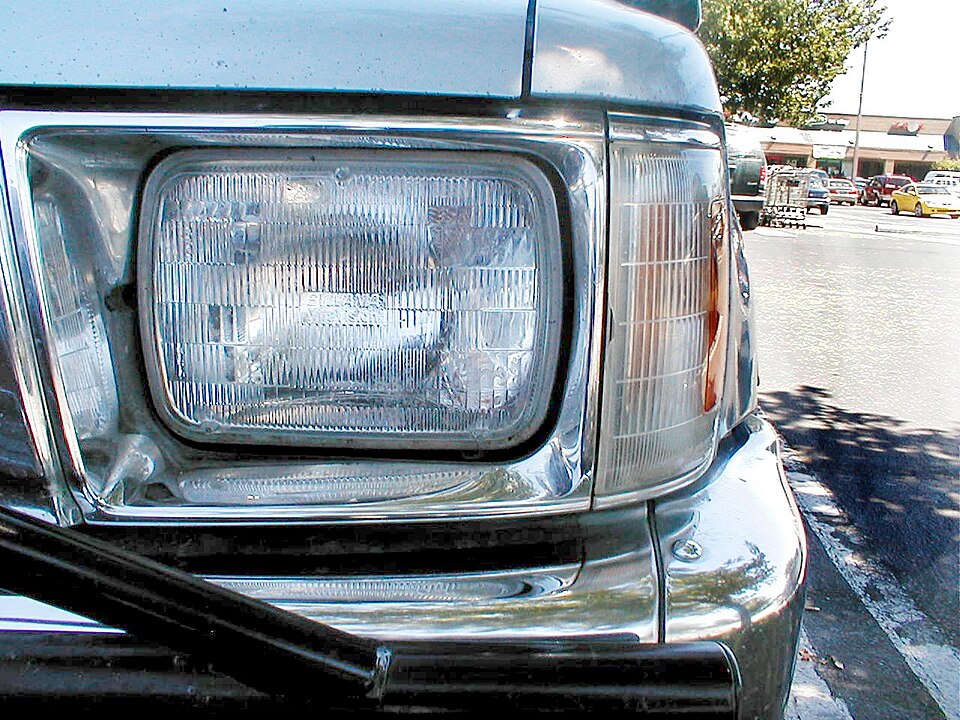
Correct: B, sends parallel rays. A concave mirror brings parallel rays to its principal focus, and the path of light is reversible, so a small source placed at the focus sends out a beam of parallel rays after reflection. Headlamps exploit that exactly: the filament or the light-emitting element sits at the focus of the concave reflector, and the reflected light leaves as a nearly parallel beam that travels far down the road without spreading and losing brightness. A bare bulb would throw light in all directions and light the road only a few metres ahead.
Why the others are wrong
- (a)focuses light from the bulb onto nearby vehicles: A headlamp is designed to light the road ahead, not to converge light on other vehicles, that would dazzle oncoming drivers. Convergence happens only when the source is beyond the focus, which is not how a headlamp is set up.
- (c)fits well into the shape of the headlight: The reasoning runs the wrong way. The lamp housing is shaped to hold the reflector, because the optics were chosen first. Shape is a consequence of the physics, not a reason for it.
- (d)is cheaper than other mirrors: A curved mirror is not cheaper than a plane one, and cost has nothing to do with why a particular curvature is used. The choice is made by the beam it produces.
Concept
For a concave mirror the image depends entirely on where the object stands. An object at infinity gives a real image at the focus; an object at the centre of curvature gives an equal-sized real image at the same place; an object between the focus and the pole gives a virtual, erect and magnified image, which is the shaving-mirror case. The headlamp uses the limiting case that lies at the boundary of these: with the source at the focus, the reflected rays neither converge nor diverge but run parallel, and the image is said to be formed at infinity.
Pair the headlamp with the vehicle's other mirror to keep the two curvatures straight. A rear-view mirror is convex, because a convex mirror always gives an erect, diminished, virtual image and so covers a wide field of view behind. A headlamp reflector is concave, because only a concave surface can turn a point source into a parallel beam. The same concave geometry appears in a torch, a searchlight, a solar cooker and a reflecting telescope; the same convex geometry appears in shop security mirrors and street-corner mirrors.
Key facts
- A source placed at the principal focus of a concave mirror produces a reflected beam of parallel rays, the image being formed at infinity.
- The reverse case is the basis of the same rule: parallel rays incident on a concave mirror converge at its focus.
- Rear-view mirrors on vehicles are convex, giving erect, diminished, virtual images and a wide field of view.
- A concave mirror placed with the object between its focus and pole gives a virtual, erect and magnified image, which is how a shaving mirror works.
- Torches, searchlights, solar cookers and reflecting telescopes all use concave reflectors.
Study next
Common traps
- Reading 'concave' as the mirror that always magnifies; magnification depends on where the object stands.
- Swapping the two vehicle mirrors: headlamp concave, rear-view convex.
- Choosing an answer about shape or cost when the question asks for the optical reason.
NDA asks where the image lies for a given object position, or why a particular mirror is used in a named device.
Related PYQs
In case of a concave mirror, if an object is placed between the principal focus F and pole P of the mirror, which one of the following statements about the image is NOT correct?
- (a) The image will be virtual
- (b) The image will be enlarged or magnified
- (c) The image will be formed at infinity
- (d) The image will be erect
Answer(c) The image will be formed at infinity
Turns on the very position this question uses: an image at infinity, meaning a parallel emergent beam, needs the source at the focus and nowhere else.
If the image of an object, formed by a concave mirror is virtual, erect and magnified, then the object is placed
- (a) at the principal focus
- (b) at the centre of curvature
- (c) beyond the centre of curvature
- (d) between the pole of the mirror and the principal focus
Answer(d) between the pole of the mirror and the principal focus
Completes the same table of object positions for a concave mirror, so the headlamp case can be told apart from the magnifying case.
Practice
- practice, not a real PYQ
The rear-view mirror of a vehicle is convex because it
- (a)gives a magnified image of the traffic behind
- (b)gives an erect, diminished image over a wide field of view
- (c)gives an inverted real image at the focus
- (d)reflects parallel rays into a single point
Answer(b) gives an erect, diminished image over a wide field of view: the property that makes a convex mirror useful for looking behind. - practice, not a real PYQ
A point source of light placed at the principal focus of a concave mirror produces, after reflection, a beam that is
- (a)converging
- (b)parallel
- (c)diverging
- (d)focused at the centre of curvature
Answer(b) parallel: the reversed case of parallel rays converging at the focus, and the principle of a headlamp or searchlight.