
If the potential difference applied to an X-ray tube is doubled while keeping the separation between the filament and the target as same, what will happen to the cutoff wavelength ?
- (a)Will remain same
- (b)Will be doubled
- (c)Will be halved
- (d)Will be four times of the original wavelength
Answer
Why
Correct — B, Will be doubled. That is what the official key for this paper awards, so it is the option that scored on the day. The physics the question rests on is the Duane–Hunt relation, λ_min = hc/eV. An electron accelerated through a potential difference V arrives at the target with energy eV, and the shortest wavelength the tube can emit is produced when the whole of that energy goes into a single photon. The cut-off therefore depends only on the tube voltage — the separation between filament and target does not enter the relation at all, which is why the question tells you it is unchanged. Working the relation through, doubling V doubles the photon energy, so the cut-off frequency doubles while the cut-off wavelength falls to half; halving is what option (c) states. The examiner's key nevertheless marks the doubling, and the honest reading of that clash is set out in the background below.
Why the others are wrong
- (a)Will remain same — The cut-off is fixed entirely by the accelerating voltage, and the voltage has been changed, so the cut-off cannot stay where it was. This option would be right only for a quantity that depends on the target material, such as the wavelength of the characteristic lines.
- (c)Will be halved — The key does not mark this option. It is, however, what λ_min = hc/eV gives when V is doubled, so a candidate who chose it was reasoning from the standard relation; what doubles under the same change is the cut-off frequency. The tension between that reading and the key is discussed in the background section.
- (d)Will be four times of the original wavelength — Nothing in the relation is quadratic in V. The cut-off wavelength varies as the simple reciprocal of the accelerating potential, so no change of voltage by a factor of two can alter it by a factor of four.
Concept
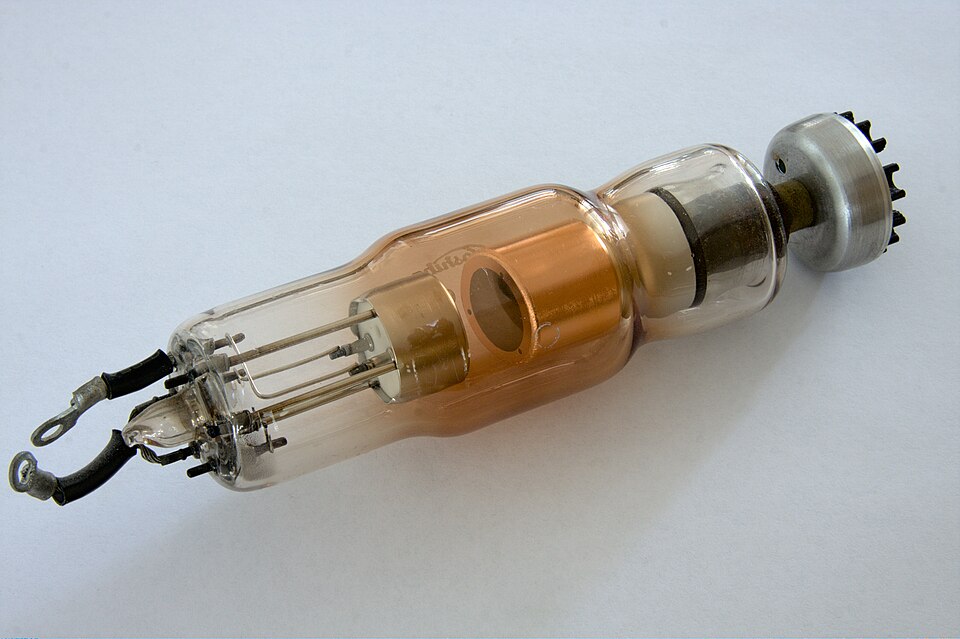
An X-ray tube fires electrons from a hot filament at a metal target through a large potential difference. Most electrons lose their energy in many small steps and produce the continuous braking spectrum, but an electron that gives up all its energy in one collision produces the most energetic photon the tube can make. Equating eV with hc/λ gives the Duane–Hunt law, λ_min = hc/eV, and in convenient numbers the minimum wavelength in picometres is about 1239.8 divided by the tube voltage in kilovolts. The cut-off is the same whatever the target is made of; the sharp characteristic lines that sit on top of the continuous spectrum are the ones that depend on the target element.
Be clear-eyed about this item, because it is the one place in this stretch of the paper where the key and the standard relation do not sit comfortably together. On λ_min = hc/eV, doubling the accelerating potential halves the cut-off wavelength and doubles the cut-off frequency; the official UPSC key for Series A nevertheless marks the doubling option, and the most likely explanation is that the intended quantity was the cut-off frequency. Two things follow for a student. In the examination hall the key is what scores, and this card is authored to it. In your notebook, learn the relation itself — inverse in V for wavelength, direct in V for frequency — because that is what every later question, and every textbook, will test you on.
Key facts
- The Duane–Hunt law gives the minimum X-ray wavelength as λ_min = hc/eV, so it is inversely proportional to the accelerating potential.
- In working numbers, λ_min in picometres is about 1239.8 divided by the tube voltage in kilovolts.
- The cut-off wavelength is independent of the target material, while the characteristic line wavelengths depend on it.
- The cut-off frequency is directly proportional to the tube voltage, since eV equals hf at the short-wavelength limit.
Study next
Common traps
- Interchanging wavelength and frequency; one falls as the voltage rises and the other climbs.
- Believing the cut-off depends on the target metal, which is true only of the characteristic lines.
- Bringing the filament-to-target distance into the calculation; it plays no part in the relation.
NDA asks how the X-ray spectrum responds to a change in tube voltage or target, and asks for the wavelength range that counts as X-rays.
Related PYQs
Barium in a suitable form is administered to patients before an X-ray examination of the stomach, because
- (a) barium allows X-rays to pass through the stomach on account of its transparency to X-rays
- (b) barium compound, like magnesium sulphate helps in cleaning the stomach before X-ray examination
- (c) barium is a good absorber of X-rays and this helps the stomach to appear clearly in contrast with the other regions in the picture
- (d) barium salts are white in colour and this helps the stomach to appear clearly in contrast with other regions in the picture
Answer(c) barium is a good absorber of X-rays and this helps the stomach to appear clearly in contrast with the other regions in the picture
The same radiation on the receiving side — how heavy atoms absorb X-rays, which is what makes a radiograph readable.
Which one of the following statements about X-rays is not true ?
- (a) They have wavelengths of about 1 Å.
- (b) These can be generated by bombarding a metal target by high energy electrons.
- (c) Due to their wavelengths being shorter, these can be used for radar systems.
- (d) These are also used for the treatment of certain forms of cancer.
Answer(c) Due to their wavelengths being shorter, these can be used for radar systems.
The properties and production of X-rays in one item, including the electron-bombardment mechanism that this question's cut-off depends on.
Which one of the following wavelengths corresponds to the wavelength of X-rays?
- (a) 500 nm
- (b) 5000 nm
- (c) 100 nm
- (d) 1 nm
Answer(d) 1 nm
The scale of the wavelengths in play, useful for sanity-checking any answer about a cut-off wavelength.
Practice
- practice — not a real PYQ
The minimum wavelength of X-rays produced by a tube depends on
- (a)the material of the target only
- (b)the accelerating potential applied to the tube
- (c)the distance between the filament and the target
- (d)the current through the filament
Answer(b) the accelerating potential applied to the tube — the Duane–Hunt relation ties the short-wavelength limit to the tube voltage alone. - practice — not a real PYQ
In an X-ray tube, the wavelengths of the characteristic lines depend mainly on
- (a)the tube voltage
- (b)the filament current
- (c)the element used as the target
- (d)the length of the tube
Answer(c) the element used as the target — the characteristic lines come from transitions in the target atoms, unlike the continuous spectrum's cut-off.