
Which one of the following Himalayan rivers does NOT originate from across the Himalayas ?
- (a)Indus
- (b)Satluj
- (c)Ganga
- (d)Brahmaputra
Answer
Why
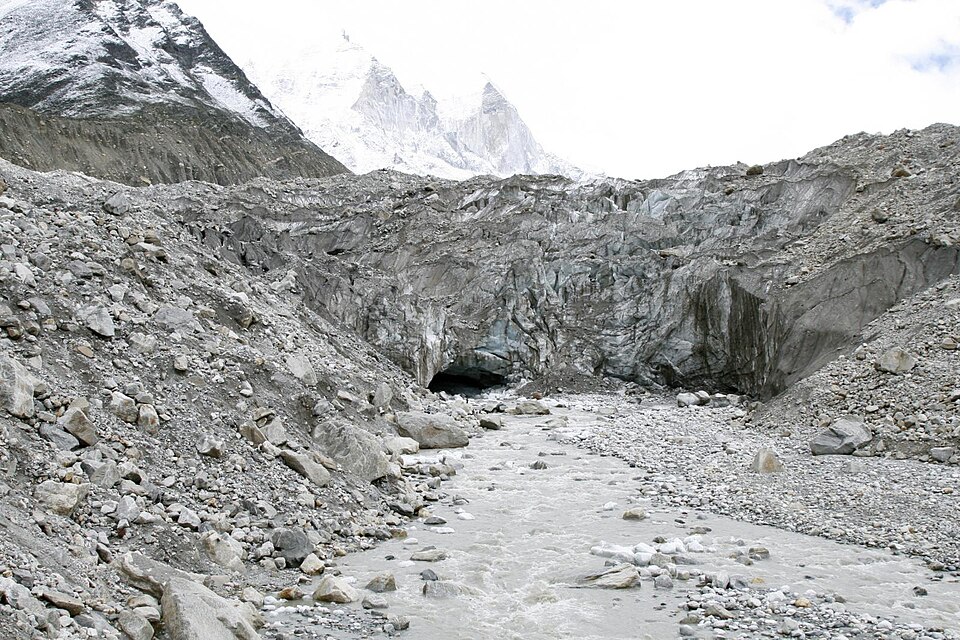
Correct — C, Ganga. The Indus, the Satluj and the Brahmaputra all rise beyond the Great Himalaya, on the Tibetan side — the Indus near Lake Mansarovar, the Satluj from the Rakshastal and Mansarovar area at the foot of Mount Kailash, and the Brahmaputra as the Tsangpo, which flows east across southern Tibet before turning south into India. Each of them then cuts across the range through a deep gorge, which is why they are called trans-Himalayan or antecedent rivers, older than the mountains they saw rise. The Ganga is the exception: its Bhagirathi headstream begins at the Gangotri glacier on the southern slopes of the Himalaya, inside India, so it does not come from across the range.
Why the others are wrong
- (a)Indus — The Indus rises in Tibet near Lake Mansarovar and enters India through Ladakh, so it comes from across the Himalaya — the definition the question is excluding.
- (b)Satluj — The Satluj rises at Langchen Khambab in Tibet, by the Mansarovar and Rakshastal lakes, and enters India at Shipki La in Himachal Pradesh. It is the classic textbook example of an antecedent river.
- (d)Brahmaputra — The Brahmaputra begins in Tibet as the Tsangpo, runs east for well over a thousand kilometres, and makes a sharp southward turn near Namcha Barwa before entering India. Its source too lies across the Himalaya.
Concept
The Himalayan rivers fall into two groups by where they begin. The trans-Himalayan or antecedent rivers — the Indus, the Satluj and the Brahmaputra — rise on the Tibetan plateau north of the Great Himalaya and maintained their courses by cutting gorges downward as the range rose beneath them. The rest, including the Ganga and the Yamuna and most of the tributaries of the Indus system such as the Jhelum, Chenab, Ravi and Beas, rise on the southern slopes within the Indian Himalaya and flow straight out on to the plains. All of them are perennial, fed by snow and glacier melt as well as by the monsoon.
The phrase to decode in the stem is 'from across the Himalayas', which means from the far, Tibetan side. Three of the four options are the standard trans-Himalayan trio, so the item reduces to knowing that the Ganga is not one of them. Fix the sources: the Ganga begins as the Bhagirathi at Gaumukh, the snout of the Gangotri glacier, and becomes the Ganga at Devprayag where the Alaknanda joins it. Also note that the Indus and the Satluj rise in the same Kailash-Mansarovar region as the Brahmaputra, so a single mental picture of that plateau carries three of the four answers.
Key facts
- The Indus, the Satluj and the Brahmaputra rise in Tibet, north of the Great Himalaya, and cut through the range in deep gorges.
- Such rivers are called antecedent because they existed before the Himalaya rose and kept their courses as the mountains were uplifted.
- The Ganga rises as the Bhagirathi at the Gangotri glacier on the southern slopes of the Himalaya and is joined by the Alaknanda at Devprayag.
- The Satluj rises near the Mansarovar and Rakshastal lakes at the foot of Mount Kailash and enters India at Shipki La in Himachal Pradesh.
- The Brahmaputra is called the Tsangpo in Tibet and turns south near Namcha Barwa before entering India.
Study next
Common traps
- Assuming every Himalayan river must rise in Tibet — the Ganga, Yamuna, Jhelum, Chenab, Ravi and Beas do not.
- Confusing the Ganga's source at Gangotri with the point at Devprayag where it takes the name Ganga.
- Reading 'across the Himalayas' as merely 'in the Himalayas'.
NDA asks which river does or does not rise beyond the Himalaya, or names a source region and asks for the river.
Related PYQs
The Brahmaputra, Irrawady and Mekong rivers originate in Tibet and flow through narrow and parallel mountain ranges in their upper reaches. Of these rivers, Brahmaputra makes a "U" turn in its course to flow into India. This "U" turn is due to
- (a) uplift of folded Himalayan series
- (b) syntaxis bending of geologically young Himalayas
- (c) geo-tectonic disturbance in the tertiary folded mountain chains
- (d) Both (a) and (b) above
Answer(b) syntaxis bending of geologically young Himalayas
Starts from the same fact this question rests on — that the Brahmaputra rises in Tibet — and follows it to how the river then breaks through the range.
River Beas, flowing from Himachal and Punjab, joins the river
- (a) Indus
- (b) Satluj
- (c) Chenab
- (d) Ravi
Answer(b) Satluj
Sets the two kinds of Himalayan river side by side — a river rising on the southern slopes joining one that came from beyond the range.
Practice
- practice — not a real PYQ
The Ganga rises from which glacier?
- (a)Siachen
- (b)Gangotri
- (c)Zemu
- (d)Pindari
Answer(b) Gangotri — the Bhagirathi emerges at Gaumukh, the snout of this glacier. - practice — not a real PYQ
Which of the following rivers is NOT an antecedent river of the Himalaya?
- (a)Indus
- (b)Satluj
- (c)Brahmaputra
- (d)Ravi
Answer(d) Ravi — it rises within the Indian Himalaya, while the other three rise on the Tibetan side and cut across the range.