
Which one of the following statements is correct ?
- (a)The measurement of mass taken by a spring weighing balance is correct at the place where the spring balance is calibrated for
- (b)The measurement of mass taken by a spring weighing balance is correct at all places
- (c)The measurement of mass taken by a spring weighing balance is correct at the places where the acceleration due to gravity is same with the place where the spring balance is calibrated for
- (d)A spring balance cannot be used to measure mass at any place
Answer
Why
Correct: C, the reading is right wherever the acceleration due to gravity matches the value the balance was calibrated for. A spring balance does not sense mass at all; it senses force. The spring stretches until its restoring force equals the weight hanging on it, and weight is mass times g. The manufacturer then prints kilogram markings on the scale by assuming one particular value of g. Take the same balance somewhere g is different (a higher latitude, a mountain top, the Moon) and the identical mass now stretches the spring by a different amount, so the kilogram reading changes even though the mass has not. The reading is trustworthy exactly where the local g equals the calibration g, which is what this option says.
Why the others are wrong
- (a)The measurement of mass taken by a spring weighing balance is correct at the place where the spring balance is calibrated for: True as far as it goes, but too narrow to be the correct statement. The calibration place is only one member of a whole family of places: every location on Earth that happens to share the same value of g will give the same, correct reading. Option (c) states the real condition, and the examiner is asking for the statement that is correct, not merely one that is not false.
- (b)The measurement of mass taken by a spring weighing balance is correct at all places: This would only hold if g were the same everywhere, which it is not. Even on Earth g runs from about 9.78 m/s² at the equator to about 9.83 m/s² at the poles, and on the Moon it is roughly one-sixth of the Earth value, where a spring balance would under-read a mass sixfold.
- (d)A spring balance cannot be used to measure mass at any place: Too strong. A spring balance measures mass perfectly well once the local g is known, which is why kitchen and luggage spring scales are useful instruments. What it cannot do is carry its kilogram calibration unchanged to a place with a different g.
Concept
Mass is the amount of matter in a body and is the same everywhere in the universe; weight is the gravitational force on that body and equals mass times the local acceleration due to gravity. A spring balance responds to weight, because the spring extends in proportion to the force pulling on it, that is Hooke's law. A beam balance, by contrast, compares the unknown against standard masses, and since both pans sit in the same gravitational field, g cancels out and the comparison stays valid anywhere.
The item is a two-way discrimination between options (a) and (c), and the trap is to stop reading at the first statement that sounds true. Both are consistent with the physics; only (c) states the full condition. The mental test that settles it is to imagine carrying a balance calibrated in Delhi to a different city at the same value of g: it still reads correctly, so 'only at the calibration place' is too restrictive. The printed English of the option is awkward, running 'is same with the place' where 'is the same as at the place' was meant; that is a slip of the booklet's phrasing and does not change what is being asserted. On the Moon the same balance would show about one-sixth of the true kilogram figure, which is the cleanest illustration of why the calibration condition matters.
Key facts
- A spring balance measures weight, a force, in newtons; the kilogram markings on its scale are a convenience printed for one assumed value of g.
- A beam balance compares an unknown mass with standard masses, so its result is independent of g and stays correct even on the Moon.
- The extension of a spring is proportional to the applied force within the elastic limit, which is Hooke's law and the basis of the instrument.
- The value of g varies with latitude, with altitude and from body to body, so weight varies while mass does not.
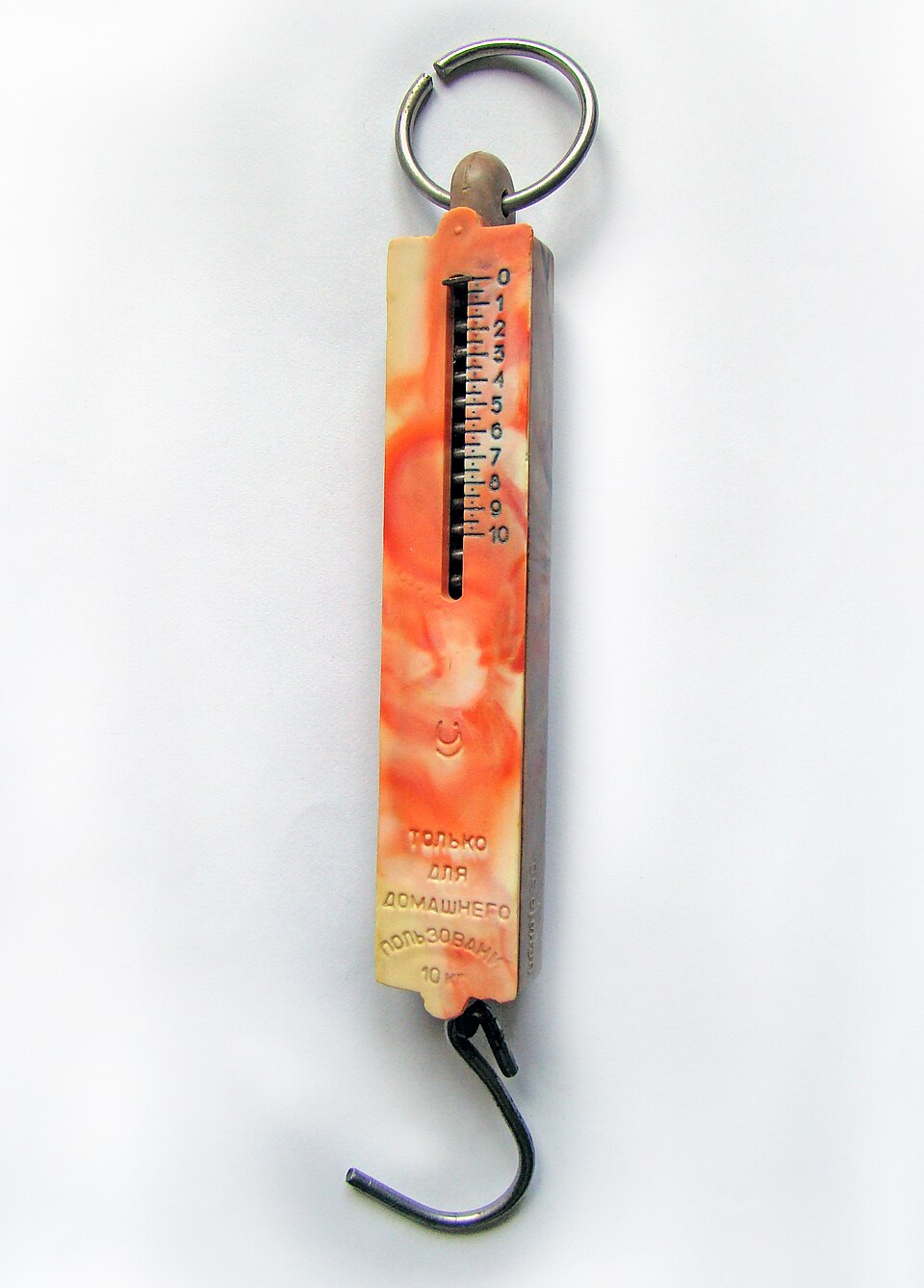
Study next
Common traps
- Marking option (a) because it is not false: the question asks for the correct statement, and (a) is only a special case of (c).
- Believing that mass itself changes when you move to the Moon; only the weight, and hence a spring balance's reading, changes.
NDA returns to the mass-against-weight distinction almost every year, usually through a spring balance on the Moon or a body carried to a different latitude, so fix the rule that springs read force and beams read mass.
Related PYQs
The mass of a body on Earth is 100 kg (acceleration due to gravity, g = 10 m/s²). If acceleration due to gravity on the Moon = g/6, then the mass of the body on the moon is
- (a) 100/6 kg
- (b) 60 kg
- (c) 100 kg
- (d) 600 kg
Answer(c) 100 kg
The same distinction from the other side: the mass is unchanged on the Moon, and it is only the weight, and therefore any spring-balance reading, that falls to one-sixth.
Which one of the following statements about the mass of a body is correct ?
- (a) It changes from one place to another
- (b) It is same everywhere
- (c) It depends on its shape
- (d) It does not depend on its temperature
Answer(b) It is same everywhere
Establishes the half of the rule that this item leans on: the mass never changes, so any change in a weighing instrument's reading has to come from the local value of g.
A mass is attached to a spring that hangs vertically. The extension produced in the spring is 6 cm on Earth. The acceleration due to gravity on the surface of the Moon is one-sixth of its value on the surface of the Earth. The extension of the spring on the Moon would be :
- (a) 6 cm
- (b) 1 cm
- (c) 0 cm
- (d) 36 cm
Answer(b) 1 cm
The numerical version of the same physics: the spring's extension tracks weight, so it falls to one-sixth on the Moon while the mass hanging on it is unchanged.
Practice
- practice, not a real PYQ
A body is taken from the Earth to the Moon. Which one of the following remains unchanged?
- (a)Its weight
- (b)Its mass
- (c)The reading of a spring balance attached to it
- (d)The gravitational force acting on it
Answer(b) Its mass: mass is an intrinsic property, while weight and any spring-balance reading fall to about one-sixth on the Moon. - practice, not a real PYQ
Which one of the following instruments would give the same reading for a given body on the Earth and on the Moon?
- (a)Spring balance
- (b)Beam balance
- (c)Both of them
- (d)Neither of them
Answer(b) Beam balance: it compares the unknown against standard masses, so the local value of g cancels out.