
Consider the following statements about cactus : 1. The leaves are reduced to spines. 2. The stem does the photosynthesis. Which of the statements given above is/are correct ?
- (a)1 only
- (b)2 only
- (c)Both 1 and 2
- (d)Neither 1 nor 2
Answer
Why
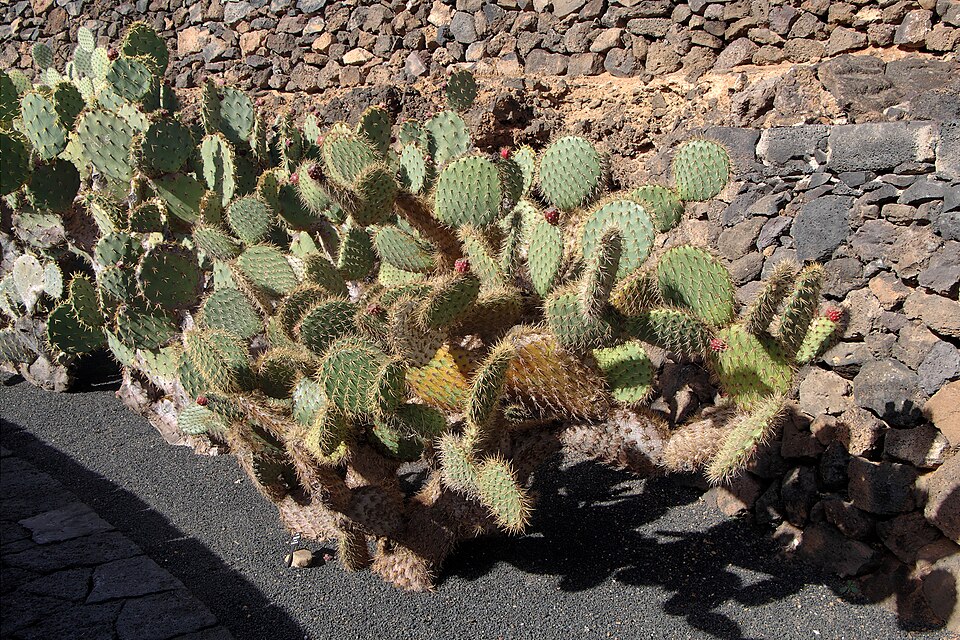
Correct: C, both 1 and 2. Take the statements one at a time. A cactus does have its leaves reduced to spines: what look like thorns are modified leaves, and shrinking them to needles removes almost the entire surface from which water could be lost, while also making the plant unpleasant to graze. That is statement 1, and it is true. Once the leaves have gone, something else must do the food-making, and in a cactus the stem takes over. The thick green stem is packed with chlorophyll and carries out photosynthesis; a stem that has taken on the leaf's job in this way is called a phylloclade. That is statement 2, and it is true as well. The two statements are in fact halves of one adaptation: the plant gives up the leaf to save water and hands the leaf's work to the stem, which is already thickened to store that water. Both being correct, the answer is option (c).
Why the others are wrong
- (a)1 only: Accepts the spines but denies that the stem photosynthesises, which would leave the plant with no green tissue at all and no way to make food. The stem's deep green colour is the visible sign that it is doing exactly that.
- (b)2 only: Accepts the photosynthesising stem but denies that the spines are modified leaves. They are: a cactus spine grows from an areole in the position a leaf bud would occupy, which is why botanists classify it as a leaf and not as a thorn of stem origin.
- (d)Neither 1 nor 2: Rejects both halves of the standard textbook description of a xerophyte, and there is nothing in either statement that is even partly wrong.
Concept
Plants of dry habitats, called xerophytes, are shaped by the need to hold water. The cactus shows the full set: leaves reduced to spines so that little surface is exposed, a swollen stem that stores water and does the photosynthesis, a thick waxy cuticle, and few stomata, sunk into pits. Most cacti go further still and open their stomata at night instead of by day, fixing carbon dioxide into an acid in the cool hours and using it in daylight, so that gas exchange never happens when evaporation is fiercest.
Multi-statement items are safest when each statement is judged separately and completely before the code is consulted. Here both statements describe the same well-known plant, and a candidate who understands why the leaf was sacrificed will immediately see that the stem must have picked up the work: the two statements support rather than compete with each other. A useful extra: the cactus family is native to the Americas, and several spiny Indian desert plants that look like cacti are actually spurges of the genus Euphorbia, which arrived at the same design independently because the same problem has the same solution.
Key facts
- In a cactus the leaves are reduced to spines, which cuts the surface available for transpiration and deters grazing animals.
- The thick green stem carries out photosynthesis and is termed a phylloclade.
- The same stem stores water, and is protected by a thick waxy cuticle and few, sunken stomata.
- Most cacti open their stomata at night, storing carbon dioxide as an acid for use in daylight, which saves water.
- The cactus family is native to the Americas; look-alike Indian desert plants are often spurges of the genus Euphorbia.
Study next
Common traps
- Calling a cactus spine a thorn; a thorn is a modified stem, while the cactus spine is a modified leaf.
- Assuming a leafless plant cannot photosynthesise, when the stem has simply taken over the task.
Plant adaptation is a dependable NDA GAT biology topic, usually as a two-statement item or a match between a modified organ and its function, so learn each modification with the problem it solves.
Related PYQs
Open stunted forests with bushes and small trees having long roots and sharp thorns or spines are commonly found in
- (a) Eastern Orissa
- (b) North-eastern Tamil Nadu
- (c) Siwaliks in Terai region
- (d) Western Andhra Pradesh
Answer(d) Western Andhra Pradesh
Places the same adaptation on the map: long roots and sharp spines are what a plant community looks like where rainfall is short, which is the ecology behind this cactus question.
The gaseous product of a process in plants is a requirement for another vital process that releases energy. Given below are four combinations of the process and product. Identify the correct answer.
- (a) Respiration and Nitric oxide
- (b) Transpiration and Water vapour
- (c) Photosynthesis and Oxygen
- (d) Germination and Carbon dioxide
Answer(c) Photosynthesis and Oxygen
Confirms what the cactus stem is actually doing when statement 2 says it photosynthesises: taking in carbon dioxide and giving out oxygen.
Practice
- practice, not a real PYQ
A green stem that has taken over the function of the leaf is called a
- (a)rhizome
- (b)phylloclade
- (c)tuber
- (d)corm
Answer(b) phylloclade: as in the cactus, where the swollen green stem both stores water and photosynthesises. - practice, not a real PYQ
The chief advantage to a desert plant of reducing its leaves to spines is that it
- (a)increases the rate of photosynthesis
- (b)reduces loss of water by transpiration
- (c)helps the plant absorb more sunlight
- (d)allows the plant to fix atmospheric nitrogen
Answer(b) reduces loss of water by transpiration: a needle exposes almost no surface from which water can escape.