
“We shall either free India or die in the attempt …” who said it?
- (a)Jawaharlal Nehru
- (b)Mahatma Gandhi
- (c)Abul Kalam Azad
- (d)V.D. Savarkar
Answer
Why
Correct — B, Mahatma Gandhi. The line comes from his Quit India speech at Gowalia Tank Maidan, Bombay, on 8 August 1942, the day the All India Congress Committee adopted the Quit India Resolution. The sentence the paper has clipped runs in full: 'The mantra is Do or Die. We shall either free India or die in the attempt; we shall not live to see the perpetuation of our slavery.' So the phrase in the stem is not a separate saying at all — it is the second clause of the sentence that gave the freedom struggle its most famous two words, and any student who knows 'Do or Die' already knows this answer. The occasion matters as much as the words. The Cripps Mission had collapsed in April 1942, the Japanese had reached the Burma frontier, and Gandhi abandoned bargaining for a demand that the British leave immediately. He was asking for a vow, not a tactic: the movement was to be non-violent, and 'die in the attempt' meant accept death, not inflict it. Within hours the Raj answered. Early on 9 August Gandhi and the entire Congress Working Committee were arrested, the Congress was banned, and tens of thousands of leaders were held until 1945; a then little-known Aruna Asaf Ali presided over the AICC gathering on 9 August and hoisted the flag. Decapitated, the movement turned spontaneous and violent. Between 9 August and 21 September 1942 crowds attacked some 550 post offices and 250 railway stations, destroyed about 70 police stations, burnt or damaged 85 other government buildings and cut telegraph wires in roughly 2,500 places; the Government of India moved 57 battalions of British troops to restore order and made over 100,000 arrests. Viceroy Linlithgow called it the most serious rebellion since 1857. And the historians' judgement on where it burned hottest points straight at this exam's home State: the greatest level of violence occurred in Bihar.
Why the others are wrong
- (a)Jawaharlal Nehru — He was in the room and went to jail for it, but the words are not his. Nehru was among those apprehensive about the Quit India call — he and Maulana Azad were critical of its timing yet backed Gandhi and stayed with him — and he was arrested with the rest of the Congress Working Committee on 9 August 1942. His own famous sentences belong to other moments, above all the 'tryst with destiny' address to the Constituent Assembly on the midnight of 14-15 August 1947. Presence at an event is not authorship of its slogan.
- (c)Abul Kalam Azad — The most defensible wrong answer, and worth understanding rather than merely eliminating. Azad was Congress President at that moment — elected at the Ramgarh session in March 1940 and continuing until 1946 — so he presided over the very Bombay session that passed the Quit India Resolution on 8 August 1942, and he was arrested the next morning with everyone else. But like Nehru he had doubts about the call, and the mantra-and-vow language of the speech is Gandhi's. Chairing the meeting is not the same as speaking the sentence.
- (d)V.D. Savarkar — The exact opposite position, which makes this the cleanest elimination on the paper. As president of the Hindu Mahasabha during the Second World War, Savarkar advanced the slogan 'Hinduise all Politics and Militarise Hindudom' and supported the British war effort, with the Mahasabha running Hindu Militarisation Boards that recruited for the armed forces. The Mahasabha openly opposed the Quit India Movement and boycotted it officially, and Savarkar wrote a letter titled 'Stick to your Posts' telling members who sat in municipalities, local bodies and legislatures or served the government to remain where they were. A man instructing his followers to stay at their posts did not tell India to die in the attempt.
Concept
Quit India was the moment the national movement stopped asking for terms. Every earlier campaign had a negotiable demand attached — Non-Cooperation had Khilafat and Punjab wrongs, Civil Disobedience had the salt tax and then the Gandhi-Irwin Pact. In August 1942 the demand was simply that British rule end at once, and the method was a mass struggle to be conducted, in Gandhi's formula, by every Indian who considered himself free. The trigger was the failure of the Cripps Mission: Sir Stafford Cripps had landed in Delhi on 22 March 1942 offering Dominion status only after the war, a constituent assembly, and the right of any province to opt out, and the talks broke down in April. With Japanese forces on the Burma border, Gandhi judged that an India held down by an unwilling ruler could neither be defended nor be free. The Congress itself was divided about it. Rajagopalachari left the party over the decision; Nehru and Azad were uneasy; Vallabhbhai Patel, Rajendra Prasad and Anugrah Narayan Sinha backed it openly. What actually happened bore little resemblance to the plan, because the plan assumed leaders. With the entire leadership in jail by dawn on 9 August, the movement improvised — underground networks, Usha Mehta's secret Congress Radio, and short-lived parallel governments at Tamluk in Midnapore, at Satara in Maharashtra and at Talcher in Odisha. It was crushed within months, and it still worked: the British came out of 1942 convinced that India could not be governed by force indefinitely.
Quotation questions are decided by three tests, and this one falls to all three. Test one, complete the sentence. 'We shall either free India or die in the attempt' is the clause immediately after 'The mantra is Do or Die' — and 'Do or Die' is welded to Quit India and to 8 August 1942, which is a Gandhi date and nobody else's. If a fragment feels familiar but unplaceable, try to recall what stands on either side of it. Test two, check the register. Gandhi's political language is vow-language — mantra, do or die, we shall not live to see the perpetuation of our slavery — where Nehru's is literary and Azad's argumentative. Test three, eliminate on position, not on fame. One of the four names actively opposed this movement: Savarkar's Hindu Mahasabha boycotted Quit India officially and told its members to stick to their posts, so he is out on principle before any date is checked. That leaves Nehru and Azad, and here the discriminator is authorship versus attendance. Azad presided over the Bombay session, Nehru sat in it, both were arrested on 9 August — being present, even being president, does not make the speech yours. The single fact worth carrying is that 'Do or Die' and 'We shall either free India or die in the attempt' are one sentence spoken by one man on one evening at Gowalia Tank Maidan.
Key facts
- The full sentence, from Gandhi's speech at Gowalia Tank Maidan, Bombay on 8 August 1942: 'The mantra is Do or Die. We shall either free India or die in the attempt; we shall not live to see the perpetuation of our slavery.' The All India Congress Committee adopted the Quit India Resolution the same day.
- The movement followed the collapse of the Cripps Mission — Cripps reached Delhi on 22 March 1942, published his draft declaration on 29 March and the talks failed in April, the offer being Dominion status only after the war with a provincial right to opt out.
- Gandhi and the whole Congress Working Committee were arrested early on 9 August 1942 and the Congress was banned; tens of thousands of leaders were held until 1945. Aruna Asaf Ali, until then relatively unknown, presided over the AICC gathering on 9 August and hoisted the flag.
- Between 9 August and 21 September 1942 the movement attacked about 550 post offices and 250 railway stations, destroyed roughly 70 police stations, burnt or damaged 85 other government buildings and cut telegraph wires in some 2,500 places; 57 battalions of British troops were deployed and over 100,000 arrests were made.
- Bihar saw the greatest level of violence of any province. Rajendra Prasad and Anugrah Narayan Sinha supported the call openly, while C. Rajagopalachari resigned from the Congress over it.
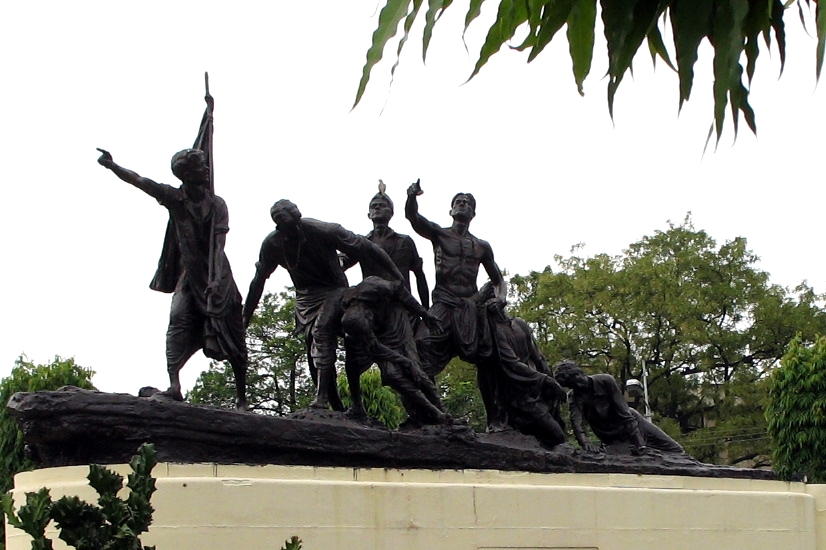
- The Martyrs' Memorial (Shaheed Smarak) east of the Patna Secretariat honours seven students shot dead in the Quit India movement of August 1942 while trying to hoist the national flag — Umakant Prasad Sinha, Ramanand Singh, Satish Prasad Jha (so named in the Government of Bihar's own history; some accounts print Satish Chandra Jha), Jagatpati Kumar, Devipada Choudhry, Rajendra Singh and Ramgovind Singh. Its foundation stone was laid on 15 August 1947 by Bihar's first Governor, Jairamdas Daulatram, and the bronze group was sculpted by Deviprasad Roychoudhury and cast in Italy.
Study next
Common traps
- Attributing the line to Nehru or Azad because both were at the Bombay session and both were arrested on 9 August 1942 — presiding over or attending a meeting is not authorship of its speech
- Treating 'Do or Die' and 'We shall either free India or die in the attempt' as two separate quotations from two occasions — they are consecutive clauses of one sentence
- Reading 'die in the attempt' as a call to violence — Gandhi's formula was to accept death, not to cause it; the destruction of August 1942 followed the arrest of the leadership, not its instructions
BPSC prints the quotation and asks for the speaker — a one-line attribution item, with the four options drawn from leaders who are all plausible for the 1940s, so the elimination has to be done on position and register rather than on period. UPSC has never asked this quotation directly; it works the same knowledge sideways. In 2009 it asked which movement the slogan 'Do or die' is associated with, in 2021 it asked what happened on 8 August 1942, in 2005 what Gandhi asked government servants, soldiers and princes to do on the eve of the launch, and in 1999 and 2000 it set Linlithgow's verdict that this was the most serious rebellion since 1857 as an assertion-reason pair.
Related PYQs
With which one of the following movements is the slogan “Do or die” associated?
- (a) Swadeshi Movement
- (b) Non-Cooperation Movement
- (c) Civil Disobedience Movement
- (d) Quit India Movement
Answer(d) Quit India Movement
The other half of the very same sentence. UPSC quotes 'Do or die' and asks for the movement; BPSC quotes the clause that follows it and asks for the speaker. Both are answered by knowing one evening — Gowalia Tank Maidan, 8 August 1942.
With reference to 8th August, 1942 in Indian history, which one of the following statements is correct?
- (a) The Quit India Resolution was adopted by the AICC,
- (b) The Viceroy’s Executive Council was expanded to include more Indians.
- (c) The Congress ministries resigned in seven provinces.
- (d) Cripps proposed an Indian Union with full Dominion Status once the Second World War was over.
Answer(a) The Quit India Resolution was adopted by the AICC,
The same date approached from the calendar rather than from the quotation, and its distractors are the neighbouring events a candidate blurs into it — the Congress ministries resigned in late 1939 and the Cripps offer was made in March 1942, months before the speech.
Practice
- practice — not a real PYQ
The Quit India Resolution was adopted by the All India Congress Committee at
- (a)Ramgarh
- (b)Gowalia Tank Maidan, Bombay
- (c)Wardha
- (d)Lahore
Answer(b) Gowalia Tank Maidan, Bombay — on 8 August 1942, followed the same evening by Gandhi's 'Do or Die' speech. Ramgarh hosted the Congress session of March 1940 under Abul Kalam Azad, and Lahore the session of December 1929 that adopted Purna Swaraj. - practice — not a real PYQ
Which one of the following political organisations officially boycotted the Quit India Movement of 1942 ?
- (a)The Forward Bloc
- (b)The Hindu Mahasabha
- (c)The Swaraj Party
- (d)The Servants of India Society
Answer(b) The Hindu Mahasabha — under V. D. Savarkar it opposed the movement openly and boycotted it, and Savarkar's letter 'Stick to your Posts' told Mahasabha members in local bodies, legislatures and government service to stay put. The Swaraj Party belonged to the 1920s and had long ceased to function by 1942.