
The UN climate conference held in Baku in 2024 concluded with an agreement that:
- (a)Aims to ban fossil fuels globally by 2030
- (b)Calls on developed countries to provide at least $500 billion annually to developing nations by 2030
- (c)Calls on developed countries to provide at least $300 billion annually to developing nations by 2035
- (d)More than one of the above
Answer
Why
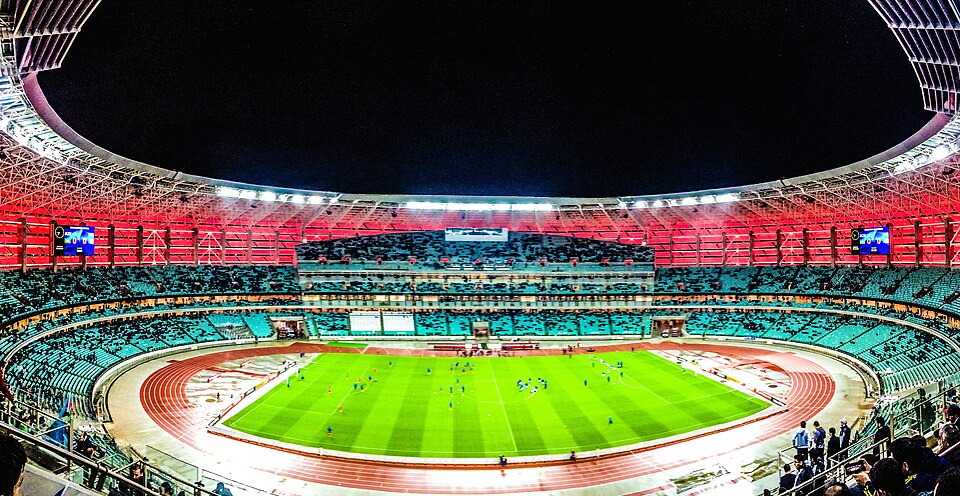
Correct — C, 'Calls on developed countries to provide at least $300 billion annually to developing nations by 2035'. The Baku meeting was COP29 of the UN Framework Convention on Climate Change, held at Baku Olympic Stadium in Azerbaijan from 11 to 22 November 2024 under the presidency of Mukhtar Babayev, and it had been billed all year as the 'finance COP' because it carried one mandated deliverable: to fix the New Collective Quantified Goal on Climate Finance, the NCQG. The text that emerged — gavelled through in the early hours of 24 November after the closing plenary ran past its deadline — sets out two numerically distinct things, and option (c) reproduces the first of them accurately in all four of its parts. The amount is at least USD 300 billion; the payer is developed countries, who are to take the lead in mobilising it; the recipient is developing countries; and the horizon is 2035. That is a trebling of the goal it replaces, the USD 100 billion a year promised at Copenhagen in 2009. The second figure is the one candidates misremember and examiners exploit: the same decision calls on ALL ACTORS — public and private, domestic and international, including voluntary South-South flows — to work together to scale finance to developing countries to USD 1.3 trillion a year by 2035, an aspiration carried forward as the 'Baku to Belem Roadmap to 1.3T'. Three hundred billion is the obligation; 1.3 trillion is the ambition. Neither is USD 500 billion, and neither runs to 2030, so option (b) is wrong in both its number and its year. Nothing at Baku banned any fuel, which disposes of (a). With exactly one true statement in the set, (d) cannot stand. Two honest additions a student should carry. First, the deal was adopted over objection. India told the closing plenary that the sum was far too small and that the text had been gavelled through before India was allowed to speak; a bloc of developing countries had been pressing for a floor of USD 500 billion a year and publicly called the 300 billion outcome paltry. Second, Baku's other real achievement was closing the Article 6 rulebook of the Paris Agreement — cooperative approaches under 6.2 and the Paris Agreement Crediting Mechanism under 6.4 — nine years after Paris left it unfinished. On exam day, 13 September 2025, COP30 at Belem in Brazil was still ahead; it has since been held, in November 2025.
Why the others are wrong
- (a)Aims to ban fossil fuels globally by 2030 — No Conference of the Parties has ever banned anything: 198 Parties decide by consensus, so a prohibition would need petro-states to vote against their own economies. The strongest text ever adopted is COP28's first Global Stocktake at Dubai in December 2023, calling on Parties to contribute to 'transitioning away from fossil fuels in energy systems' so as to reach net zero by 2050 — transition, not ban, and 2050, not 2030.
- (b)Calls on developed countries to provide at least $500 billion annually to developing nations by 2030 — Wrong twice over — wrong amount and wrong deadline — and sharper than it looks, because 500 billion was not invented. It was a real number at Baku: many developing countries pushed for a minimum of USD 500 billion a year, and the 300 billion they got is what they denounced as too little. But a demand tabled in negotiation is not an agreement adopted, and no Baku text pairs 500 billion with anything, least of all with 2030 — the year candidates import from the Sustainable Development Goals and from India's own NDC targets.
- (d)More than one of the above — This option needs at least two of (a), (b) and (c) to survive, and only (c) does. It is a live answer elsewhere in this paper — Q21 and Q30 both key to a 'more than one' option — so it cannot be dismissed as filler; it fails here on arithmetic. A candidate who is sure about the 300-billion figure but also half-believes the fossil-fuel headline from COP28 is precisely who ticks it.
Concept
Climate finance is the money developed countries owe developing ones under the 1992 UN Framework Convention on Climate Change, and it rests on the Convention's founding principle of common but differentiated responsibilities and respective capabilities: those who industrialised first, and emitted first, carry the heavier burden. The Convention put that obligation on its Annex II Parties, and successive COPs have built the plumbing to deliver it — the Global Environment Facility from the start, the Adaptation Fund under the Kyoto Protocol, the Green Climate Fund agreed at Cancun in 2010 and seated at Songdo in the Republic of Korea, and most recently the Loss and Damage Fund agreed at Sharm el-Sheikh in 2022 and operationalised at Dubai in 2023. Alongside the institutions runs a series of quantum pledges. Copenhagen in 2009 produced the promise of USD 100 billion a year by 2020; Paris in 2015 extended that to 2025 and instructed the Parties to set a NEW collective quantified goal before 2025, starting from a floor of USD 100 billion. Baku existed to discharge that instruction, and could not be postponed. Keep three destinations distinct, because every finance question turns on them: mitigation money cuts emissions, adaptation money pays for living with impacts already locked in, and loss-and-damage money answers for harm already done. The perennial fights are over composition — how much is grant and how much is loan at commercial rates — and over who counts as a contributor, since China and the Gulf states are now among the largest emitters but sit outside Annex II under the 1992 classification.
Read this as an arithmetic-of-memory question, not a climate question. Four amount-and-year pairings are offered and exactly one is real, so what is being tested is whether you stored the number with its deadline attached. Two figures came out of Baku and they must never be swapped: USD 300 billion a year is the obligation on developed countries; USD 1.3 trillion a year is the all-actor aspiration behind the Baku to Belem roadmap. Both run to 2035. Neither is USD 500 billion, which was a developing-country demand at Baku rather than anything Baku adopted, and neither runs to 2030 — which kills option (b) twice, and 2030 is a genuinely attractive wrong year because it belongs to a whole other family of targets a candidate has revised: the SDGs, and India's updated NDC of 45 per cent emissions-intensity reduction and about 50 per cent non-fossil installed capacity by 2030. Option (a) yields to a rule of thumb worth internalising for every COP question ever set: the UNFCCC process does not prohibit, it exhorts. It took twenty-eight conferences before the words 'fossil fuels' appeared in a cover decision at all, at Dubai in 2023, and even then the verb was 'transitioning away'. Baku, notably, failed to carry that Dubai language forward, which was one of the loudest criticisms levelled at it. Strike (a) and (b) and option (d) falls automatically, because 'more than one' needs two survivors and there is one. The single discriminator is therefore an ordered pair — 300 billion, 2035. Carry that pair and the question takes fifteen seconds; carry only 'COP29 was about finance' and all four options look equally plausible.
Key facts
- COP29 of the UNFCCC met at Baku Olympic Stadium, Azerbaijan, from 11 to 22 November 2024 under COP President Mukhtar Babayev; the closing plenary overran and the finance decision was adopted in the early hours of 24 November 2024.
- The New Collective Quantified Goal commits developed countries to take the lead in mobilising at least USD 300 billion a year for developing countries by 2035 — three times the previous USD 100 billion a year goal.
- A second and separate Baku figure: the decision calls on all actors, public and private, to scale up finance to developing countries to USD 1.3 trillion a year by 2035, taken forward as the 'Baku to Belem Roadmap to 1.3T'. The 300 billion is the core obligation; the 1.3 trillion is the mobilisation aspiration.
- The goal Baku replaced was set at COP15 in Copenhagen in 2009 — USD 100 billion a year by 2020, extended to 2025 by the Paris Agreement — and the OECD reported it was first met only in 2022, at USD 115.9 billion, two years behind schedule.
- Baku also completed the Article 6 rulebook of the Paris Agreement, nine years after Paris: cooperative approaches under Article 6.2 and the Paris Agreement Crediting Mechanism under Article 6.4. India objected in the closing plenary that USD 300 billion was far too small, and the package was adopted over the stated objections of several developing countries. COP30 followed at Belem, Brazil, in November 2025.
Study next
Common traps
- Swapping the two Baku numbers — USD 300 billion is what developed countries must lead on, USD 1.3 trillion is what all actors are asked to mobilise; USD 500 billion was only a demand tabled by developing countries, never an agreed figure
- Attaching 2030 to a Baku figure: both Baku numbers run to 2035, while 2030 belongs to the SDGs and to India's NDC targets
- Expecting a COP to prohibit a fuel — the strongest language ever adopted is COP28's 'transitioning away from fossil fuels', and Baku did not even repeat it
BPSC asks for the number itself. One conference, one figure, one deadline, and distractors built by shifting a digit or a decade — thirty seconds to mark, and worth nothing to a candidate who learned that COP29 was 'the finance COP' without learning the amount. UPSC almost never makes the headline figure the answer; it plants a corrupted one inside a statement set and waits. Its 2016 Paris question offered 'donate $1000 billion a year from 2020' against the real USD 100 billion, and its 2015 question on the Green Climate Fund asked who founded the fund rather than what it holds. Same syllabus, opposite technique: BPSC rewards recall, UPSC rewards detection.
Related PYQs
With reference to the Agreement at the UNFCCC Meeting in Paris in 2015, which of the following statements is/are correct? 1. The Agreement was signed by all the member countries of the UN and it will go into effect in 2017. 2. The Agreement aims to limit the greenhouse gas emissions so that the rise in average global temperature by the end of this century does not exceed 2°C or even 1.5°C above pre-industrial levels. 3. Developed countries acknowledged their historical responsibility in global warming and committed to donate $1000 billion a year from 2020 to help developing countries to cope with climate change. Select the correct answer using the code given below.
- (a) 1 and 3 only
- (b) 2 only
- (c) 2 and 3 only
- (d) 1, 2 and 3
Answer(b) 2 only
The same fact tested from the other side. Statement 3 is a corrupted climate-finance figure — '$1000 billion a year from 2020' against the real USD 100 billion a year — and it is exactly the goal that COP29 at Baku was convened to replace. A student who can spot the inflated number here will not be caught by the manufactured USD 500 billion in the BPSC item.
Which of the following statements regarding ‘Green Climate Fund’ is/are correct? 1. It is intended to assist the developing countries in adaptation and mitigation practices to counter climate change. 2. It is founded under the aegis of UNEP, OECD, Asian Development Bank and World Bank. Select the correct answer using the code given below.
- (a) 1 only
- (b) 2 only
- (c) Both 1 and 2
- (d) Neither 1 nor 2
Answer(a) 1 only
The institution behind the number. The Green Climate Fund is the UNFCCC's own vehicle for channelling adaptation and mitigation money to developing countries, and it sits under the Conference of the Parties rather than under the multilateral development banks — the same treaty machinery through which the USD 300 billion Baku goal will have to flow.
Practice
- practice — not a real PYQ
The New Collective Quantified Goal on Climate Finance agreed at COP29, Baku, replaced which earlier goal ?
- (a)USD 50 billion a year by 2015
- (b)USD 100 billion a year by 2020
- (c)USD 200 billion a year by 2025
- (d)USD 1 trillion a year by 2030
Answer(b) USD 100 billion a year by 2020 — pledged at COP15 in Copenhagen in 2009 and extended to 2025 by the Paris Agreement. The OECD reported it was first met only in 2022, at USD 115.9 billion. Baku trebled it to USD 300 billion a year by 2035. - practice — not a real PYQ
The Green Climate Fund, the principal financing vehicle under the UNFCCC, was agreed at which Conference of the Parties, and where is it headquartered ?
- (a)COP15, Copenhagen; headquartered at Bonn
- (b)COP16, Cancun; headquartered at Songdo, Republic of Korea
- (c)COP21, Paris; headquartered at Geneva
- (d)COP26, Glasgow; headquartered at Nairobi
Answer(b) COP16, Cancun; headquartered at Songdo, Republic of Korea — the fund was agreed at Cancun in 2010 to support mitigation and adaptation in developing countries. Bonn hosts the UNFCCC secretariat, not the fund.