
The part which we eat in Mango is :
- (a)Epicarp
- (b)Mesocarp
- (c)Endocarp
- (d)None of the above
Answer
Why
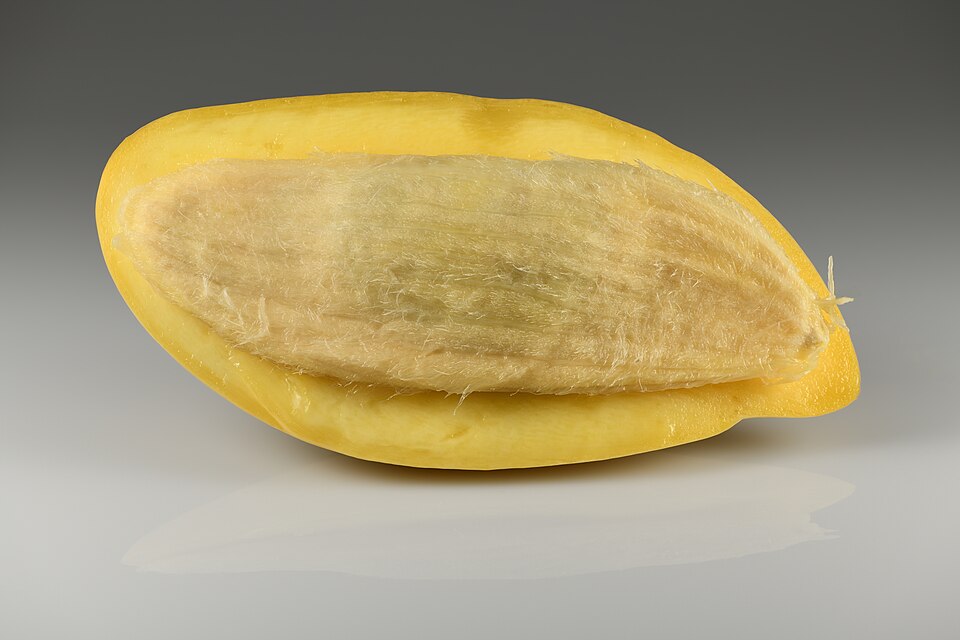
Correct — B, Mesocarp. The mango, Mangifera indica, is botanically a drupe, or stone fruit, and the part we eat is the middle layer of its fruit wall. After fertilisation the ovary wall of the flower ripens into the pericarp, and in a fleshy fruit that pericarp differentiates into three concentric layers: the epicarp on the outside, the mesocarp in the middle and the endocarp innermost. Cut a mango lengthwise and all three are visible at once — the thin skin you peel off is epicarp, the thick yellow, juicy, sweet flesh is mesocarp, and the flat woody stone in the centre is endocarp. It is the mesocarp that is eaten, ripe as fruit and pulp or unripe as pickle, chutney and amchur. Two structural details make the identification certain rather than merely plausible. First, the defining characteristic of a drupe is that its hard, woody, lignified stone is derived from the ovary wall itself, so the stone is fruit tissue and not a seed coat — what north Indian kitchens call the guthli is endocarp plus the seed inside it, and in mango that woody endocarp is only about 1–2 mm thick around a single seed 4–7 cm long. Second, a drupe is indehiscent and normally develops from a single carpel, which is why there is exactly one stone and one seed rather than many seeds loose in pulp as in a berry. The same three-layer architecture runs through every drupe — coffee, olive, jujube or ber, date, pistachio, cashew, and the whole genus Prunus from almond and apricot to peach, plum and cherry — and all that changes from fruit to fruit is which layer turns fleshy. In the mango that layer is the mesocarp, and it is the reason the tree is grown at all. Mango is the national fruit of India, Pakistan and the Philippines; the mango tree is the national tree of Bangladesh.
Why the others are wrong
- (a)Epicarp — The epicarp is the mango's thin outer skin — green, ripening through yellow to red or crimson depending on cultivar — and it is peeled off and thrown away, not eaten. It is not inert either: contact with the oils in mango skin, sap and leaves is a well-known cause of plant dermatitis, and people already sensitised to urushiol from poison ivy or poison oak can cross-react, because mango belongs to the same family, Anacardiaceae, as cashew and pistachio.
- (c)Endocarp — The endocarp is the hard, fibrous, woody stone at the centre — in mango a lignified shell roughly 1–2 mm thick wrapped round a single seed 4–7 cm long. Being stony is the definition of the endocarp in a drupe, so it can never be the edible layer of one. Candidates pick it when they confuse the fruit with the citrus group, where the juicy edible pulp really does come from endocarp tissue in the form of juice vesicles.
- (d)None of the above — This option is only right for fruits whose edible part is not pericarp at all — the flesh of an apple or pear, which is thalamus; the translucent white flesh of a litchi, which is an aril; the white kernel of a coconut, which is endosperm; or the cashew 'apple', which is a swollen flower stalk. The mango is not one of those exceptions. Its edible flesh is straightforwardly the middle layer of the fruit wall, so a named layer fits and the catch-all fails.
Concept
A fruit, in botany, is nothing more than a ripened ovary, and a seed is a ripened ovule. Once fertilisation is over, the ovary wall thickens into the pericarp, which is the entire fruit wall, and in fleshy fruits that pericarp separates into three layers — epicarp, mesocarp and endocarp, outermost to innermost. Which of the three becomes juicy is what distinguishes one fleshy fruit type from another, and this is the whole content of a large class of exam questions. In a drupe such as mango, coconut or ber, the mesocarp is fleshy or fibrous and the endocarp is stony, with one seed inside. In a berry such as tomato, grape, brinjal or banana, the mesocarp and endocarp are both soft and the seeds lie free in the pulp. In a hesperidium — orange, lemon, mosambi — the edible juice sacs are outgrowths of the endocarp, and the peel is epicarp plus the oil-glanded mesocarp. In a pome such as apple or pear the ovary itself is small and the flesh comes from the thalamus, which makes the pome a false fruit. Beyond the pericarp entirely lie the special cases: an aril, an outgrowth around the seed, is what is eaten in litchi; endosperm, the seed's own food store, is what is eaten in coconut; and in cashew the fleshy 'apple' is a swollen peduncle carrying the true fruit, a nut, on its tip.
Three of the four options are simply the three layers of the pericarp, listed from outside to inside, so the question reduces to naming the layer you would be holding if you cut a mango in half. Do that mentally and the sequence is unmistakable: peel, flesh, stone — epicarp, mesocarp, endocarp. The single fact that discriminates is the definition of a drupe: in a drupe the endocarp is by definition hard and lignified, so once you have classified the mango as a drupe the endocarp is disqualified automatically, the epicarp is obviously the discarded peel, and the mesocarp is forced without any further recall. The traps are analogies with other fruits. A candidate who has memorised the coconut, the standard textbook drupe, remembers that its mesocarp is the dry fibrous husk we make coir from and that nobody eats it, and hesitates. A candidate who thinks of litchi remembers that the edible flesh there is an aril and that none of the three layers would be right, which makes option (d) look sophisticated. Both analogies are true statements about the wrong fruit. The safe habit is to answer 'which part do we eat' questions from the structure of that particular fruit rather than from a general rule, because the botanical identity of the edible part changes from species to species: stem tuber in potato, root in carrot and sweet potato, thalamus in apple, aril in litchi, endosperm in coconut, mesocarp in mango.
Key facts
- Mango is Mangifera indica of the family Anacardiaceae, the family that also holds cashew and pistachio, and its fruit is a drupe: epicarp = skin, mesocarp = edible flesh, endocarp = stone. Mango is the national fruit of India, Pakistan and the Philippines, and the mango tree is the national tree of Bangladesh.
- The defining characteristic of a drupe is that the hard, woody, lignified stone is derived from the ovary wall — the stone is therefore fruit tissue, not seed coat. Drupes are indehiscent and mostly develop from a single carpel; in mango the woody endocarp is about 1–2 mm thick and the single seed inside it is 4–7 cm long.
- Other drupes include coffee, jujube (ber), olive, date and most other palms, pistachio, cashew and the entire genus Prunus — almond, apricot, cherry, damson, peach, nectarine and plum. Blackberry and raspberry are aggregates of tiny drupelets from a single flower with many free carpels.
- Coconut is also a drupe, but its mesocarp is the dry fibrous husk that yields coir and its endocarp is the hard shell, so the white kernel that is eaten is endosperm and not pericarp at all — the standard counter-example to a blanket rule that 'we eat the mesocarp of a drupe'.
- Contact with the oils in mango leaves, stems, sap and skin can cause dermatitis in susceptible people, and those already sensitised to urushiol — the allergen of poison ivy, poison oak and poison sumac — may cross-react; mangiferin is another compound implicated. This is the epicarp's chemistry, and one practical reason it is peeled.
Study next
Common traps
- Arguing from the coconut, the textbook drupe — its mesocarp is the fibrous husk used for coir and its edible kernel is endosperm, so the coconut analogy leads straight to a wrong answer for mango
- Reaching for 'None of the above' because of fruits where the edible part really is outside the pericarp — litchi's aril, the apple's thalamus, the cashew apple's peduncle
- Treating the mango stone as 'the seed' — the guthli is endocarp plus seed, and in a drupe that stone is fruit tissue derived from the ovary wall
BPSC asks this as a single flat line with the three pericarp layers as options and a catch-all fourth, so the mark turns purely on whether you can label a cut fruit, and the same template recurs with coconut, apple and litchi swapped in for mango. UPSC rarely names a tissue layer; it asks the same idea about a real plant and expects you to identify the organ — which part of the plant yields saffron (the stigma, 2009), or which of these is a modified stem (the potato, 1996) — so revise edible parts as a plant-by-plant table rather than as a definition.
Related PYQs
In making the saffron spice, which one of the following parts of the plant is used ?
- (a) Leaf
- (b) Petal
- (c) Sepal
- (d) Stigma
Answer(d) Stigma
The identical skill on a different plant: name the botanical part that is actually harvested and used. Saffron is the dried stigma of the Crocus sativus flower just as the eaten portion of a mango is the mesocarp of its fruit wall, and in both cases the wrong options are the neighbouring parts of the same structure.
Which one of the following is a modified stem?
- (a) Carrot
- (b) Sweet potato
- (c) Coconut
- (d) Potato
Answer(d) Potato
The companion question on edible plant parts and their true identity — potato is a modified stem while carrot and sweet potato are roots, which is exactly the habit this BPSC item rewards: knowing what the part we eat is botanically, not what it looks like on the plate.
Practice
- practice — not a real PYQ
The edible part of the coconut is
- (a)Mesocarp
- (b)Endocarp
- (c)Endosperm
- (d)Epicarp
Answer(c) Endosperm — coconut is a drupe whose mesocarp is the dry fibrous husk that yields coir and whose endocarp is the hard shell; the white kernel and the coconut water inside are endosperm, the seed's own food store, not part of the fruit wall. - practice — not a real PYQ
In litchi, the juicy white part of the fruit that is eaten is the
- (a)Mesocarp
- (b)Aril
- (c)Thalamus
- (d)Endosperm
Answer(b) Aril — in Litchi chinensis, of the family Sapindaceae, the fleshy translucent edible portion is an aril surrounding a single dark brown inedible seed; it is an outgrowth associated with the seed, not a layer of the pericarp.