
Which one of the following term characterizes the interaction between herpes simplex virus and a human?
- (a)Parasitism
- (b)Symbiosis
- (c)Endosymbiosis
- (d)Endoparasitism
Answer
Why
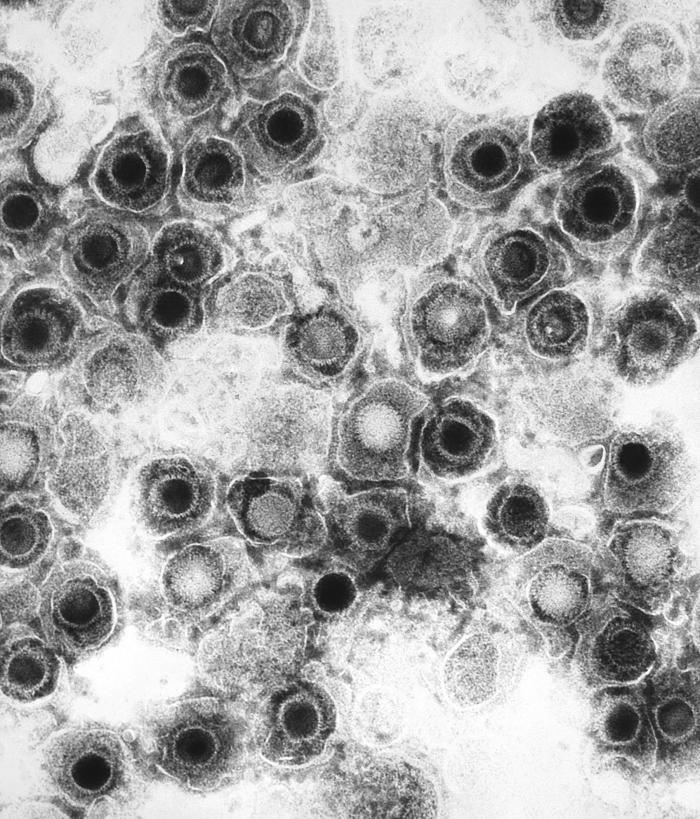
Correct — D, Endoparasitism. Begin with what this question is not: option (a), Parasitism, is not wrong. Herpes simplex virus is unquestionably a parasite — it gains, the human is harmed, and the interaction is the textbook plus-minus. Endoparasitism is a kind of parasitism, so the two options stand as a general term and a specific one, both true. The key takes the specific, and the Commission's own record shows it deciding exactly that: the provisional key marked (a) Parasitism, and the final revised key of 31 October 2025 changed the answer to (d), publishing its reason — all viruses, herpes simplex included, are obligate intracellular parasites that use the host cell's resources and cellular functions for their replication and survival, so this is one of the best examples of endoparasitism. The precision is earned. An ectoparasite lives on the host's surface — a head louse, a tick, a leech. An endoparasite lives inside the host — a roundworm in the gut, Plasmodium in the blood and liver. HSV goes further than either: it lives inside the host's individual cells. The virion is a relatively large, linear, double-stranded DNA genome sealed in an icosahedral capsid, joined by a protein tegument to a lipid envelope, and carrying at least 74 genes. It has no ribosomes, no metabolism and no way of making a single protein for itself, so replication is only possible within a living cell — its virion host shutoff protein, VHS or UL41, degrades the host's own messenger RNA and shuts down host protein synthesis so that the cell's machinery is turned over to making virus. That is precisely why bacteria and fungi grow happily on artificial media and viruses cannot be cultured on any medium at all. And the tenancy does not end with the illness. After the lytic episode the viral genome retreats into neurons and persists as circular DNA held in the nucleus as an episome — HSV-1 characteristically in the trigeminal ganglion, HSV-2 in the sacral ganglia — expressing latency-associated transcript RNA that interferes with the cell's own death programme and so preserves the reservoir for later reactivation. A lifelong residence inside the host's own nerve cells is endoparasitism in its strongest possible form.
Why the others are wrong
- (a)Parasitism — True, and deliberately so — this is the trap, not an error. Parasitism is the genus and endoparasitism the species, and HSV satisfies both descriptions: the virus benefits, the human is harmed. BPSC's own provisional key marked this option before the revised key moved to (d). It is not the answer because it omits the one feature that defines this particular relationship — that the parasite lives and replicates INSIDE the host's cells. The general rule to take away: where two options are both true and one is strictly more specific, mark the specific one.
- (b)Symbiosis — In the sense Indian textbooks use, symbiosis means mutualism — both partners gain. Rhizobium fixes nitrogen and the legume feeds it; zooxanthellae photosynthesise and the coral shelters them; in a lichen the fungus supplies structure and the alga supplies food. The human gains nothing whatever from herpes simplex. One honest caveat: Anton de Bary, who coined the word in 1879, defined symbiosis broadly as the living together of unlike organisms, which would technically embrace parasitism — but Indian prelims papers use the narrow mutualistic sense throughout.
- (c)Endosymbiosis — The most seductive distractor, because it supplies the right location and the wrong sign. Endosymbiosis means one organism living inside another to MUTUAL benefit: Rhizobium inside root nodules, zooxanthellae inside coral polyps, cellulose-digesting flagellates inside the termite gut, and above all Lynn Margulis's 1967 endosymbiotic theory that mitochondria and chloroplasts descend from bacteria engulfed and retained to the host's advantage. HSV is indeed inside the cell, but the human derives no benefit at all, so the 'symbiosis' half of the word fails.
Concept
Ecology labels every interaction between two species by the sign of its effect on each partner. Mutualism is plus-plus, commensalism plus-zero, amensalism minus-zero, competition minus-minus, and both predation and parasitism are plus-minus. Predation and parasitism are separated by what happens next: a predator kills its prey immediately and lives outside it, while a parasite feeds on a living host over time and usually does not kill it, because a dead host is a lost habitat — a parasitoid, which does eventually kill, sits between the two. Parasites are then sorted by location — ectoparasites on the surface, endoparasites within — and by dependence, obligate parasites being unable to complete their life cycle without a host while facultative ones can live free. Viruses are the extreme case on every axis. They are acellular, have no ribosomes and no metabolism of their own, and are inert outside a host, which is why they sit on the boundary of the living and the non-living. Indian textbooks trace that discovery through D. J. Ivanowsky, who in 1892 showed that the agent of tobacco mosaic disease passed through filters that stopped bacteria; M. W. Beijerinck, who in 1898 called the infectious sap contagium vivum fluidum; and W. M. Stanley, who in 1935 crystallised the tobacco mosaic virus. Every virus is therefore an obligate intracellular parasite by definition, and herpes simplex is simply the version of that fact the examiner chose to name.
Sort the four options on two independent axes and the answer falls out. The first axis is the direction of benefit. Options (b) and (c) both assert mutual benefit, and no reading of herpes simplex gives the human any benefit at all — recurrent cold sores or genital lesions, ocular keratitis in some, and in rare cases encephalitis. Both fall regardless of anything else, so half the paper's field is gone in a single step. The second axis is location, and it separates the two survivors. Options (a) and (d) are both true statements about HSV; they differ only in how much they say. The single discriminating fact is that HSV is an obligate INTRACELLULAR parasite. That is not incidental colour — it is the defining property of the interaction, the reason no artificial medium can grow the virus, the reason antiviral drugs are so much harder to design than antibiotics (you must attack a process running inside a human cell without destroying the cell), and the reason infection is lifelong rather than episodic. Because 'inside' is the essence rather than a detail, the term that names it wins. Two exam-hall cautions. Do not spend time trying to prove that parasitism is false — it is not, and the Commission itself keyed it before revising. And do not read 'endo' as automatically friendly: 'endo' fixes only where the partner lives, while the prefix-free part of the word — parasite or symbiont — fixes who benefits.
Key facts
- BPSC's provisional key for this question marked option (a) Parasitism; the final revised key, published 31 October 2025, changed the answer to (d) Endoparasitism, with the Commission's stated reason that all viruses, herpes simplex included, are obligate intracellular parasites that use the host cell's resources and functions for replication and survival.
- The herpes simplex virion is a relatively large, linear, double-stranded DNA genome inside an icosahedral capsid, joined by a protein tegument to a lipid envelope, and carries at least 74 genes; its virion host shutoff protein (VHS, also called UL41) degrades host messenger RNA and shuts off host protein synthesis to divert the cell to virus production.
- In latency the HSV genome sits in the nucleus of a neuron as circular DNA called an episome — HSV-1 characteristically in the trigeminal ganglia and HSV-2 in the sacral ganglia — and expresses latency-associated transcript (LAT) RNA, which interferes with the cell's death mechanisms and so keeps the viral reservoir alive for periodic reactivation.
- As of 2016 about 67% of the world's population under the age of 50 carried HSV-1; both HSV-1 and HSV-2 spread when an infected person sheds virus, and a large proportion of carriers never develop any symptom at all.
- Terminology to keep separate: an ectoparasite lives on the host's surface (head lice, ticks, leeches) and an endoparasite within it (Ascaris, tapeworm, Plasmodium); endosymbiosis means living inside to MUTUAL benefit — Rhizobium in root nodules, zooxanthellae in corals, and Lynn Margulis's 1967 endosymbiotic theory deriving mitochondria and chloroplasts from engulfed bacteria.
Study next
Common traps
- Concluding that parasitism is wrong. It is right but general; endoparasitism is right and specific, and BPSC's own provisional key chose the general term before revising to the specific one
- Treating 'endo' as a sign of partnership. The prefix says only where the organism lives; whether the host benefits is carried by the root — symbiont or parasite
- Calling a virus an ectoparasite because lesions appear on the skin. The blisters are the visible damage; the virus itself replicates inside epithelial cells and hides inside neurons
BPSC asks you to NAME the relationship in a single word and then sets a general true term beside a specific true term, so the mark turns on precision of vocabulary rather than on knowing any biology about herpes — and the Commission cared enough about that precision to revise its own key from parasitism to endoparasitism. UPSC never asks for the label. It tests the consequence of the same fact: whether viruses can be cultured on artificial media (2021), whether viruses count as decomposers in a food chain (2013), what two organisms actually make up a lichen (2014).
Related PYQs
Consider the following: 1. Bacteria 2. Fungi 3. Virus Which of the above can be cultured in artificial/synthetic medium?
- (a) 1 and 2 only
- (b) 2 and 3 only
- (c) 1 and 3 only
- (d) 1, 2 and 3
Answer(a) 1 and 2 only
The identical fact, asked as a consequence instead of as a label. Viruses are excluded from artificial culture for exactly the reason the BPSC key gives for preferring 'endoparasitism' — they are obligate intracellular parasites that can replicate only inside a living host cell. Answer one and you have already answered the other.
Lichens, which are capable of initiating ecological succession even on a bare rock, are actually a symbiotic association of
- (a) algae and bacteria
- (b) algae and fungi
- (c) bacteria and fungi
- (d) fungi and mosses
Answer(b) algae and fungi
The other half of the same vocabulary. UPSC uses 'symbiotic' in its strict mutual-benefit sense — the fungus supplies structure and water, the photosynthetic partner supplies food — which is precisely the sense in which options (b) and (c) fail for herpes simplex, where the human partner gains nothing.
Practice
- practice — not a real PYQ
Viruses cannot be grown on artificial nutrient media because they
- (a)are killed by the agar used in laboratory media
- (b)are obligate intracellular parasites and need living host cells to replicate
- (c)require an anaerobic atmosphere that media cannot provide
- (d)reproduce only by binary fission, which media do not support
Answer(b) are obligate intracellular parasites and need living host cells to replicate — a virus has no ribosomes and no metabolism of its own, so it can multiply only by taking over a living cell's machinery. Viruses are cultured in living cell lines, embryonated eggs or whole animals instead. - practice — not a real PYQ
Which one of the following pairs is an example of endosymbiosis rather than of parasitism?
- (a)Plasmodium and a human being
- (b)Ascaris and a human being
- (c)Rhizobium and a leguminous root nodule
- (d)Head louse and a human being
Answer(c) Rhizobium and a leguminous root nodule — the bacterium lives inside the host's tissue and both partners gain, the plant receiving fixed nitrogen and the bacterium receiving shelter and carbohydrate. Plasmodium and Ascaris are endoparasites; the head louse is an ectoparasite.