
Which Material is used for smart film?
- (a)Indium tin oxide
- (b)Calcium carbonate
- (c)Zinc chloride
- (d)Silica
Answer
Why
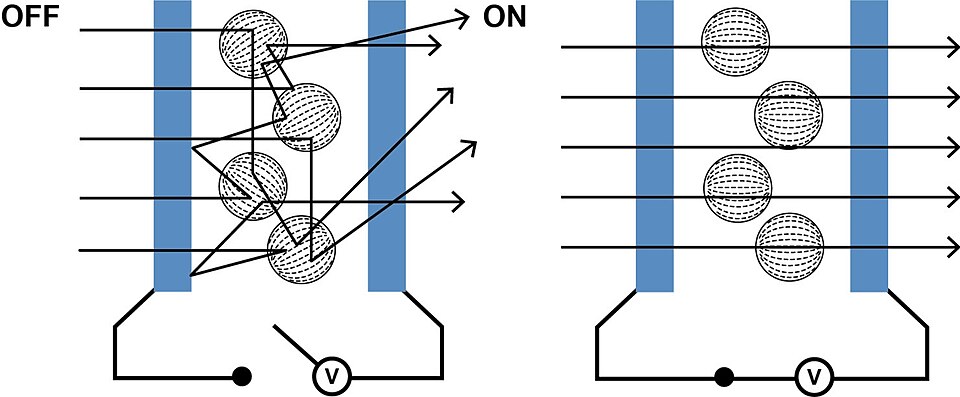
Correct — A, Indium tin oxide. Smart film — the switchable sheet that turns a glass partition from milky white to clear at the flick of a switch — is almost always a polymer-dispersed liquid crystal (PDLC) laminate, and indium tin oxide, ITO, is the transparent electrode that makes it switch. The construction is a sandwich: droplets of liquid crystal cured into a solid polymer, held between two sheets of glass or plastic, each of which carries a thin conductive coating. Electrically the whole assembly is a capacitor. With no voltage the liquid-crystal droplets point in random directions, scatter the light passing through and leave the panel translucent and milky; apply a voltage across the two coatings and the electric field lines the crystals up, light travels through almost unscattered, and the panel goes clear. Intermediate voltages give intermediate haze. Notice what that design demands of the electrode material: it must conduct electricity, because it carries the switching field, and it must be transparent, because you are looking through it. Ordinary metals conduct but are opaque; ordinary glass is transparent but insulating. ITO resolves the conflict. It is a ternary composition of indium, tin and oxygen — typically about 74% indium, 8% tin and 18% oxygen by weight — an n-type semiconductor with a band gap near 4 eV, an electrical resistivity of roughly 10⁻⁴ Ω·cm, and an optical transmittance above 80% as a thin film, colourless in thin layers though yellowish-grey in bulk. It is normally laid down by physical vapour deposition, sputtering or electron-beam evaporation. The same coating sits behind touchscreens, LCD and plasma panels, the anode of an OLED, thin-film solar cells, EMI shielding and the heated windscreens that de-ice aircraft.
Why the others are wrong
- (b)Calcium carbonate — CaCO₃ is limestone, marble, chalk and the shell of an egg — the feedstock of cement and lime, a bulk filler in paper, paint and plastics, and the active ingredient of common antacids. As a powder it is opaque white and it is an electrical insulator, so it fails both requirements a smart film places on its electrode at once: it cannot carry the switching voltage and you could not see through it if it did.
- (c)Zinc chloride — A deliquescent white salt used as a soldering flux, a wood preservative, a textile mordant and the electrolyte of the ordinary zinc-carbon dry cell. That last use is the source of the temptation — it does conduct. But it conducts ionically, and only when molten or dissolved in water; a smart film needs a solid, stable, electronically conducting layer bonded to the substrate. A hygroscopic salt that draws moisture from the air is the opposite of a durable thin-film electrode.
- (d)Silica — The intelligent wrong answer. SiO₂ is quartz and the basis of ordinary glass, so it passes the transparency test brilliantly — and the words 'smart film' and 'smart glass' pull the mind straight to it. It fails the other test completely: silica is one of the best electrical insulators known, which is precisely why it serves as the gate dielectric in transistors, the layer whose job is to stop current. Silica is what a smart panel is built on, never the layer that switches it.
Concept
Transparency and electrical conductivity normally exclude one another, and understanding why is the whole of this question. A metal conducts because it holds a sea of loosely bound electrons, and those same free electrons absorb and reflect visible light — which is why every good conductor you can name is opaque and shiny. An insulator such as silica is transparent because its band gap is far larger than the energy of a visible photon (about 1.8 to 3.1 eV), so no electron can absorb one and be promoted; the light simply passes. A transparent conducting oxide escapes the trap by combining both mechanisms. Take a wide-band-gap oxide semiconductor — indium oxide has a gap near 4 eV, comfortably above visible photon energies, so visible light goes straight through — and then dope it heavily with tin, whose extra valence electron is donated into the conduction band. The result is transparent because of the gap and conducting because of the doping. The compromise never disappears entirely: thickening the film or raising the carrier concentration improves conduction and reduces transmission, so every device settles on a working point. Smart film itself comes in several families, and it is worth keeping them apart. PDLC switches by scattering; suspended-particle devices align rod-shaped nanoparticles; electrochromic glazing shifts colour by shuttling ions into a tungsten-oxide layer and then holds that state with almost no further power; thermochromic polymers respond to temperature alone and use no electricity at all. Every electrically driven one of them needs a transparent electrode, which is why ITO turns up in all of them.
Do not try to recall the answer — derive it from the job description. A smart film changes state when a voltage is placed across it, so it must carry an electrode on each face, so the material in question must conduct electricity. You are also looking through the film, so it must be transparent. Those two demands, applied together, decide the question by themselves. Test each option against both. Calcium carbonate is an opaque white insulator and fails on both counts. Zinc chloride conducts, but only as ions in solution or in the melt, and it is deliquescent — it pulls water out of the air — which disqualifies it as a durable solid film. Silica passes the transparency test and fails the conductivity test as completely as any material can; it is the standard insulator of the electronics industry. Indium tin oxide alone satisfies both, and the single discriminating fact is exactly that: it is the standard transparent conducting oxide, a wide-band-gap oxide doped until it conducts. The trap is (d), and it is well laid, because 'film' and 'glass' summon silica instantly and silica genuinely is present in a smart-glass panel — as the substrate, not as the switch. Carry one sentence into the hall and make it this one: silica is what the light passes through, indium tin oxide is what the electricity passes through.
Key facts
- Indium tin oxide is a ternary composition of indium, tin and oxygen — typically about 74% In, 8% Sn and 18% O by weight. It is an n-type semiconductor with a band gap near 4 eV, resistivity around 10⁻⁴ Ω·cm, and thin-film optical transmittance above 80%.
- Smart film is usually a polymer-dispersed liquid crystal laminate: liquid-crystal droplets cured into a polymer between two conductively coated sheets. Unpowered, the droplets are randomly oriented and scatter light, so the panel looks milky white; a voltage aligns them and it turns clear, with intermediate voltages giving intermediate haze.
- Every transparent conductor trades conductivity against transparency — a thicker film or a higher carrier density conducts better and transmits less. ITO is normally deposited by physical vapour deposition, either sputtering or electron-beam evaporation, both of which require a vacuum.
- The same coating carries touchscreens, LCD and plasma panels, the anode or hole-injection layer of an OLED, thin-film and perovskite solar cells, antistatic and EMI-shielding layers, supermarket freezer doors, and aircraft windshields that are de-iced by passing a current through the film.
- Indium's scarcity and cost, ITO's brittleness and the vacuum needed to deposit it have driven a hunt for replacements: aluminium-doped zinc oxide (AZO), gallium- and indium-doped zinc oxide, carbon nanotubes, silver-nanowire meshes, conductive polymers such as PEDOT:PSS, and graphene films that reach about 90% transparency at a lower resistance than standard ITO.
Study next
Common traps
- Choosing silica because 'film' and 'glass' suggest SiO₂ — silica is the transparent substrate, but it is an insulator and can never be the switching electrode
- Treating smart film as a single technology; PDLC, suspended-particle, electrochromic and thermochromic films switch by different physics, and only the thermochromic kind needs no electricity at all
- Reading the milky state as a fault — a PDLC panel is opaque when unpowered and clear when powered, so a power cut restores privacy rather than removing it
BPSC keeps this at material-identification level — name the substance behind a consumer technology, four bare options, nothing to weigh — and it has done the same across this paper for the glow pigment at Q132 and the anti-knock petrol additive at Q137. UPSC treats the identical transparent-electrode idea as an applications question instead: its 2012 graphene item asks you to judge the statement that graphene can serve as the conducting electrode for touch screens, LCDs and organic LEDs, and its 2017 item asks what flexible and transparent OLED displays make possible. BPSC names the material; UPSC asks what it enables.
Related PYQs
Graphene is frequently in news recently. What is its importance? 1. It is a two-dimensional material and has good electrical conductivity. 2. It is one of the thinnest but strongest materials tested so far. 3. It is entirely made of silicon and has high optical transparency. 4. It can be used as conducting electrodes required for touch screens, LCDs and organic LEDs. Which of the statements given above are correct?
- (a) 1 and 2 only
- (b) 3 and 4 only
- (c) 1, 2 and 4 only
- (d) 1, 2, 3 and 4
Answer(c) 1, 2 and 4 only
The same concept from the successor's side. Statement 4 describes precisely the job indium tin oxide does — a conducting electrode you can see through, for touch screens, LCDs and organic LEDs — and graphene is the leading candidate to replace ITO in that role because indium is scarce and ITO films are brittle.
Organic Light Emitting Diodes (OLEDs) are used to create digital display in many devices. What are the advantages of OLED displays over Liquid Crystal displays? 1. OLED displays can be fabricated on flexible plastic substrates. 2. Roll-up displays embedded in clothing can be made using OLEDs. 3. Transparent displays are possible using OLEDs. Select the correct answer using the code given below:
- (a) 1 and 3 only
- (b) 2 only
- (c) 1, 2 and 3
- (d) None of the above statements is correct
Answer(c) 1, 2 and 3
Both display families in this question are built on the same transparent electrode: indium tin oxide forms the anode of an OLED and the electrode layer of an LCD, exactly as it forms the switching layer of smart film. It also shows the limit of ITO — because ITO films are brittle, flexible and roll-up displays push designers towards graphene and silver-nanowire electrodes.
Practice
- practice — not a real PYQ
A polymer-dispersed liquid crystal (PDLC) smart film appears translucent and milky white when
- (a)A voltage is applied across it
- (b)No voltage is applied across it
- (c)It is heated above room temperature
- (d)It is exposed to ultraviolet radiation
Answer(b) No voltage is applied across it — unpowered, the liquid-crystal droplets are randomly oriented and scatter the light, so the panel looks milky. Applying a voltage aligns them and the panel turns clear, which is why a power failure leaves such a partition opaque. - practice — not a real PYQ
Which one of the following materials is being actively developed as a substitute for indium tin oxide in transparent electrodes ?
- (a)Graphene
- (b)Bakelite
- (c)Portland cement
- (d)Calcium sulphate
Answer(a) Graphene — graphene films combine roughly 90% optical transparency with a lower sheet resistance than standard ITO and, unlike ITO, are flexible. Bakelite is a thermosetting insulating plastic, while Portland cement and calcium sulphate are opaque construction materials.