
Ladang refers to -
- (a)Shifting Agriculture
- (b)Plantation Agriculture
- (c)Subsistence type of Agriculture
- (d)Dry forming
Answer
Why
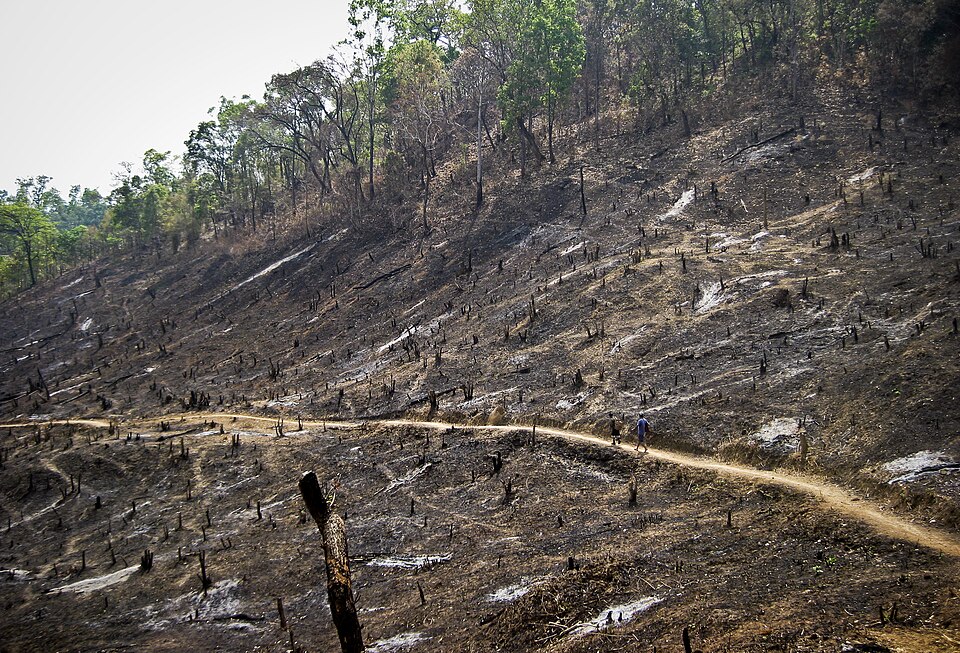
Correct — A, Shifting Agriculture. Ladang is the Malay and Indonesian name for shifting, slash-and-burn cultivation as practised in South-East Asia, and the Commission's own remark on the final key says so — it identifies Ladang as the South-East Asian name for shifting cultivation, particularly in Malaysia and Indonesia. The word itself gives the answer away: in Indonesian and Malay a *ladang* is an unirrigated, dry field used to grow crops, the direct opposite of a *sawah*, the bunded and irrigated wet-rice paddy. A dry upland plot cut out of forest, cropped for a season or two and then walked away from, is exactly the shifting-cultivation cycle: trees and bush are slashed, what remains is burnt so the ash adds potash to the soil, the plot is cropped while that nutrient flush lasts — typically one to three years — and then abandoned to a far longer fallow while the vegetation regenerates and the cultivator opens a new patch elsewhere. Now the option that has to be dealt with honestly, because it is not false. Option (c), 'Subsistence type of Agriculture', is a true statement about Ladang: shifting cultivation is a subsistence system, and every standard classification files it under primitive subsistence agriculture. But (c) names the genus while (a) names the species. 'Subsistence agriculture' also covers intensive wet-rice subsistence farming across monsoon Asia, primitive herding on dry margins, and settled subsistence tillage — none of which is Ladang. The question asks what the word Ladang *refers to*, and a local term refers to one named practice, not to the whole family that practice belongs to. Where one option is the specific term and another is the category containing it, prelims convention takes the specific one — and here the Commission's published remark confirms the specific reading, so the key at (a) is not merely defensible, it is explained.
Why the others are wrong
- (b)Plantation Agriculture — Geographically right and conceptually opposite. Malaysia and Indonesia really are dominated by plantations — of the world's 77.3 million tonnes of palm oil in 2023–24, Indonesia produced 44 million tonnes and Malaysia 19.7 million, about 80 per cent between them, besides their rubber estates — so the country association pulls hard. But a plantation is permanent, commercial and capital-intensive, worked by hired labour on a single export crop with processing on site, whereas a ladang is temporary, subsistence, family-worked and mixed-cropped.
- (c)Subsistence type of Agriculture — Not false — which is exactly what makes it dangerous. Shifting cultivation genuinely is a subsistence system, so a candidate choosing this has made no factual error. The trouble is that 'subsistence type of agriculture' is a whole category that also covers intensive wet-rice subsistence farming and primitive herding; it places Ladang without identifying it. A named local term calls for the named practice, so the specific option beats the general one and the key takes (a).
- (d)Dry forming — Printed exactly like that in the booklet — a typographical slip for 'dry farming', and it should be read as such rather than as some unfamiliar concept. Dry farming is cropping in low-rainfall regions by conserving soil moisture through fallowing, mulching and drought-hardy varieties. It looks close because a ladang really is a dry, unirrigated field; but dry farming is a permanent, settled system on semi-arid plains, with no forest clearing, no burning and no shifting of the plot.
Concept
Shifting cultivation is an agricultural system in which plots are cultivated only temporarily and then abandoned, while the fallow vegetation that follows is allowed to grow back freely. Its usual technique is slash-and-burn: trees, bushes and forest are cleared by slashing and the remaining vegetation is burnt, the ashes adding potash to the soil. The cropping phase is short — commonly one to three years, until the nutrient flush is exhausted and weeds take hold — and is far shorter than the fallow that follows, which historically ran to 20–40 years in the European versions of the system. It is a subsistence economy: no ploughing of a permanent field, little or no purchased input, mixed food crops grown for the household, and land held and rotated by the community rather than by title. The same system carries a different name almost everywhere it is practised, and those names are staple exam material: Ladang in Malaysia and Indonesia, Jhum in North-East India, Podu or Penda in the Andhra–Odisha belt, Bewar and Dahiya in Madhya Pradesh, Kumari in Kerala and the Western Ghats, Chena in Sri Lanka, Ray in Vietnam, Taungya in Myanmar, Milpa in Mexico and Central America, Roca in Brazil, Conuco in Venezuela and Masole in the Congo basin.
Two of the four options can be knocked out hard and the real contest is between the other two. Plantation agriculture is commercial, permanent and capital-intensive, which is the opposite of everything a local vernacular term for a forest clearing implies; dry farming is settled cropping in a semi-arid belt, with no clearing and no shifting. That leaves 'Shifting Agriculture' and 'Subsistence type of Agriculture', and here the candidate has to know a habit of examiners rather than a fact: when one option is the exact practice and another is the broad class it sits inside, the exact practice is what a name 'refers to'. Ladang is not a synonym for subsistence farming in general — an Indonesian farmer's irrigated sawah is subsistence farming too, and it is emphatically not a ladang. The single distinction that discriminates is the pair ladang and sawah: sawah is the wet, irrigated, permanently bunded paddy; ladang is the dry, unirrigated, temporary forest clearing. Once that pair is fixed, the answer stops depending on any convention at all. One practical caution: option (d) is printed as 'Dry forming'; read the booklet's typos as typos and do not invent a fifth concept out of one.
Key facts
- BPSC's own remark on the final key states that Ladang is the South-East Asian name for shifting cultivation, particularly in Malaysia and Indonesia.
- In Indonesian and Malay, *ladang* literally means an unirrigated (dry) field used to grow crops — as against *sawah*, the irrigated wet-rice paddy.
- In shifting cultivation the slashed vegetation is burnt and the ash adds potash to the soil; the plot is cropped for roughly one to three years and then left to a much longer fallow to regenerate.
- Local names for the same system: Jhum (North-East India), Podu/Penda (Andhra–Odisha), Bewar/Dahiya (Madhya Pradesh), Kumari (Kerala and the Western Ghats), Chena (Sri Lanka), Ray (Vietnam), Taungya (Myanmar), Milpa (Mexico and Central America), Roca (Brazil), Conuco (Venezuela), Masole (Congo).
- The plantation distractor is right about the region and wrong about the system: Indonesia produced 44 million tonnes and Malaysia 19.7 million tonnes of the world's 77.3 million tonnes of palm oil in 2023–24, but plantations are permanent commercial estates, not shifting subsistence plots.
Study next
Common traps
- Choosing 'Subsistence type of Agriculture' because it is true of Ladang. It is true but too broad — the question asks what the term refers to, and that is the specific practice
- Choosing 'Plantation Agriculture' because Malaysia and Indonesia are plantation economies; the region is right, the farming system is the opposite one
- Reading the printed 'Dry forming' as a distinct concept. It is a typographical slip for dry farming, which is settled cropping in low-rainfall areas
BPSC tests the vocabulary head-on — one local term, four named farming systems — so a candidate either has met the word or has not, and the near-miss between the specific and the general option is where the mark is lost. UPSC almost never asks the term itself; it asks the consequences, such as which agricultural practice is eco-friendly with shifting cultivation offered as a foil (1999), or places the practice inside a statement set on soil erosion, forest rights and tribal livelihoods.
Related PYQs
Which one of the following agricultural practices is eco-friendly?
- (a) Organic farming
- (b) Shifting cultivation
- (c) Cultivation of high yielding varieties
- (d) Growing plants in glass-houses
Answer(a) Organic farming
The same practice, tested from the other end — UPSC offers shifting cultivation as a foil and expects the candidate to know that clearing and burning forest is not the eco-friendly option.
“Climate is extreme, rainfall is scanty and the people used to be nomadic herders.” The above statement best describes which of the following regions?
- (a) African Savannah
- (b) Central Asian Steppe
- (c) North American Prairie
- (d) Siberian Tundra
Answer(b) Central Asian Steppe
The companion topic in the same chapter — nomadic herding and shifting cultivation are the two classic primitive subsistence economies, and both are tested by matching the livelihood to the place where it is practised.
Practice
- practice — not a real PYQ
'Milpa' is the local name for shifting cultivation in which region?
- (a)Mexico and Central America
- (b)Sri Lanka
- (c)Vietnam
- (d)The Congo basin
Answer(a) Mexico and Central America — Chena is Sri Lanka's name, Ray is Vietnam's and Masole is used in the Congo basin. - practice — not a real PYQ
In shifting cultivation, burning the slashed vegetation benefits the soil chiefly by adding:
- (a)Nitrogen fixed from the air
- (b)Potash from the ash
- (c)Sulphur from the smoke
- (d)Humus from unburnt wood
Answer(b) Potash from the ash — a short-lived nutrient flush, which is why the plot supports only one to three years of cropping before it is abandoned to fallow.