
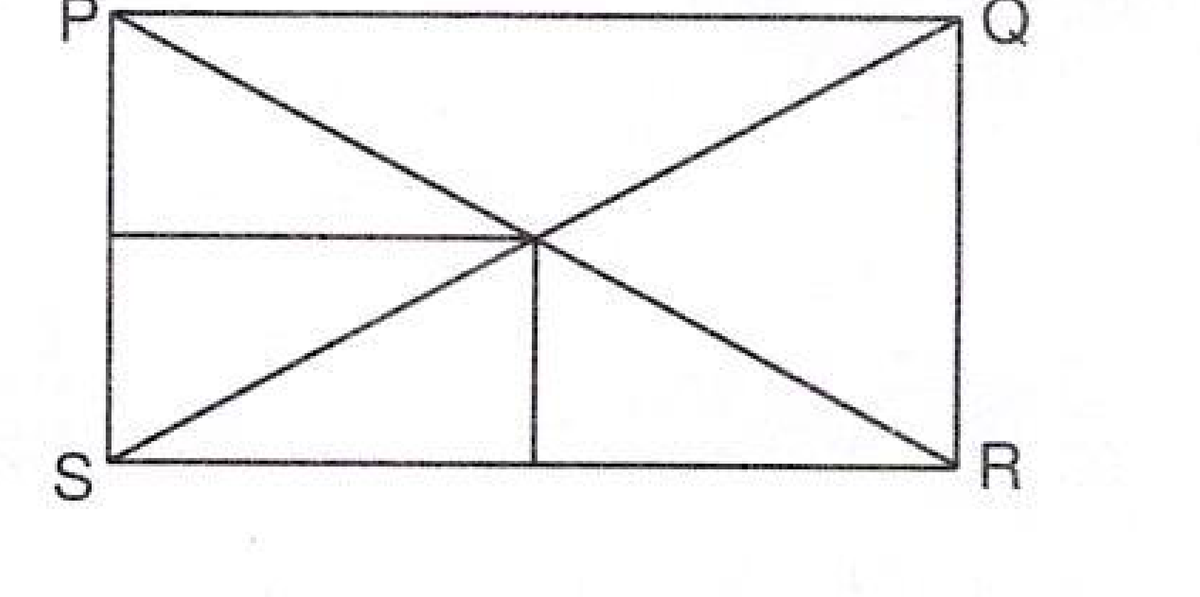
How many triangles are there in the following figure PQRS ?
- (a)10
- (b)16
- (c)12
- (d)18
Answer
Why
Correct: C, 12. Read the printed figure precisely first, because the whole question turns on how far the two extra lines run. Rectangle PQRS has both diagonals PR and QS, crossing at the centre O. A horizontal segment runs from M, the midpoint of the left side PS, rightward to O and stops there. A vertical segment runs from O downward to N, the midpoint of the bottom side SR, and stops there. Neither extra line crosses to the far side, so O, M and N are the only points added and the complete vertex list is P, Q, R, S, M, N, O: seven points, no other crossings anywhere. Now count in four disciplined groups instead of hunting by eye. (1) Each full diagonal cuts the rectangle into two halves: PR gives PQR and PRS, QS gives PQS and QRS: 4 triangles. (2) The two diagonals together carve four quadrant triangles around O, each standing on one full side: PQO on the top, QRO on the right, RSO on the bottom, PSO on the left: 4 more, running total 8. (3) The segment MO cuts the left quadrant PSO into PMO and SMO: 2 more, total 10. (4) The segment ON cuts the bottom quadrant RSO into SNO and RNO: 2 more, total 12. Nothing else qualifies: P–O–R and Q–O–S are straight lines, not triangles, and so are P–M–S and R–N–S. A full check of all 35 triples of the seven points confirms exactly these 12.
Why the others are wrong
- (a)10: Exactly what you get if you find one of the two subdivided quadrants and miss the other: most often you notice that MO splits the left quadrant into two, but overlook that ON splits the bottom quadrant the same way. Ten is the honest answer of a candidate who counted carefully but stopped one step early.
- (b)16: The count you reach if you misread the two extra lines as complete mid-lines running right across the rectangle. Drawing the full horizontal and full vertical through O splits all four quadrants instead of two, adding four small triangles rather than two, and the total becomes exactly 16. It is the wrong figure, correctly counted.
- (d)18: No reading of this figure produces 18: even the fully mid-lined version tops out at 16. It sits above the correct answer to catch the candidate who assumes a busy-looking diagram must contain more triangles than a careful count found, and who therefore inflates rather than re-checks.
Concept
Figure-counting questions look like a test of eyesight but are really a test of method. Any such figure reduces to a set of marked points and the straight segments drawn between them, and a triangle exists for every set of three points that are (i) pairwise joined by drawn line, and (ii) not all on one straight line. Once the point set is fixed, the count is finite and provable rather than a matter of squinting. The reliable technique in the examination hall is to build up by size: first the triangles that use whole sides and whole diagonals, then the ones formed as those large triangles are cut by internal lines. Counting largest-first also gives a natural check, since every small triangle should be a piece of a larger one you have already listed.
The single decisive observation is how far the two internal segments travel. In this figure they stop at the centre; the horizontal reaches O from the left side and goes no further, and the vertical drops from O to the bottom side and no further. That asymmetry is what makes the answer 12 rather than 16, and it is why the figure itself has to be seen: from the words 'two internal segments' alone, either count is defensible. With seven vertices there are only 35 possible triples, so the exhaustive method is genuinely doable on paper if you distrust your tally: strike out the four collinear triples (P–O–R, Q–O–S, P–M–S, R–N–S) and the triples whose three connecting segments are not all drawn, and 12 survive.
Key facts
- The complete vertex set is seven points: the four corners P, Q, R, S, the diagonal intersection O, and the two feet M (on PS) and N (on SR)
- The two diagonals of a rectangle bisect each other, so O is the centre and the four quadrant triangles PQO, QRO, RSO, PSO are equal in area
- The 12 triangles are PQR, PRS, PQS, QRS (halves); PQO, QRO, RSO, PSO (quadrants); PMO, SMO (left quadrant split by MO); SNO, RNO (bottom quadrant split by ON)
- Four triples of the seven points are collinear and must be excluded: P–O–R, Q–O–S, P–M–S and R–N–S
- Had both internal lines been full mid-lines crossing the rectangle, all four quadrants would split and the count would be 16: the source of option (b)
The two highlighted rows are the whole difference between 10, 12 and 16: only two of the four quadrants are subdivided, because each internal segment stops at the centre.
Study next
Common traps
- Assuming an internal line runs across the whole figure when it stops partway: here it is the difference between 12 and 16
- Counting only the smallest visible pieces and forgetting the large triangles built from whole sides and whole diagonals
- Counting the same triangle twice under two different letter orders, e.g. PMO and OMP
BPSC puts two or three purely diagrammatic reasoning items in Paper I and prints the figure itself, so the question cannot be attempted from the words alone: budget a minute and count in groups. UPSC prelims does not ask figure-counting at all in the General Studies paper; the nearest equivalent is in the CSAT qualifying paper, and even there the emphasis falls on data interpretation and logical reasoning rather than on counting shapes.
Related PYQs
No directly related past PYQ was found.
Practice
- practice, not a real PYQ
How many triangles are there in a rectangle in which both diagonals are drawn and no other line is added ?
- (a)4
- (b)6
- (c)8
- (d)10
Answer(c) 8: the four quadrant triangles around the centre plus the four half-rectangles cut off by each full diagonal. - practice, not a real PYQ
In a square, both diagonals and both mid-lines (joining the midpoints of opposite sides) are drawn. How many triangles does the figure contain ?
- (a)12
- (b)14
- (c)16
- (d)20
Answer(c) 16: the four half-figures, the four quadrants formed by the diagonals, and the eight smallest triangles produced when each quadrant is split by a mid-line.