
Which of the following radiation is used to get relief from body aches ?
- (a)Infra-red radiation
- (b)UV radiation
- (c)Visible radiation
- (d)None of these
Answer
Why
Correct: A, Infra-red radiation. Infrared occupies the band of the electromagnetic spectrum just beyond the red end of visible light, from roughly 700 nanometres to about a millimetre in wavelength, and its defining practical property is that biological tissue absorbs it and converts it directly into heat. An infrared lamp directed at a shoulder or a knee raises the temperature of the tissue a few millimetres below the skin; the local blood vessels dilate in response, blood flow to the area increases, muscle tone relaxes and the perception of pain falls. That is the entire basis of the infrared lamp used in physiotherapy departments, and of every heat pad and hot-water bottle applied to a sore back: infrared is simply the radiant version of the same therapy. The reason it is infrared and not one of the neighbouring bands is a matter of photon energy. Photon energy rises as wavelength falls, so infrared photons are too weak to break chemical bonds and can only set molecules vibrating, which is what heat is. Ultraviolet photons are energetic enough to damage DNA, which is why UV is used to kill microorganisms rather than to soothe muscles. Visible light lies between the two and passes through or scatters off tissue without depositing a useful amount of heat. Since option (a) is a real and standard clinical use, 'None of these' cannot stand.
Why the others are wrong
- (b)UV radiation: Ultraviolet has genuine medical uses, which is precisely why it is the tempting wrong answer: it sterilises water, air and instruments because its photons damage microbial DNA, and UV-B on the skin drives the synthesis of vitamin D. Neither is analgesia. In dose it is harmful, causing sunburn, cataract and skin cancer, and no one treats a sore muscle with it.
- (c)Visible radiation: Visible light, from about 400 to 700 nanometres, carries too little energy to affect molecular bonds and too little absorbed heat to warm tissue usefully; it is largely scattered or reflected at the skin. Its medical roles are in imaging, endoscopy and phototherapy for neonatal jaundice, not in pain relief.
- (d)None of these: Available only if all three named bands failed, and one of them plainly does not: the infrared lamp is standard physiotherapy equipment. Treat a 'None of these' option the way you would treat any universal claim: it requires every other option to be false, so a single confirmed true option destroys it.
Concept
The electromagnetic spectrum runs, in order of increasing wavelength and decreasing photon energy, from gamma rays and X-rays through ultraviolet, visible light and infrared to microwaves and radio waves. All travel at the speed of light in vacuum and differ only in wavelength and frequency, but that one difference determines everything about how each interacts with matter, and therefore what each is used for. The high-energy end is ionising: gamma rays and X-rays can knock electrons out of atoms and break DNA, which makes them both dangerous and useful: X-rays for imaging, cobalt-60 gamma rays for radiotherapy and sterilisation. Ultraviolet sits at the boundary, energetic enough to damage biological molecules but not to penetrate deeply. Infrared is absorbed as vibrational energy, that is, as heat. Microwaves excite water molecules, which is why they cook food. Radio waves pass through most matter and carry communication. Infrared was the first band to be discovered beyond the visible: William Herschel found it in 1800 by placing a thermometer just beyond the red edge of a prism's spectrum and observing that it registered the highest temperature of all.
The reliable way to answer any 'which radiation is used for X' question is to run down a short list of one-line associations rather than to reason from first principles under time pressure. Gamma: radiotherapy and sterilisation. X-ray: imaging bones and internal structures, and airport screening. Ultraviolet: sterilisation, vitamin D, and the ozone layer that absorbs it. Visible: sight and photosynthesis. Infrared: heating, thermal imaging, night vision, television remote controls, and the greenhouse effect, since it is infrared re-radiated from the Earth's surface that greenhouse gases trap. Microwave: cooking and radar. Radio: broadcasting and mobile telephony. Ten associations cover almost every question the paper can set. Notice that the same list also warns you off the trap here: 'UV is used in hospitals' is true but for a different purpose, and a candidate who has stored only the hospital association without the purpose will pick it. Store the purpose, not the setting.
Key facts
- Infrared spans roughly 700 nanometres to 1 millimetre in wavelength, immediately beyond the red end of visible light, and is absorbed by tissue as heat
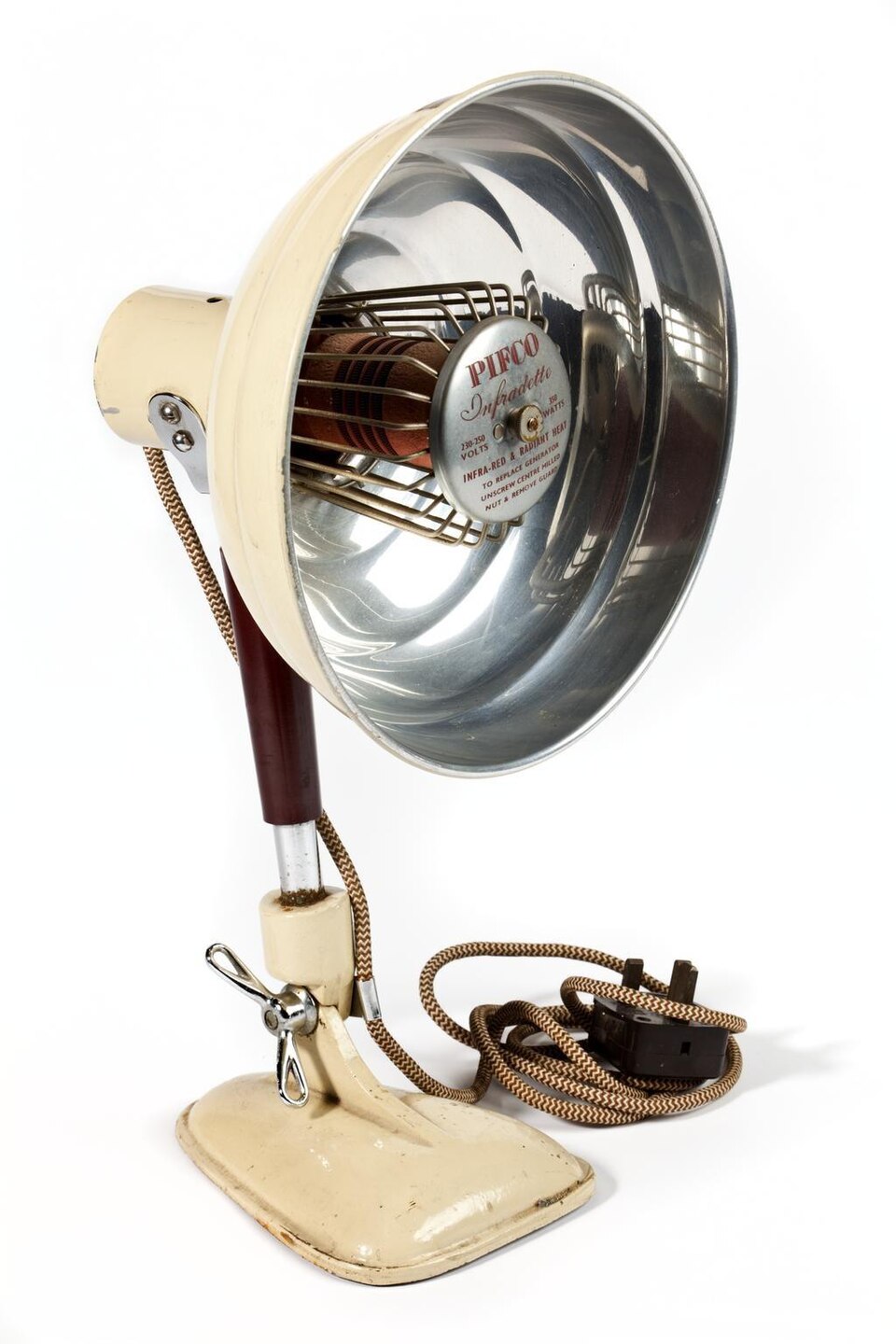
- Infrared lamps are standard physiotherapy equipment: they warm tissue a few millimetres deep, dilate local blood vessels, relax muscle and reduce pain
- Infrared was discovered by William Herschel in 1800, using a thermometer placed beyond the red edge of a prism's spectrum
- Ultraviolet's medical uses are sterilisation, because its photons damage microbial DNA, and vitamin D synthesis in skin, not analgesia
- Spectrum order by increasing wavelength: gamma, X-ray, ultraviolet, visible, infrared, microwave, radio; photon energy falls in the same direction
- Other infrared applications: thermal imaging and night vision, remote controls, infrared spectroscopy, and the trapping of outgoing terrestrial infrared by greenhouse gases
Study next
Common traps
- Picking UV because it has well-known medical uses; sterilisation and vitamin D are not pain relief
- Choosing 'None of these' when one option is a standard clinical practice: a universal negative needs every other option to fail
- Assuming longer wavelength means more energy; photon energy rises as wavelength falls, which is why UV damages tissue and infrared merely warms it
BPSC asks the electromagnetic spectrum as a one-line use-to-band match, and relies on candidates who have stored the band without the reason it works. UPSC asks the same physics indirectly (which glass blocks ultraviolet, which radiation cobalt-60 emits, whether red light is more energetic than green) so the UPSC version needs the wavelength-energy relationship itself, not just the application list.
Related PYQs
Assertion (A): In the visible spectrum of light, red light is more energetic than green light. Reason (R): The wavelength of red light is more than that of green light.
- (a) Both A and R are individually true and R is the correct explanation of A
- (b) Both A and R are individually true but R is not the correct explanation of A
- (c) A is true but R is false
- (d) A is false but R is true
Answer(d) A is false but R is true
The inverse relationship between wavelength and photon energy, tested directly: the same relationship that explains why infrared merely warms tissue while ultraviolet, at shorter wavelength, damages it.
Which one of the following types of glass can cut off ultraviolet rays?
- (a) Soda glass
- (b) Pyrex glass
- (c) Jena glass
- (d) Crookes glass
Answer(d) Crookes glass
The applied counterpart on the other side of the visible band: ultraviolet is the part of the spectrum you engineer materials to block, which is exactly why it is not the band you point at a sore muscle.
A photoelectric cell is a device which
- (a) converts light energy into electric energy
- (b) converts electric energy into light energy
- (c) stores light energy
- (d) None of the above
Answer(a) converts light energy into electric energy
Radiation converted into another form of energy, asked a year earlier: light into electricity there, radiant energy into heat here, and both items hinge on knowing what the radiation actually does when matter absorbs it.
Practice
- practice, not a real PYQ
Infrared radiation was discovered by
- (a)Wilhelm Roentgen
- (b)William Herschel
- (c)Johann Ritter
- (d)Heinrich Hertz
Answer(b) William Herschel: in 1800, by finding that a thermometer placed just beyond the red end of a prism's spectrum recorded the highest temperature. Ritter found ultraviolet the following year, Roentgen X-rays in 1895 and Hertz radio waves in the 1880s. - practice, not a real PYQ
Which of the following is arranged in order of INCREASING wavelength ?
- (a)Radio waves, infrared, visible light, X-rays
- (b)X-rays, ultraviolet, visible light, infrared
- (c)Infrared, visible light, ultraviolet, gamma rays
- (d)Visible light, ultraviolet, X-rays, radio waves
Answer(b) X-rays, ultraviolet, visible light, infrared: wavelength increases and photon energy falls in that direction, which is why X-rays ionise and infrared only heats.