
Which two words have been incorporated in the Preamble by 42nd Amendment ?
- (a)Republic and secular
- (b)Democratic and socialist
- (c)Secular and socialist
- (d)Socialist and sovereign
Answer
Why
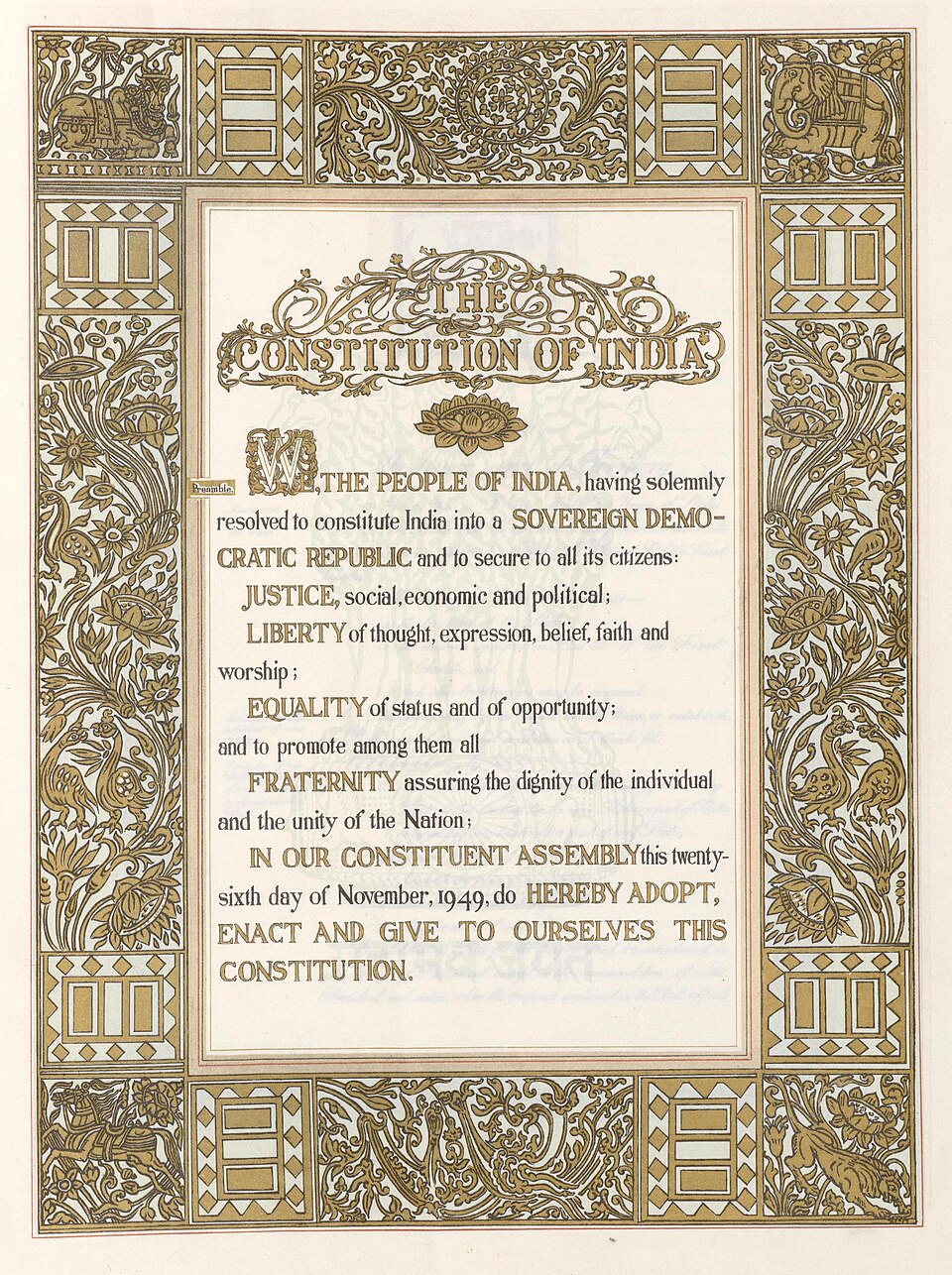
Correct: C, Secular and socialist. The Preamble as it now stands declares that the people of India resolved to constitute India into a 'SOVEREIGN SOCIALIST SECULAR DEMOCRATIC REPUBLIC', and the official text of the Constitution carries a footnote at exactly that point recording where the words came from: they were substituted by 'the Constitution (Forty-second Amendment) Act, 1976, s. 2, for "SOVEREIGN DEMOCRATIC REPUBLIC"', with effect from 3 January 1977. So the phrase in the Constitution adopted on 26 November 1949 was 'Sovereign Democratic Republic', and section 2 of the 42nd Amendment inserted SOCIALIST and SECULAR into the middle of it. That footnote settles the whole question, because it also tells you what was already there (Sovereign, Democratic and Republic) and every wrong option is built from one of those three. Section 2 made one further change to the Preamble that candidates routinely forget. It substituted 'unity and integrity of the Nation' for 'Unity of the Nation' in the fraternity clause, adding the word integrity. Three words were therefore added altogether (socialist, secular and integrity) but only two of them describe the character of the State, and it is those two the question asks for. The distinction matters, because a question phrased 'which three words' and a question phrased 'which two words' have different correct answers from the same amendment, and BPSC has asked both forms.
Why the others are wrong
- (a)Republic and secular: Republic and secular: half right, which is what makes each of these compound options dangerous. Secular was indeed inserted in 1976. Republic was not: it stood in the Preamble from the moment the Constitution was adopted on 26 November 1949, and it is the word that gives 26 January 1950 its name as Republic Day. An option is wrong if either of its two words fails, so this one falls on 'Republic' alone.
- (b)Democratic and socialist: Democratic and socialist: the mirror image of option (a). Socialist was added by the 42nd Amendment; Democratic was part of the original formula 'Sovereign Democratic Republic' from 1949. A candidate who remembers that one of the two words in this pair was inserted, and does not check the other, will mark it.
- (d)Socialist and sovereign: Socialist and sovereign: again one genuine addition paired with an original word, and arguably the least plausible of the three, because sovereignty is the founding claim of the entire document. A Constitution given by the people to themselves could hardly have waited twenty-seven years to describe the State as sovereign; the word opens the formula in the 1949 text.
Concept
The Preamble states the source of the Constitution's authority, the character of the State, the objectives it is to secure and the date of adoption, and it has been amended exactly once in seventy-five years. Its legal standing was settled in Kesavananda Bharati in 1973, where the Supreme Court held that the Preamble is part of the Constitution and can therefore be amended under Article 368, though not so as to damage the basic structure; the 42nd Amendment's change three years later is the only exercise of that power. The amendment itself is the largest in Indian constitutional history and is commonly called the mini-Constitution. Enacted during the Emergency, it inserted Part IVA carrying the Fundamental Duties in Article 51A (ten of them, the eleventh being added much later by the 86th Amendment in 2002) added new Directive Principles including Article 39A on equal justice and free legal aid, Article 43A on the participation of workers in the management of industries and Article 48A on the protection of the environment, and moved five subjects, among them education and forests, from the State List to the Concurrent List. A great deal of it was reversed by the 44th Amendment in 1978, but the Preamble change was not, which is why it remains the visible legacy of the 42nd.
Every option here pairs two words, and three of the four pair one genuine 1976 insertion with one word that was in the Preamble from the start. So the efficient method is not to recall what was added but to recall what was already there, and then test each word of each option against it. The original formula is three words long (Sovereign, Democratic, Republic) and that short string is far easier to hold than a list of amendments. Any option containing any of those three is wrong on that word alone, which kills (a) on 'Republic', (b) on 'Democratic' and (d) on 'Sovereign' in a single pass and leaves (c) standing without your ever having had to remember what the 42nd Amendment inserted. This subtractive habit is worth generalising to every compound-option question in polity: identify the smaller, more stable set and eliminate against it. Keep one further precision in reserve. The 42nd Amendment changed three words in the Preamble, not two, because it also added 'integrity' to the fraternity clause, so a stem asking for three words is a different question with a different answer.
Key facts
- The Preamble now reads 'SOVEREIGN SOCIALIST SECULAR DEMOCRATIC REPUBLIC'; the official footnote records that this was substituted by the Constitution (Forty-second Amendment) Act, 1976, section 2, for 'SOVEREIGN DEMOCRATIC REPUBLIC', with effect from 3 January 1977.
- The same section also substituted 'unity and integrity of the Nation' for 'Unity of the Nation', so the amendment added three words in all: socialist, secular and integrity.
- The Preamble was adopted on 26 November 1949 and the 42nd Amendment is the only occasion on which it has ever been amended.
- The 42nd Amendment was enacted during the Emergency and is known as the mini-Constitution: it inserted Part IVA and the Fundamental Duties in Article 51A (ten duties, the eleventh added by the 86th Amendment in 2002) and new Directive Principles including Articles 39A, 43A and 48A.
- It also transferred five subjects, including education and forests, from the State List to the Concurrent List; much of the amendment was undone by the 44th Amendment of 1978, but the Preamble change was not.
- In Kesavananda Bharati in 1973 the Supreme Court held that the Preamble forms part of the Constitution and is amendable under Article 368, subject to the basic structure, which is what made the 1976 change constitutionally possible.
Study next
Common traps
- Checking only one word of a compound option. Three of the four pairs here contain a genuine 1976 insertion alongside an original word, so half-recognition marks the wrong answer.
- Confusing 'which two words' with 'which three words'. The 42nd Amendment added socialist, secular and integrity, but only the first two describe the character of the State.
- Assuming 'Republic' was added because Republic Day marks 26 January 1950. The word was in the Preamble adopted on 26 November 1949; the date marks the Constitution's commencement, not the word's insertion.
BPSC asks the Preamble as a compound recall (two words, four pairings) and constructs the wrong options by combining one real insertion with one original word, so a candidate must verify both halves rather than recognise one. It also varies the count between editions, asking for two words in one paper and three in another. UPSC rarely asks which words were inserted; it asks what else the same amendment did, or what constitutional status the Preamble has, so the 42nd Amendment must be prepared as a whole rather than through the Preamble alone.
Related PYQs
The mind of the makers of the Constitution of India is reflected in which of the following?
- (a) The Preamble
- (b) The Fundamental Rights
- (c) The Directive Principles of State Policy
- (d) The Fundamental Duties
Answer(a) The Preamble
Why the Preamble is worth amending at all. UPSC keys it as the place where the mind of the makers of the Constitution is reflected, which is exactly the status that made inserting 'socialist' and 'secular' into it a political act rather than a drafting tidy-up.
The Ninth Schedule to the Indian Constitution was added by
- (a) First Amendment
- (b) Eighth Amendment
- (c) Ninth Amendment
- (d) Forty second Amendment
Answer(a) First Amendment
The same skill in reverse: attaching a constitutional change to the right amendment, with the 42nd printed as one of the wrong options. The Ninth Schedule came from the First Amendment, not the Forty-second, and a candidate who credits every large change to the mini-Constitution will be caught by exactly that assumption.
Consider the following statements regarding the 42nd Amendment to the Constitution of India : 1. It added three words to the Preamble—‘Socialist’, ‘Secular’ and ‘Integrity’. 2. It added eight Fundamental Duties to the Constitution. 3. It added new Directive Principles, i.e., Article 39A, Article 43A and Article 47. 4. It granted power to the President, in consultation with the Election Commission, to disqualify members of the State Legislatures. Which of the above statements are incorrect ?
- (a) 1 and 2
- (b) 3 and 4
- (c) 2 and 3
- (d) 1 and 4
Answer(c) 2 and 3
The 69th asked about the same amendment a year earlier and in the harder form, requiring candidates to identify which statements about it were incorrect. Its first statement (that three words were added to the Preamble, socialist, secular and integrity) is correct, which is precisely the 'three words, not two' precision this card warns about; and the statement that eight Fundamental Duties were added is false, because ten were.
Practice
- practice, not a real PYQ
Apart from inserting 'Socialist' and 'Secular', what other change did the 42nd Amendment make to the Preamble ?
- (a)It replaced 'Sovereign' with 'Sovereign Democratic'
- (b)It substituted 'unity and integrity of the Nation' for 'Unity of the Nation'
- (c)It added the words 'Justice, social, economic and political'
- (d)It changed the date of adoption
Answer(b) it substituted 'unity and integrity of the Nation' for 'Unity of the Nation': adding the word integrity to the fraternity clause. Together with socialist and secular, that makes three words added by section 2 of the amendment. - practice, not a real PYQ
Which one of the following was inserted into the Constitution by the 42nd Amendment ?
- (a)The Right to Property as a legal right
- (b)The Fundamental Duties in Part IVA
- (c)The Right to Education under Article 21A
- (d)The Tenth Schedule on anti-defection
Answer(b) the Fundamental Duties in Part IVA, Article 51A. The Right to Property was made a legal right by the 44th Amendment of 1978, Article 21A came with the 86th Amendment in 2002, and the Tenth Schedule with the 52nd Amendment in 1985.