
The meter that is used to measure the distance moved by the vehicle is known as
- (a)Speedometer
- (b)Ammeter
- (c)Odometer
- (d)Chronometer
Answer
Why
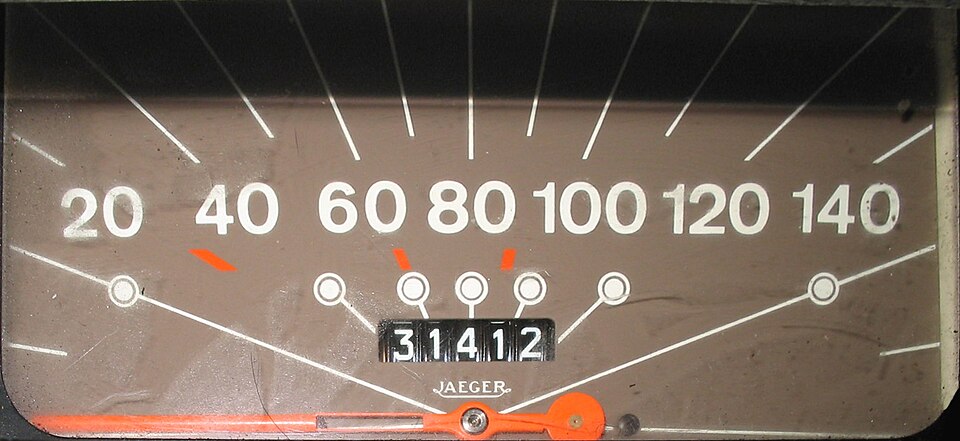
Correct: C, Odometer. The word is assembled from the Greek hodos, meaning a road or way, and metron, a measure (a road-measurer) and that is precisely its function: it counts the total distance a vehicle has covered and displays it, in India normally in kilometres, on the instrument cluster. The mechanism explains the name. A classical odometer is driven off the transmission or a wheel, and since each full rotation of a wheel carries the vehicle forward by exactly the circumference of its tyre, counting rotations and multiplying by that circumference gives distance. Modern vehicles do the same arithmetic electronically, with a sensor generating pulses that the cluster's processor counts. Two consequences of that design are examinable in their own right. First, fitting tyres of a different size changes the reading, because the calibration assumes a fixed circumference. Second, an odometer measures path length and not displacement: drive twenty kilometres out and twenty back, and your displacement is zero while the odometer has advanced by forty. Most vehicles in fact carry two: a main odometer that cannot normally be reset, which serves as the legal record of how much the vehicle has been used, and a resettable trip meter for measuring a single journey. The other three options are all real instruments in daily use, and each measures something entirely unrelated to distance, which is exactly what this question is checking.
Why the others are wrong
- (a)Speedometer: Speedometer: the instrument that sits immediately next to the odometer on the same cluster, which is why it is the trap. It measures the rate at which distance is being covered rather than the distance itself, and since speed is distance divided by time, the two instruments stand in the relation of a quantity to its rate of change. A driver reads the speedometer to answer 'how fast am I going right now' and the odometer to answer 'how far has this vehicle travelled in all'.
- (b)Ammeter: Ammeter: a contraction of ampere-meter, an instrument that measures electric current and is connected in series in a circuit so that the whole current passes through it. It belongs to the electricity chapter of the syllabus and has no connection with motion or distance. It appears on this list only because its name ends in the same suffix as the answer.
- (d)Chronometer: Chronometer: from the Greek chronos, time: a precision timekeeper rather than a distance measurer. It is worth remembering for its own sake, because the marine chronometer is what made longitude determinable at sea, a navigator comparing local noon with the time still shown for a reference meridian. That is a distance calculation of a kind, which is what gives the option a faint plausibility, but the instrument itself measures only time.
Concept
Almost every instrument in the school science syllabus announces what it measures in its own name, because the names are built from Greek and Latin roots joined to metron, a measure. Learning the roots converts a long memorisation list into a short one: hodos is a road, so an odometer measures distance travelled; tachys is swift, so a tachometer measures rotational speed in revolutions per minute; chronos is time, baros is weight and hence pressure, hygros is wet and hence humidity, anemos is wind, seismos is a shaking, and sphygmos is the pulse. The standard set an Indian examiner draws from is finite and recurs every year: odometer for distance, speedometer for instantaneous speed, tachometer for engine revolutions, ammeter for current, voltmeter for potential difference, galvanometer for very small currents, barometer for atmospheric pressure, manometer for gas pressure, hygrometer for humidity, anemometer for wind speed, thermometer and pyrometer for ordinary and very high temperatures, hydrometer for the relative density of a liquid, lactometer for the purity of milk, altimeter for altitude, fathometer for ocean depth, seismograph for earthquake waves, audiometer for hearing and sphygmomanometer for blood pressure.
Take the quantity named in the stem (distance moved by the vehicle) and then look for the option whose name contains that quantity, rather than trying to recall four definitions. Three of the four can be struck out on their roots alone. 'Speedometer' says speed, which is not distance. 'Ammeter' is ampere-meter and belongs to circuits. 'Chronometer' carries chronos and therefore measures time. Only 'odometer' carries hodos, the road, and that is the one the stem describes. Etymology is the cheapest reliable technique available on this entire family of questions, and it works even on instruments a candidate has never met. The one real difficulty here is the speedometer, and it is worth being deliberate about why: both instruments are on the same dashboard, both concern a vehicle in motion, and in ordinary conversation people do not distinguish carefully between how far and how fast. Fix the pair by their units. A speedometer reads in kilometres per hour and its value drops to zero the moment you stop; an odometer reads in kilometres and never goes down at all.
Key facts
- Odometer comes from the Greek hodos, a road or way, and metron, a measure; it records the cumulative distance a vehicle has travelled.
- It works by counting rotations of a wheel or of the transmission, each rotation corresponding to the tyre's circumference, which is why fitting tyres of a different size alters the reading.
- It measures path length rather than displacement: a journey out and back leaves displacement at zero while the odometer records the whole distance covered.
- Vehicles usually carry two, a main odometer that cannot normally be reset and serves as the record of the vehicle's use, and a resettable trip meter for a single journey.
- The three instruments most easily confused on the same cluster measure three different things: the speedometer gives instantaneous speed in kilometres per hour, the odometer gives total distance in kilometres, and the tachometer gives the engine's rotational speed in revolutions per minute.
- The other options belong elsewhere entirely: an ammeter measures electric current in amperes and is connected in series in a circuit, while a chronometer is a precision timekeeper, historically the instrument that made longitude determinable at sea.
Study next
Common traps
- Choosing the speedometer because it is the instrument a driver actually watches. It reads speed in kilometres per hour; the odometer reads distance in kilometres.
- Assuming an odometer records displacement. It records path length, so an out-and-back journey adds to it even though the vehicle finishes where it started.
- Being drawn by the shared '-meter' suffix. Ammeter and chronometer end the same way and measure current and time respectively.
BPSC asks the instrument list as a bare definitional one-liner and builds the options from other instruments ending in the same suffix, with one of them (here the speedometer) measuring a quantity closely related to the one asked about, so the distinction has to be exact rather than approximate. UPSC very rarely asks a bare definition; it asks instead which instrument would detect a stated phenomenon, or what a change in an instrument's reading implies, so the same list has to be known as a set of uses and not only as a set of names.
Related PYQs
106. Which one of the following can be used to confirm whether drinking water contains a gamma-emitting isotope or not?
- (a) Microscope
- (b) Lead plate
- (c) Scintillation counter
- (d) Spectrophotometer
Answer(c) Scintillation counter
The same skill applied to an unfamiliar instrument: state the measurement to be made and pick the device that makes it. A candidate who works from what each instrument is for, rather than from which name looks scientific, answers both questions the same way.
Which of the following weather conditions is indicated by a sudden fall in barometer reading?
- (a) Stormy weather
- (b) Calm weather
- (c) Cold and dry weather
- (d) Hot and sunny weather
Answer(a) Stormy weather
Instruments examined one step further on, through what a reading means rather than what the device is called. Knowing that a barometer measures atmospheric pressure is only the start; the mark comes from knowing what a falling reading indicates. UPSC habitually asks the instrument list in that applied form.
Practice
- practice, not a real PYQ
The instrument used to measure the rotational speed of an engine, in revolutions per minute, is the
- (a)odometer
- (b)tachometer
- (c)speedometer
- (d)hydrometer
Answer(b) tachometer: from the Greek tachys, swift. The odometer measures distance travelled, the speedometer the vehicle's speed over the ground, and the hydrometer the relative density of a liquid. - practice, not a real PYQ
Which one of the following instruments is used to measure atmospheric pressure ?
- (a)Hygrometer
- (b)Anemometer
- (c)Barometer
- (d)Lactometer
Answer(c) Barometer: from the Greek baros, weight. A hygrometer measures humidity, an anemometer wind speed, and a lactometer the purity of milk by its density.