
Who gave the slogan “DO OR DIE” and when ?
- (a)Subhash Chandra Bose during Quit India Movement
- (b)Jawahar Lal Nehru during Non-cooperation Movement
- (c)Gandhiji during Quit India Movement
- (d)More than one of the above
Answer
Why
Correct: C, Gandhiji during Quit India Movement. The words are Gandhi's and the occasion is fixed to a single day: 8 August 1942, when he addressed the All India Congress Committee at Bombay, the session that adopted the Quit India resolution. The passage reads: 'Here is a mantra, a short one, that I give you. You may imprint it on your hearts and let every breath of yours give expression to it. The mantra is: Do or Die. We shall either free India or die in the attempt; we shall not live to see the perpetuation of our slavery.' The speech was delivered in Hindustani, so the phrase as it was actually spoken is karo ya maro, and 'Do or Die' is the English rendering that has passed into the textbooks. In the early hours of the following morning, 9 August, Gandhi and effectively the whole Congress leadership were arrested and the Congress was declared unlawful, which is why the movement that followed ran without its leaders and turned more violent than any Gandhian campaign before it. Every option here bundles a person with a movement, and both halves must hold. Naming Gandhi is not enough on its own, because Gandhi also led the Non-Cooperation Movement of 1920 to 1922 and the Civil Disobedience Movement that began with the Dandi March in 1930, and the 'Do or Die' call belongs to neither of them. UPSC has asked this exact discrimination, giving four movements and requiring the candidate to attach the slogan to Quit India rather than to the other three.
Why the others are wrong
- (a)Subhash Chandra Bose during Quit India Movement: Subhash Chandra Bose during Quit India Movement: the movement half is right and the person half is impossible, which is what makes this the most dangerous option on the list. Bose escaped from India in January 1941, more than eighteen months before the Quit India resolution, and spent the whole of the movement outside the country, first in Germany and afterwards in Southeast Asia, where he took command of the Indian National Army in 1943. His own calls are famous and quite different in register: 'Give me blood and I will give you freedom', 'Chalo Delhi' and 'Jai Hind', and none of them is 'Do or Die'.
- (b)Jawahar Lal Nehru during Non-cooperation Movement: Jawahar Lal Nehru during Non-cooperation Movement: wrong in both halves at once, which makes it the weakest option even though it names two of the most familiar items in the syllabus. The Non-Cooperation Movement of 1920 to 1922 was Gandhi's, adopted by the Congress at the Nagpur session and called off by Gandhi himself after the violence at Chauri Chaura in February 1922. Nehru took part in it; he did not author it, and he gave no slogan of this kind either then or later.
- (d)More than one of the above: More than one of the above: this option is correct only when at least two of the three preceding pairings are true at the same time, so it must be settled by counting rather than by instinct. Option (a) has the right movement and the wrong person, option (b) has both wrong, and option (c) has both right. That is exactly one true pairing out of three, which is not more than one, so the option fails on arithmetic before any question of history arises.
Concept
The Quit India Movement grew out of a specific war-time collapse of trust. The Cripps Mission of March and April 1942 offered dominion status after the war and was rejected; Japanese forces had taken Singapore in February and Rangoon in March and were on India's eastern doorstep; and confidence that Britain could either defend India or concede anything meaningful had drained away. Against that background the All India Congress Committee met at Bombay on 8 August 1942 and passed the Quit India resolution, and Gandhi's speech to it carried the 'Do or Die' mantra. The Government moved before dawn on 9 August, arresting Gandhi, Nehru, Patel, Azad and the entire Congress Working Committee and outlawing the organisation, so the movement was leaderless from its first day. What followed was therefore improvised and often violent: strikes, sabotage of railways and telegraph lines, and in several districts short-lived parallel governments: at Ballia in the United Provinces, at Tamluk in Midnapore and at Satara in Maharashtra, the last of which survived longest. Leadership fell to those who had escaped the net, among them Jayaprakash Narayan, Ram Manohar Lohia, Aruna Asaf Ali and Usha Mehta of the underground Congress Radio.
Treat every option as two claims joined by 'during', and reject the whole option if either claim fails. That discipline is what this question is really testing, because the option list has been built so that a candidate who checks only one half can be caught twice over. Option (a) offers the right movement with the wrong man; option (b) offers the wrong man with the wrong movement; only (c) survives both checks. The chronology is the sharpest tool for option (a): Bose had left India in January 1941, so he was not present at any point of a movement launched in August 1942, and a slogan cannot be given at a meeting one is not at. Then apply the counting rule to option (d), which is correct only when two or more of the earlier options are simultaneously true. Finally, keep the slogans of the freedom struggle as a table rather than as loose phrases, because examiners pair them at random: 'Do or Die' with Gandhi and Quit India, 'Give me blood and I will give you freedom' and 'Chalo Delhi' and 'Jai Hind' with Bose, 'Swaraj is my birthright' with Tilak, and 'Inquilab Zindabad' with Bhagat Singh and the Hindustan Socialist Republican Association.
Key facts
- Gandhi gave the 'Do or Die' call on 8 August 1942 while addressing the All India Congress Committee at Bombay, the session that adopted the Quit India resolution.
- His words were: 'The mantra is: Do or Die. We shall either free India or die in the attempt; we shall not live to see the perpetuation of our slavery.' The speech was delivered in Hindustani, so karo ya maro is the original phrase.
- Gandhi, Nehru, Patel, Azad and the whole Congress Working Committee were arrested in the pre-dawn hours of 9 August 1942 and the Congress was declared unlawful, leaving the movement without its leadership from day one.
- The immediate triggers were the failure of the Cripps Mission in March and April 1942 and the Japanese advance that had taken Singapore in February and Rangoon in March of the same year.
- Short-lived parallel governments emerged at Ballia in the United Provinces, Tamluk in Midnapore and Satara in Maharashtra, while Jayaprakash Narayan, Ram Manohar Lohia, Aruna Asaf Ali and Usha Mehta led what remained of the movement underground.
- Subhas Chandra Bose, named in option (a), had left India in January 1941 and was abroad throughout; he took command of the Indian National Army in Southeast Asia in 1943 and his own battle cry was 'Chalo Delhi'.
Study next
Common traps
- Checking only the person and stopping. Option (a) names the correct movement, and a candidate who reads 'Quit India' and moves on will mark it.
- Forgetting that Bose was outside India from January 1941 onwards. He could not have addressed a meeting held in Bombay in August 1942.
- Treating 'More than one of the above' as a hedge. It requires at least two of the earlier options to be true together, and here exactly one is.
BPSC asks freedom-struggle slogans as compound options that fuse a person with a movement, so a half-check marks the wrong answer, and it closes the list with 'More than one of the above' to catch a candidate who cannot decide. UPSC asks the same fact stripped down, which movement is the slogan 'Do or die' associated with, or which episode produced a particular Gandhi utterance: testing the pairing directly rather than through a person. Either way the preparation is the same table of quotation, speaker, occasion and year.
Related PYQs
With which one of the following movements is the slogan “Do or die” associated?
- (a) Swadeshi Movement
- (b) Non-Cooperation Movement
- (c) Civil Disobedience Movement
- (d) Quit India Movement
Answer(d) Quit India Movement
The same fact asked from the opposite end. UPSC gives the slogan and asks for the movement; BPSC gives the movement options and asks for the person and the movement together. Anyone who has stored 'Do or Die' as belonging to Quit India answers both, and the wrong options in the UPSC version are the other Gandhian movements that this card warns against.
"Sedition has become my religion" was the famous statement given by Gandhiji at the time of
- (a) the Champaran Satyagraha
- (b) publicly violating Salt Law at Dandi
- (c) attending the Second Round Table Conference in London
- (d) the launch of the Quit India Movement
Answer(b) publicly violating Salt Law at Dandi
The same skill applied to a different Gandhi utterance, and with Quit India planted as the decoy. Attaching a famous line to the right episode of the freedom struggle is a recurring UPSC demand, and the discipline it requires (quotation, speaker, occasion, year, all four together) is exactly what this question needs.
Who assumed the command of the Indian National Army and gave famous battle cry, 'Chalo Delhi'?
- (a) Rash Behari Bose
- (b) Mohan Singh
- (c) Shah Nawaz Khan
- (d) Subhash Chandra Bose
Answer(d) Subhash Chandra Bose
The direct answer to what option (a) gets wrong, asked by BPSC the following year. Bose's famous call was 'Chalo Delhi', given when he took command of the Indian National Army, not 'Do or Die', and not in India during 1942. Read together, the two papers separate the two leaders' slogans cleanly.
The Quit India Movement in 1942 witnessed significant contributions from leaders of Bihar. Which prominent Bihar leader was known as the ‘Bihar Kesari’ and actively participated in the Quit India Movement?
- (a) Dr. Rajendra Prasad
- (b) Shri Krishna Singh
- (c) Anugrah Narayan Sinha
- (d) Ram Manohar Lohia
Answer(b) Shri Krishna Singh
The 69th examined the same movement through its Bihar leadership, asking which Bihar figure of the 1942 struggle was known as 'Bihar Kesari'. BPSC returns to Quit India repeatedly and approaches it from both ends: the all-India slogan and the state's own participants, so both need preparing.
Practice
- practice, not a real PYQ
The Quit India Resolution was adopted by the All India Congress Committee on
- (a)26 January 1930
- (b)8 August 1942
- (c)9 August 1942
- (d)15 August 1947
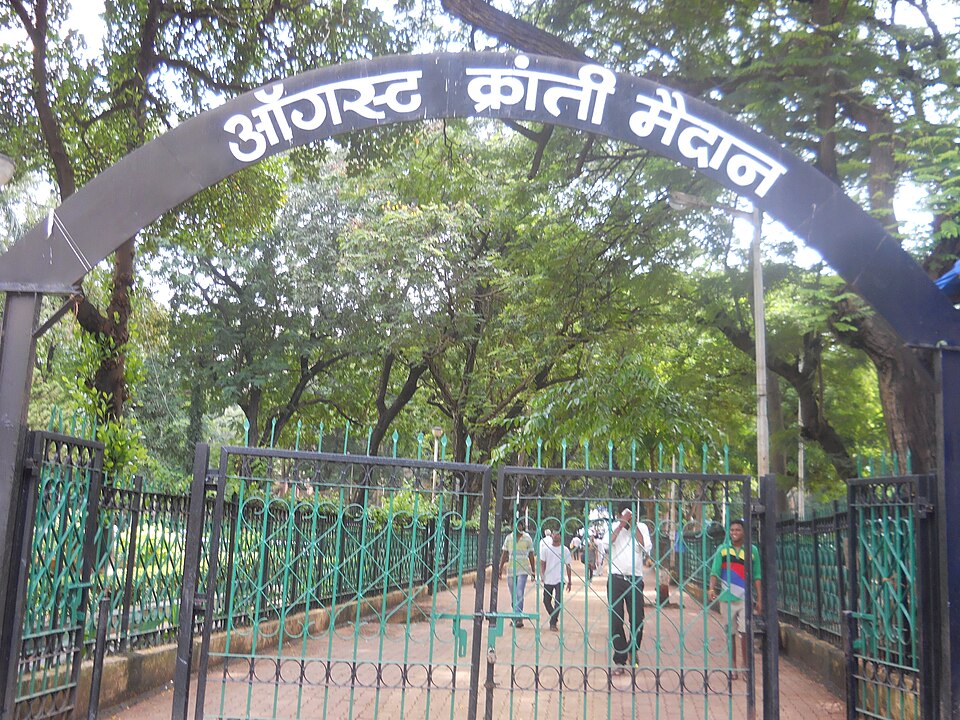
Answer(b) 8 August 1942, at Bombay. 9 August is the date of the mass arrests that followed in the early hours of the next morning, and it is observed as August Kranti Day, which is why option (c) is the sharpest decoy. - practice, not a real PYQ
The Quit India Movement was launched immediately after the failure of
- (a)the Simon Commission
- (b)the Cripps Mission
- (c)the Cabinet Mission
- (d)the Wavell Plan
Answer(b) the Cripps Mission of March-April 1942. The Cabinet Mission came in 1946 and the Wavell Plan in 1945, both after Quit India, and the Simon Commission belongs to 1927-28.