
Which of the following is equivalent to tesla ?
- (a)Newton per Coulomb
- (b)Ampere per Newton
- (c)Newton per ampere meter
- (d)Newton per ampere-second
Answer
Why
Correct: C, Newton per ampere meter. The tesla is the SI unit of magnetic flux density, and the fastest way to derive it is from the force on a current-carrying conductor in a magnetic field, F = BIL. Rearranged, B = F/(IL), so the unit of B is the newton divided by the product of an ampere and a metre: newton per ampere metre, N/(A·m). The same result comes out of the Lorentz force on a moving charge, F = qvB, since B = F/(qv) gives newtons divided by coulomb-metres-per-second, and a coulomb per second is an ampere, so it reduces to N/(A·m) again. In base units the tesla is kg·s⁻²·A⁻¹, and it is equally often written as one weber per square metre. There is a second, purely logical route to the answer that does not need any of that physics, and it is worth seeing because it is the kind of observation that saves a mark under time pressure: one coulomb is one ampere-second, so 'newton per coulomb' and 'newton per ampere-second' in options (a) and (d) are the very same unit written two ways. A well-set question has one correct option, so two options that are identical must both be wrong, which eliminates half the list at a stroke. What that shared unit actually measures is electric field strength, not magnetic flux density. Option (b), ampere per newton, is not a standard unit of anything.
Why the others are wrong
- (a)Newton per Coulomb: The unit of electric field strength, equivalently the volt per metre: it measures the force on a unit of charge at rest, not on a moving charge or a current. It is the most familiar 'newton per something' in electromagnetism, which is precisely why it is offered first.
- (b)Ampere per Newton: Not the unit of any standard physical quantity. It is the tesla's own combination turned upside down and stripped of the metre, so it looks like it belongs on the list without corresponding to anything measurable.
- (d)Newton per ampere-second: Identical to option (a), because one ampere-second is one coulomb, so this too is the unit of electric field, not of magnetic flux density. Two options expressing the same unit is a strong signal that neither is the answer, and the missing factor in both is the metre.
Concept
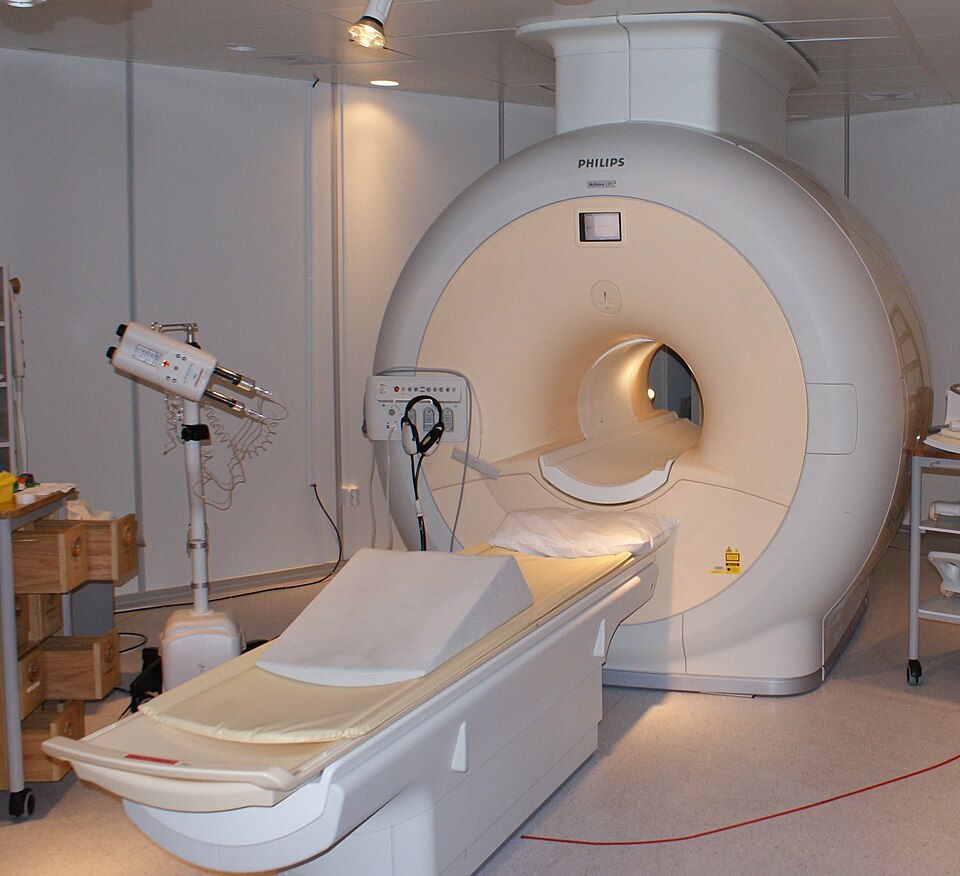
Magnetic flux density B, sometimes loosely called magnetic field strength, is defined by the force a magnetic field exerts on moving charge. Two standard expressions define it: F = BIL for a straight conductor of length L carrying current I at right angles to the field, and F = qvB for a single charge q moving with velocity v. Either gives the tesla as newton per ampere metre. The unit was named after Nikola Tesla and adopted into the SI in 1960; the older CGS unit, the gauss, equals one ten-thousandth of a tesla, which tells you how large a tesla is. For scale, the Earth's own magnetic field at the surface is only about 25 to 65 microtesla, a small refrigerator magnet is of the order of a few millitesla, and a clinical magnetic resonance imaging scanner runs at 1.5 or 3 tesla, which is why the machine's field strength is quoted in teslas in hospital literature. Keep the companion quantities straight: magnetic flux is measured in webers, and one tesla is one weber per square metre; electric field is measured in newtons per coulomb, equivalently volts per metre.
Unit questions are best answered by deriving rather than recalling, because a derivation is checkable and a memory is not. Write down the defining equation, rearrange for the quantity you want and read off the units. Here F = BIL gives B = F/(IL) in a single line, and the metre in the denominator is the whole difference between the answer and the distractors: every wrong option omits the length. That is the general shape of a units trap: the wrong options usually differ from the right one by exactly one factor, not by something wild. The second habit this question rewards is scanning the option list for redundancy before starting. If two options reduce to the same thing, as newton per coulomb and newton per ampere-second do once you remember that a coulomb is an ampere-second, then neither can be the unique correct answer, and you are down to a fifty-fifty before doing any physics at all. Between the two survivors, ampere per newton has no metre and no plausible defining equation behind it, so newton per ampere metre stands.
Key facts
- The tesla (T) is the SI unit of magnetic flux density; from F = BIL, B = F/(IL), so 1 T = 1 N/(A·m)
- Equivalent forms: 1 T = 1 weber per square metre = 1 volt-second per square metre = 1 kg·s⁻²·A⁻¹
- One coulomb equals one ampere-second, so newton per coulomb and newton per ampere-second are the same unit: the unit of electric field, equivalently the volt per metre
- The unit is named after Nikola Tesla and was adopted into the SI in 1960; the older CGS unit, the gauss, equals 10⁻⁴ tesla
- The Earth's surface magnetic field is roughly 25 to 65 microtesla, while a clinical MRI scanner typically operates at 1.5 or 3 tesla
- The Lorentz force on a moving charge, F = qvB, gives the same unit: newton divided by coulomb-metre-per-second reduces to newton per ampere metre
Study next
Common traps
- Choosing newton per coulomb, which is the unit of electric field, not magnetic flux density
- Dropping the metre; every wrong option in this list differs from the answer by exactly that factor
- Not noticing that two options are the same unit, since one coulomb equals one ampere-second: a redundancy that rules both of them out
BPSC asks units and constants as bare one-line identifications with symbolic options, and this cluster (the ohm, the tesla, the joule, the siemens) recurs across editions, so a short table of derived units with their defining equations is the efficient preparation. UPSC rarely asks a unit outright; it asks the physics the unit belongs to, such as what a Nobel-winning imaging technique was, or which statements about the Earth's magnetic field are correct.
Related PYQs
The research work of Paul Lauterbur and Peter Mansfield, the Nobel Prize winners for Medicine in 2003, relates to
- (a) The control of AIDS
- (b) Magnetic resonance imaging
- (c) Respiratory diseases
- (d) Genetic engineering
Answer(b) Magnetic resonance imaging
The application in which the tesla is a household number: an MRI scanner is specified by its field strength in teslas, which is what makes this unit worth knowing outside a physics class.
Consider the following statements : 1. The axis of the earth’s magnetic field is inclined at 23 ½° to the geographic axis of the earth. 2. The earth’s magnetic pole in the northern hemisphere is located on a peninsula in northern Canada. 3. Earth’s magnetic equator passes through Thumba in South India. Which of the statements given above is/are correct?
- (a) 1, 2 and 3
- (b) 2 and 3
- (c) 2 only
- (d) 3 only
Answer(b) 2 and 3
The same physical quantity at planetary scale: the Earth's magnetic field, whose flux density of a few tens of microtesla gives the tesla its sense of scale.
Energy consumed in a home is 250 units then the total energy in Joule will be :
- (a) 9×10⁵
- (b) 8×10⁶
- (c) 9×10⁸
- (d) 10⁵
Answer(c) 9×10⁸
The Commission's steady interest in SI units on the next paper, tested by conversion rather than by definition: the same requirement to know exactly what a named unit stands for.
Practice
- practice, not a real PYQ
One tesla is equivalent to
- (a)One weber per square metre
- (b)One weber per metre
- (c)One volt per metre
- (d)One joule per coulomb
Answer(a) One weber per square metre: magnetic flux density is flux per unit area; volt per metre is the unit of electric field and joule per coulomb is the volt. - practice, not a real PYQ
The CGS unit gauss is related to the SI unit tesla as
- (a)1 gauss = 10⁴ tesla
- (b)1 gauss = 10⁻⁴ tesla
- (c)1 gauss = 10² tesla
- (d)1 gauss = 1 tesla
Answer(b) 1 gauss = 10⁻⁴ tesla, which is why the Earth's field of a few tens of microtesla is conveniently written as a fraction of a gauss.