
The sikh pilgrimage site “TAKHAT SRI HARIMANDIR JI PATNA SAHIB” which is considered as the second holiest Takhat is located at
- (a)Bhagalpur
- (b)Gaya
- (c)Patna
- (d)More than one of the above
Answer
Why
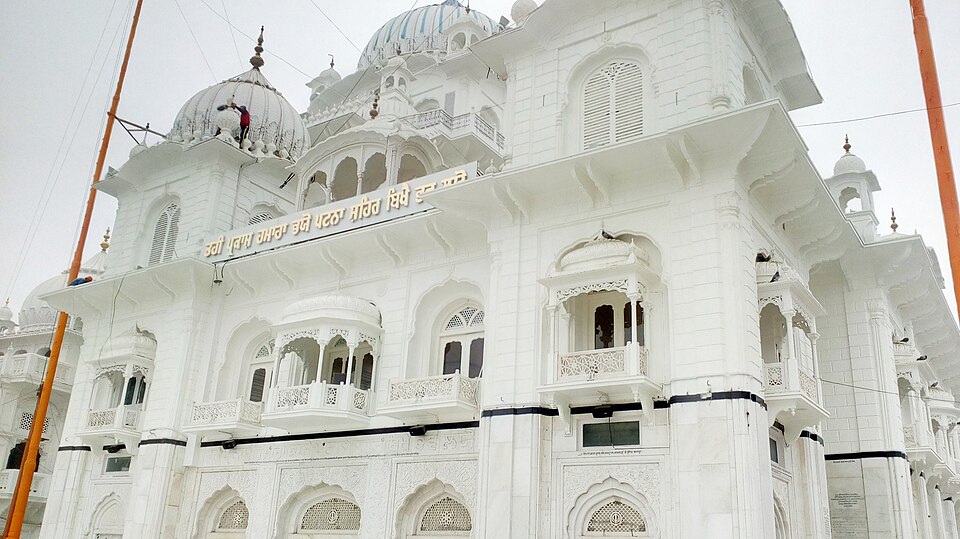
Correct: C, Patna. Takht Sri Harimandir Ji stands in Patna City, in the eastern part of Patna, Bihar, on the site where the tenth Sikh Guru, Guru Gobind Singh, was born on 22 December 1666. He spent his early childhood in Patna before the family moved to Anandpur Sahib, which is why the shrine is counted among the five Takhts (the seats of Sikh temporal authority) and why Sikhs across the world know Patna by the name Patna Sahib. The present building was not raised by the Sikh community of Bihar but commissioned in the nineteenth century by Maharaja Ranjit Singh of Lahore; it was damaged in the great earthquake of 1934 and rebuilt between 1948 and 1957 at a cost of about ₹20 lakh. The other two Bihar cities on the list are famous for other traditions entirely: Bhagalpur for silk and for the ruins of Vikramshila at Antichak, near Kahalgaon in the same district, Gaya for the Vishnupad temple and for Bodh Gaya, where the Buddha attained enlightenment, and neither has ever held a Takht. On the stem's own description, 'second holiest', treat it as the paper's characterisation rather than a formal ranking: what is settled is that Patna Sahib is one of the five Takhts, that the Akal Takht at Amritsar is the supreme seat, and that the other three are Keshgarh Sahib at Anandpur Sahib and Damdama Sahib at Talwandi Sabo, both in Punjab, and Hazur Sahib at Nanded in Maharashtra. Note too that the stem contains its own answer: the shrine's name ends in 'Patna Sahib', which is worth spotting when the clock is running.
Why the others are wrong
- (a)Bhagalpur: A major Bihar city on the south bank of the Ganga, known for its tussar silk and as the district that holds the Vikramshila ruins at Antichak, near Kahalgaon, and it gives its name to the Vikramshila Gangetic Dolphin Sanctuary. It has no Takht and no association with Guru Gobind Singh's birth.
- (b)Gaya: Bihar's great pilgrimage city, but for two other traditions: the Vishnupad temple and the pind-daan rites for ancestors, and Bodh Gaya nearby, where the Buddha attained enlightenment under the Bodhi tree. Its fame as a place of pilgrimage is exactly what makes it a plausible-looking wrong answer here.
- (d)More than one of the above: This option is correct only when at least two of the other three are simultaneously true, and a single building has a single address. Takht Sri Harimandir Ji stands at one site in Patna City; no part of it is at Bhagalpur or Gaya, so only one of the three cities can be right and this option cannot be.
Concept
A takht, literally a throne, is a seat of temporal authority in Sikhism, from which decisions binding on the community (hukamnamas) may be issued. There are five. The Akal Takht at Amritsar, established by the sixth Guru, Hargobind, is the supreme seat and sits directly opposite the Harmandir Sahib. Takht Sri Keshgarh Sahib at Anandpur Sahib in Punjab marks the founding of the Khalsa in 1699. Takht Sri Damdama Sahib at Talwandi Sabo in Bathinda district, Punjab, is where Guru Gobind Singh prepared the final recension of the Guru Granth Sahib. Takht Sri Hazur Sahib at Nanded in Maharashtra marks the place where he died in 1708. And Takht Sri Harimandir Ji at Patna Sahib marks his birth in 1666. So the five Takhts trace the life of the tenth Guru almost end to end, and two of the five lie outside Punjab: one in Bihar, one in Maharashtra, which is the fact this question is really testing.
Two routes get you there and both are quick. The first is that the answer is embedded in the question: the shrine's own name is 'Patna Sahib', and BPSC's Bihar questions often carry their answer in a place-name inside the stem. The second is elimination by tradition. Bihar's religious geography divides cleanly (Bodh Gaya and Rajgir and Nalanda for Buddhism, Pawapuri for Jainism, Gaya and Sitamarhi for Hindu pilgrimage, Patna Sahib for Sikhism) and Bhagalpur belongs to none of those circuits. The fourth option deserves a deliberate habit rather than a guess. 'More than one of the above' is a claim about the other options, not about the world: it is right only when you can name at least two of them that are true at the same time. Test it that way every time it appears. Here the test fails immediately, because a shrine cannot stand in two cities, so the option is dead the moment you understand what it asserts.
Key facts
- Takht Sri Harimandir Ji, Patna Sahib, is in Patna City, Patna district, Bihar, on the birthplace of Guru Gobind Singh, born 22 December 1666
- The present shrine was commissioned in the nineteenth century by Maharaja Ranjit Singh; damaged in the 1934 earthquake, it was rebuilt between 1948 and 1957 at a cost of about ₹20 lakh
- The five Takhts are Akal Takht (Amritsar), Keshgarh Sahib (Anandpur Sahib), Damdama Sahib (Talwandi Sabo, Bathinda) (all in Punjab) plus Patna Sahib (Bihar) and Hazur Sahib (Nanded, Maharashtra)
- The Akal Takht at Amritsar is the supreme seat of Sikh temporal authority; the takhts issue hukamnamas binding on the community
- Guru Gobind Singh spent his early years at Patna before the family moved to Anandpur Sahib in Punjab
- Bhagalpur is known for tussar silk and the Vikramshila Gangetic Dolphin Sanctuary; Gaya for the Vishnupad temple and for Bodh Gaya: neither city holds a Takht
Study next
Common traps
- Picking Gaya because it is Bihar's best-known pilgrimage city: its shrines are Hindu and Buddhist, not Sikh
- Reaching for 'More than one of the above' without testing it; the option is right only when at least two other options are true at the same time
- Assuming all the Takhts are in Punjab: two of the five, Patna Sahib and Hazur Sahib, are not
BPSC keeps returning to Bihar's places of worship and asks them as flat location questions (which district, which city, which tradition) and it now attaches its house fourth option 'More than one of the above' to many of them, so the candidate has to judge an option about the options as well as the fact. UPSC does not ask where a shrine stands; it asks about the tradition behind it, such as which Guru compiled the Adi Granth or which Guru founded the Khalsa.
Related PYQs
Consider the following statements about Sikh Gurus: 1. Banda Bahadur was appointed as the military leader of the Sikhs by Guru Tegh Bahadur. 2. Guru Arjun Dev became the Sikh Guru after Guru Ram Das. 3. Guru Arjun Dev gave to Sikhs their own script – Guru mukhi. Which of the statements given above is/are correct?
- (a) 1 only
- (b) 2 and 3
- (c) 1 and 3
- (d) 1 and 2
Answer(b) 2 and 3
The same tradition approached through its Gurus rather than its seats: the succession and the institutions that produced the five Takhts, one of which stands on Guru Gobind Singh's birthplace at Patna.
Which one of the following pairs is correctly matched?
- (a) Guru Amar Das … Miri and Piri
- (b) Guru Arjan Dev … Adi Granth
- (c) Guru Ram Das … Dal Khalsa
- (d) Guru Gobind Singh … Manji
Answer(b) Guru Arjan Dev … Adi Granth
Pairs each Guru with the institution he founded: the doctrine of miri and piri, temporal alongside spiritual authority, is precisely what a takht embodies, and Guru Gobind Singh appears among the options.
Which Buddhist council was not held in Bihar?
- (a) First
- (b) Second
- (c) Third
- (d) Fourth
Answer(d) Fourth
The Commission's recurring interest in placing a religious tradition's landmark on the Bihar map: the same skill, applied there to Buddhism's councils and here to Sikhism's Takht.
Practice
- practice, not a real PYQ
Which of the following Takhts of Sikhism is located in Maharashtra ?
- (a)Takht Sri Keshgarh Sahib
- (b)Takht Sri Damdama Sahib
- (c)Takht Sri Hazur Sahib
- (d)Akal Takht
Answer(c) Takht Sri Hazur Sahib: at Nanded, where Guru Gobind Singh died in 1708; the other three are in Punjab. - practice, not a real PYQ
The present building of Takht Sri Harimandir Ji, Patna Sahib was commissioned by
- (a)Guru Tegh Bahadur
- (b)Maharaja Ranjit Singh
- (c)Banda Singh Bahadur
- (d)Maharaja Duleep Singh
Answer(b) Maharaja Ranjit Singh: the ruler of the Sikh empire at Lahore had the shrine built in the nineteenth century on Guru Gobind Singh's birthplace.