
Which of the following is a non-contact force ?
- (a)Magnetic force
- (b)Frictional force
- (c)Impact force
- (d)None of these
Answer
Why
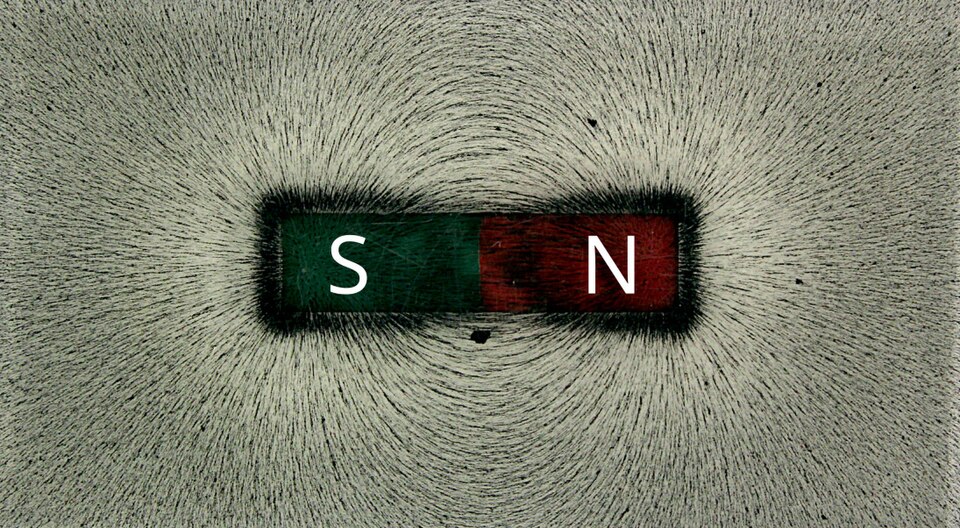
Correct: A, Magnetic force. A force is classified as non-contact when the two bodies influence each other across empty space, with no physical touching and no intervening medium required. Magnetic force is the textbook case: a bar magnet lifts an iron nail before the nail reaches it, deflects a compass needle from across a table, and does both equally well inside a vacuum, because the interaction is carried by the magnetic field surrounding the magnet rather than by any surface pressed against another. The strength falls off steeply with separation (the force between two magnetic poles follows an inverse-square law, so doubling the gap cuts the force to a quarter) which is exactly the behaviour of a field force and not of a push or a pull transmitted through touching surfaces. The other two named forces both fail this test by definition. Friction arises only where two surfaces are already in contact and are sliding, rolling or tending to slide over one another, and its magnitude f = μN depends on the normal force pressing those surfaces together; remove the contact and the friction vanishes instantly. An impact force is the very large, very short-lived force exerted during a collision (a bat on a ball, a hammer on a nail) and a collision is contact, by the meaning of the word. Since option (a) is a genuine non-contact force, option (d) 'None of these' cannot stand.
Why the others are wrong
- (b)Frictional force: Friction is the standard example of a contact force, not a non-contact one. It acts along the surface of contact, opposes relative motion, and is proportional to the normal reaction (f = μN). A body with no surface touching it (a stone in free fall through vacuum) experiences no friction at all.
- (c)Impact force: An impact force is the large force generated during a collision, related to the change of momentum by impulse = F × Δt. A collision requires the bodies to meet, so impact force is contact by definition. Candidates sometimes pick it because impacts feel instantaneous and 'invisible', but the bodies do touch.
- (d)None of these: This would only be right if all three named forces were contact forces. Magnetic force plainly is not (it acts through a field across a gap, as a magnet attracting iron filings without touching them demonstrates) so at least one option qualifies and 'None of these' is false.
Concept
Forces are grouped in school physics into contact forces and non-contact (field, or action-at-a-distance) forces. Contact forces include muscular or applied force, friction, the normal reaction, tension in a string, air resistance, the spring force and impact force during a collision: every one of them needs the two bodies to be touching. Non-contact forces are gravitational, electrostatic and magnetic force; each is described by a field that fills the space around the source, so the second body responds to the field at its own location rather than to any direct touch. At the deeper level all interactions in nature reduce to four fundamental forces (gravitational, electromagnetic, strong nuclear and weak nuclear) and every so-called contact force, friction included, is ultimately electromagnetic repulsion between the electron clouds of atoms in the two surfaces.
Read the options as a classification exercise and test each one with a single question: can this force act across a gap? Friction cannot: take the surfaces apart and it is gone. Impact cannot: no collision, no impact force. Magnetic force can, and everyone has seen it do so, which settles the question in one step and simultaneously kills option (d). The trap in BPSC's 'None of these' fourth option is that it rewards over-thinking: a candidate who starts wondering whether magnetism 'really' involves the exchange of virtual particles, or whether a magnetic field counts as a medium, can talk themselves out of the plain answer. The examiner is working at the NCERT Class 8 'Force and Pressure' level, where the contact/non-contact split is stated exactly as used here.
Key facts
- Non-contact forces in school physics: gravitational, electrostatic (Coulomb) and magnetic: all act through a field across empty space
- Contact forces: muscular/applied, friction, normal reaction, tension, air resistance, spring force and impact force
- Force of friction f = μN is proportional to the normal reaction between the two touching surfaces, so it disappears the moment contact ends
- The four fundamental interactions are gravitational, electromagnetic, strong nuclear and weak nuclear; magnetic and electrostatic forces are two aspects of the single electromagnetic interaction
- Both Newton's law of gravitation and Coulomb's law are inverse-square laws: the hallmark of a long-range field force; gravity is the weakest of the four but dominates at astronomical scale because it is always attractive and never cancels
Study next
Common traps
- Treating 'None of these' as a safe hedge: it is only correct when every named option fails, and here one of them clearly does not
- Calling gravity a contact force because we feel our own weight through the ground; the weight itself is non-contact, the ground's push is the separate normal reaction
- Confusing impact force with impulse: impulse is F × Δt, a quantity, while impact force is the contact force acting during the collision
BPSC keeps its general-science physics at NCERT school level and asks for a definition or a classification in one line, with a 'None of these' escape option attached, exactly as here. UPSC almost never asks a bare definition; it embeds the same physics inside a situation (a satellite that does not fall, ball bearings that reduce friction, tides raised across 384,000 km) and expects you to identify which force is doing the work. Learn the classification, then practise spotting it inside a described scenario.
Related PYQs
An artificial satellite orbiting around the Earth does not fall down. This is so because the attraction of Earth
- (a) does not exist at such distance
- (b) is neutralized by the attraction of the moon
- (c) provides the necessary speed for its steady motion
- (d) provides the necessary acceleration for its motion
Answer(d) provides the necessary acceleration for its motion
The same idea in scenario form: Earth's gravity keeps a satellite in orbit across hundreds of kilometres of vacuum with nothing touching it, which is precisely what makes gravitation, like magnetism, a non-contact force.
Ball bearings are used in bicycles, cars, etc., because
- (a) the actual area of contact between the wheel and axle is increased
- (b) the effective area of contact between the wheel and axle is increased
- (c) the effective area of contact between the wheel and axle is reduced
- (d) None of the above statements is correct
Answer(c) the effective area of contact between the wheel and axle is reduced
The complementary half of the same classification: friction can be engineered away only by reducing the area of contact, which is the clearest possible demonstration that friction is a contact force and not a field force.
Practice
- practice, not a real PYQ
Which one of the following is NOT a non-contact force ?
- (a)Electrostatic force
- (b)Gravitational force
- (c)Tension in a stretched string
- (d)Magnetic force
Answer(c) Tension in a stretched string: tension is transmitted through the material of the string in contact with the body, so it is a contact force; the other three act through fields. - practice, not a real PYQ
Which of the following is the weakest of the four fundamental forces of nature, yet governs the motion of planets ?
- (a)Strong nuclear force
- (b)Gravitational force
- (c)Electromagnetic force
- (d)Weak nuclear force
Answer(b) Gravitational force: by far the weakest of the four, but it is always attractive and unlimited in range, so it never cancels out and dominates at astronomical distances.