
Which of the following mammals lays eggs ?
- (a)Loris
- (b)Kangaroo
- (c)Hedgehog
- (d)Echidna
Answer
Why
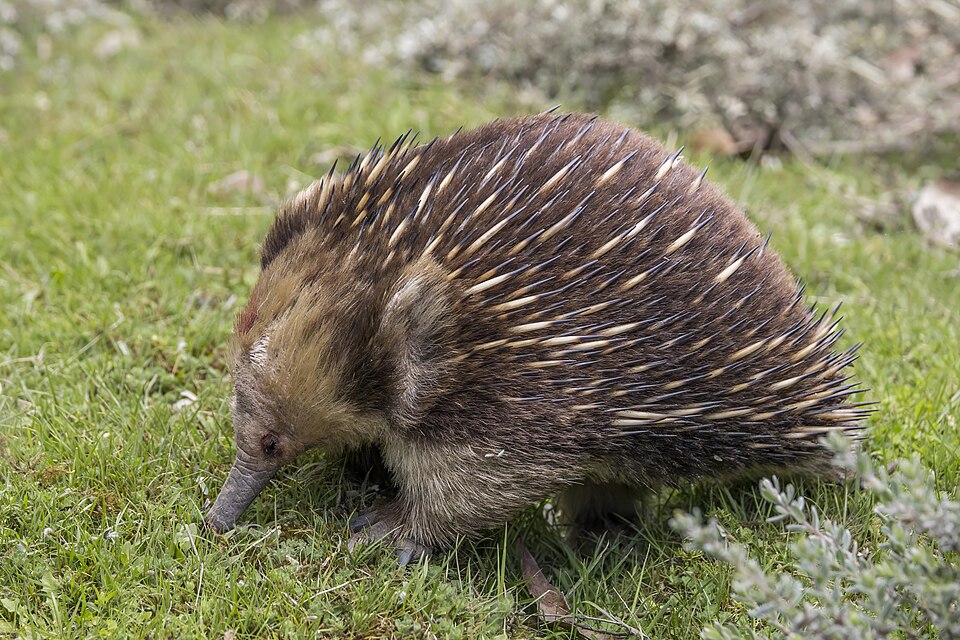
Correct — D, Echidna. The echidna, or spiny anteater, is a monotreme — one of only two surviving groups of egg-laying mammals, the other being the platypus. The female lays a single small, leathery-shelled egg, which she transfers to a temporary pouch-like fold on her belly; the young hatches after roughly ten days and then feeds on milk that oozes from patches of skin, because monotremes secrete milk but have no nipples. Everything else about the echidna is mammalian: it is warm-blooded, it has hair modified into spines, and it suckles its young. Egg-laying does not disqualify it from being a mammal — it makes it the living reminder that mammals evolved from egg-laying ancestors, and monotremes are the branch that never abandoned the egg.
Why the others are wrong
- (a)Loris — The loris is a primate — a slow-moving, large-eyed, nocturnal one — and primates are placental mammals that give birth to live young. India has both the grey slender loris in the south and the Bengal slow loris in the north-east, which is why the name is familiar to Indian candidates, but nothing about its reproduction is unusual.
- (b)Kangaroo — The best trap on the list for a candidate who half-remembers the biology. The kangaroo is a MARSUPIAL, not a monotreme: it gives birth to live young, but the newborn is extraordinarily undeveloped — a few centimetres long — and crawls to the mother's pouch to complete its growth attached to a teat. Because the pouch is the memorable feature, and because Australia is the memorable place, kangaroo and echidna get conflated. The distinction to hold is exact: marsupials give live birth and finish the job in a pouch; monotremes lay an egg.
- (c)Hedgehog — The best trap on the list for a candidate who reasons from appearance. The hedgehog is covered in spines, rolls into a ball when threatened and eats insects — all of which the echidna also does — yet it is an ordinary placental mammal that gives birth to live young. The resemblance is convergent evolution: two unrelated insect-eating mammals arrived independently at the same spiny defence. Spines are not evidence of egg-laying.
Concept
Living mammals fall into three groups defined by how they reproduce. Monotremes lay eggs and are represented today only by the platypus and the echidnas, all confined to Australia and New Guinea; the name means 'single opening', from the cloaca they share with reptiles and birds. Marsupials, such as kangaroos, koalas and opossums, give birth to extremely immature live young that complete development attached to a teat, usually inside a pouch. Placental or eutherian mammals — the overwhelming majority, including humans, the loris and the hedgehog — nourish the embryo through a placenta and give birth to relatively well-developed young. What all three share, and what actually defines a mammal, is hair and the production of milk from mammary glands, not the manner of birth.
The question is built so that every wrong option is wrong for a different reason, and each reason is a lesson. The loris punishes pure unfamiliarity. The kangaroo punishes the belief that 'Australian and pouched' means 'egg-laying'. The hedgehog punishes reasoning from appearance rather than from taxonomy. The safe route is to remember the two monotremes by name — platypus and echidna — because the list is only two items long and everything else in the mammal class is disqualified automatically. That is far more reliable than trying to reason about which animal 'looks primitive'. It is also worth noticing that this is a definitional question dressed as a factual one: the examiner is really checking whether the candidate knows that being a mammal is defined by hair and milk, not by live birth.
Key facts
- Monotremes are the only egg-laying mammals; the surviving members are the platypus and the echidnas, found in Australia and New Guinea.
- A female echidna lays a single leathery egg into a pouch-like fold of skin; it hatches in about ten days and the young feeds on milk secreted from mammary patches, since monotremes have no nipples.
- Kangaroos are marsupials — they give birth to live but highly undeveloped young that complete development in the pouch; they do not lay eggs.
- Hedgehogs are placental mammals; their resemblance to echidnas is convergent evolution, both being spiny insect-eaters that roll up in defence.
- The defining features of a mammal are hair and milk-producing mammary glands, not the method of giving birth — which is why an egg-laying echidna is still a mammal.
Study next
Common traps
- Treating kangaroos as egg-layers because they have a pouch. Marsupials give live birth; only monotremes lay eggs, and the echidna also uses a pouch — so the pouch proves nothing either way.
- Reasoning from spines. Hedgehog and echidna look alike and behave alike, but only one is a monotreme; appearance is not taxonomy.
- Assuming an egg-laying animal cannot be a mammal. Hair and milk define the class; the echidna has both and is therefore a mammal that lays eggs.
This is a recall question with a one-line stem and four animals, and it recurs almost unchanged — UPSC asked exactly the same thing in 2008, with echidna again the answer and kangaroo again among the distractors. Both commissions also test the same material sideways, through animal behaviour and habitat: UPSC asked in 2021 which animals roll up to protect themselves, an option list that again included the hedgehog. Learning the two monotremes and a handful of representative marsupials by name covers the whole area.
Related PYQs
Among the following, which one lays eggs and does not produce young ones directly?
- (a) Echidna
- (b) Kangaroo
- (c) Porcupine
- (d) Whale
Answer(a) Echidna
Very nearly the same question, fourteen years earlier: the same correct answer, the same kangaroo distractor, and a spiny placental mammal (porcupine there, hedgehog here) planted to catch reasoning from appearance. It is as clear a demonstration as this store offers that a UPSC recall item can reappear on a state paper almost word for word.
Consider the following animals: 1. Hedgehog 2. Marmot 3. Pangolin To reduce the chance of being captured by predators, which of the above organism/organisms rolls up and protects its/their vulnerable parts?
- (a) 1 and 2
- (b) 2 only
- (c) 3 only
- (d) 1 and 3
Answer(d) 1 and 3
The hedgehog again, and again as a test of whether a candidate knows the animal rather than its silhouette. Rolling into a spiny ball is a defence the hedgehog shares with the echidna and the pangolin, none of which are closely related — the clearest available illustration of the convergent evolution that makes option (c) tempting here.
Practice
- practice — not a real PYQ
The platypus and the echidna are the only living members of which group of mammals ?
- (a)Marsupialia
- (b)Monotremata
- (c)Eutheria
- (d)Insectivora
Answer(b) Monotremata — the egg-laying mammals, found today only in Australia and New Guinea. Marsupials such as the kangaroo give live birth and rear the young in a pouch, while eutherians are the placental mammals. - practice — not a real PYQ
Which one of the following statements about the reproduction of the kangaroo is correct ?
- (a)It lays a leathery egg which hatches inside the pouch
- (b)It gives birth to a very undeveloped live young which completes its growth in the pouch
- (c)It nourishes the embryo through a fully developed placenta until birth like humans
- (d)It lays eggs which are incubated outside the body by the male
Answer(b) It gives birth to a very undeveloped live young which completes its growth in the pouch — that is the defining marsupial pattern. Egg-laying is the monotreme pattern, seen in the echidna and the platypus.