
From which archaeological site of Indus Valley Civilization, the figures or models of boat are found ?
- (a)Harappa and Kotdiji
- (b)Kalibangan and Ropar
- (c)Dhaulabira and Bhagatrav
- (d)Mohenjodaro and Lothal
Answer
Why
Correct — D, Mohenjodaro and Lothal. The Lothal half of this pair is firmly attested and is the reason the option is right: terracotta models of boats were recovered at Lothal, the Harappan port in Gujarat, around the great brick-lined basin that excavators identified as a dockyard. Those little clay boats are the standard textbook evidence that the Indus people built and used watercraft. The Mohenjodaro half rests on a different kind of object — a boat depicted on a seal from the site, showing a vessel with birds carried aboard, the device ancient sailors used to find land. That is a 'figure' of a boat rather than a three-dimensional model, and the question's own wording, 'figures OR models of boat', accommodates both. In the interest of honesty a student should know that the unambiguous, physically modelled boats are the Lothal ones; the Mohenjodaro attribution is standard in Indian textbooks and is supported by the seal, but it is the weaker half of the pair. None of that disturbs the answer, because no other option contains a site associated with boats at all.
Why the others are wrong
- (a)Harappa and Kotdiji — Neither is a maritime site. Harappa, on the Ravi, is the type site of the civilisation and is remembered for its great granary, its citadel and the cemetery designated R-37; Kot Diji, in Sindh, is best known for the fortified Early Harappan settlement and the distinctive pottery phase that carries its name. Both are inland river-valley sites with no boat finds attached to them in the standard accounts.
- (b)Kalibangan and Ropar — Both are inland sites on the northern rivers. Kalibangan in Rajasthan is famous for the earliest excavated ploughed field and for its rows of fire altars; Ropar (Rupnagar) in Punjab, on the Sutlej, was the first Harappan site excavated after Independence and is known for a burial in which a dog was interred with a human. Neither has produced boats or any evidence of seafaring.
- (c)Dhaulabira and Bhagatrav — This is the option that requires a moment's thought, because both sites lie in Gujarat and Bhagatrav is a small coastal Harappan settlement near the estuaries of the Narmada and Kim, so a candidate can reasonably associate it with the sea. But coastal location is not the same as a boat find. Dhaulabira — Dholavira, on Khadir Bet in the Rann of Kutch — is celebrated for something entirely different: its elaborate system of check-dams, channels and stone-lined reservoirs, and the great ten-sign inscription often called the world's oldest signboard. Neither site carries the boat evidence that Lothal does.
Concept
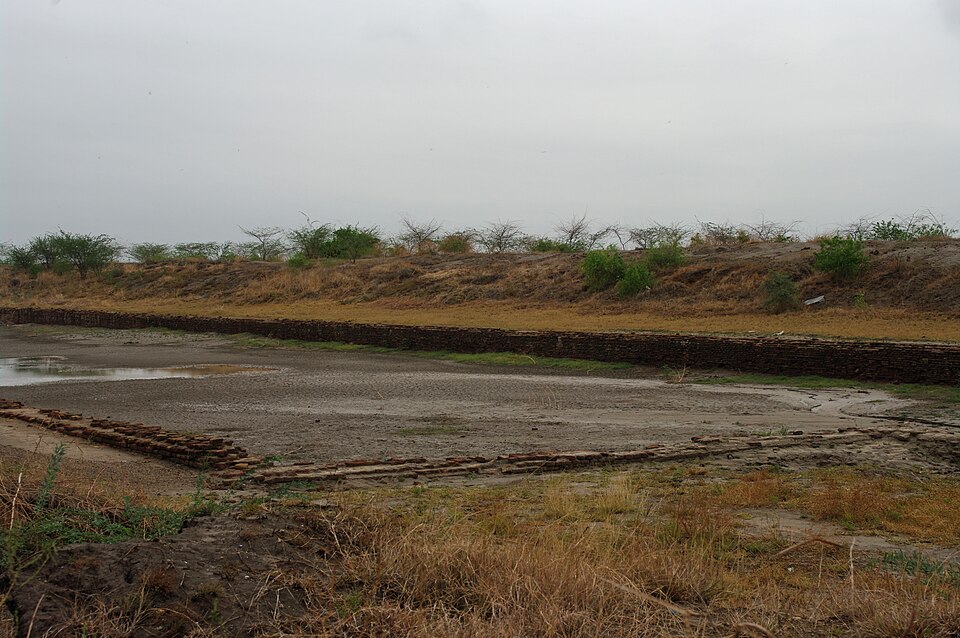
Maritime trade is one of the defining features of the Mature Harappan phase, and Lothal is the site that carries most of the evidence. It lies in Gujarat near the head of the Gulf of Khambhat, and its most striking structure is a large trapezoidal basin lined with kiln-fired brick, with an inlet channel and a spill-way; the excavator S. R. Rao interpreted it as a tidal dockyard where boats could be floated in at high tide. Alongside it were found a warehouse on a raised platform, a bead factory, Persian Gulf-type seals and the terracotta boat models. Together these support the wider picture drawn from Mesopotamian records, which speak of trade with Meluhha — generally identified with the Indus region — through the intermediate stations of Dilmun and Magan. Not every scholar accepts the dockyard interpretation of the basin; some read it as an irrigation tank. The boat models, however, are not in dispute.
The efficient way to handle a two-site option list is to test each site independently and reject the pair as soon as either half fails. Here, only one site in the whole question has any strong association with watercraft — Lothal — and it appears in exactly one option. That single association decides the answer without needing to adjudicate the Mohenjodaro half at all. This is also a reminder to store Harappan sites as site-plus-signature-find pairs rather than as a list of names: Lothal with the dockyard and boat models, Kalibangan with the ploughed field and fire altars, Dholavira with the water reservoirs and the signboard inscription, Harappa with the granary and cemetery R-37, Ropar with the dog burial, Alamgirpur in Uttar Pradesh as the eastern limit of the culture. Almost every prelims question on the civilisation is a test of that table.
Key facts
- Terracotta models of boats were found at Lothal, in Gujarat, around the brick-lined basin usually identified as a Harappan dockyard.
- Mohenjodaro has yielded a seal depicting a boat carrying birds — the device used by ancient sailors to locate land; this is a depiction rather than a physical model.
- Lothal also produced a warehouse, a bead-making workshop and Persian Gulf-type seals, all pointing to organised overseas trade.
- Kalibangan is known for the earliest excavated ploughed field and for fire altars; Dholavira for its water-harvesting reservoirs and its ten-sign inscription; Ropar for a dog buried with a human; Harappa for its granary and cemetery R-37.
- Mesopotamian texts refer to trade with Meluhha, generally identified with the Indus region, via Dilmun and Magan.
Study next
Common traps
- Assuming a coastal site must be the boat site. Bhagatrav lies on the Gujarat coast, yet the boat evidence belongs to Lothal.
- Accepting a two-site option because one half sounds right. In a paired option both halves must survive; the discipline is to test each name separately.
- Mixing up the Gujarat sites. Lothal means dockyard and boat models; Dholavira means water reservoirs and the ten-sign inscription. They are the two most-asked Gujarat sites and they are asked for opposite reasons.
UPPSC returns to the Indus civilisation almost every year and almost always through site identification — which state a site is in, which site marks the eastern boundary, which sites lie in Uttar Pradesh, which site goes with which find. UPSC asks the same table in match-list and 'which is not a Harappan site' form. The single most efficient preparation is a two-column list of about fifteen sites against their distinctive discoveries, with the modern state written beside each.
Related PYQs
Which of the following pairs are correctly matched? I. Lothal: Ancient dockyard II. Sarnath: First Sermon of Buddha III. Rajgir: Lion capital of Asoka IV. Nalanda: Great seat of Buddhist learning Select the correct answer using the codes given below: Codes:
- (a) I, II, III and IV
- (b) III and IV
- (c) I, II and IV
- (d) I and II
Answer(c) I, II and IV
The same site for the same reason. UPSC certifies the pairing 'Lothal — ancient dockyard' as correct, which is precisely the maritime character that makes Lothal the boat-model site in the 2022 UPPSC question.
Which one of the following ancient towns is well-known for its elaborate system of water harvesting and management where a series of bunds created check-dams and canals carried the water to connected reservoirs?
- (a) Dholavira
- (b) Kalibangan
- (c) Rakhigarhi
- (d) Ropar
Answer(a) Dholavira
The site-plus-signature-find table in action, and it covers two of the names offered as distractors here — Dholavira and Ropar. It confirms what Dholavira is actually famous for, which is water management rather than watercraft.
Match List – I with List – II and select the correct answer using the codes given below the lists : List – I (Harappan Site): A. Balu, B. Manda, C. Padri, D. Hulas List – II (UT/State of India): 1. Uttar Pradesh, 2. Jammu and Kashmir, 3. Haryana, 4. Gujarat
- (a) A-3, B-2, C-1, D-4
- (b) A-2, B-3, C-4, D-1
- (c) A-2, B-4, C-3, D-1
- (d) A-3, B-2, C-4, D-1
Answer(d) A-3, B-2, C-4, D-1
The same commission testing the same skill — knowing individual Harappan sites well enough to place them — two years earlier, and going well beyond the famous names into Balu, Manda, Padri and Hulas. It is the clearest evidence that UPPSC expects a wide site list, not just Mohenjodaro and Harappa.
Eastern boundary of the Harappa culture is indicated by which of the following?
- (a) Manda
- (b) Alamgirpur
- (c) Rakhigarhi
- (d) Harappa
Answer(b) Alamgirpur
The following year's Indus question from the same commission, again turning on the identity and position of a single site. Together with the 2022 boat question it shows the pattern: UPPSC asks 'which site', not 'what was the civilisation like'.
Practice
- practice — not a real PYQ
The earliest excavated evidence of a ploughed field in the Indian subcontinent has been found at which Harappan site ?
- (a)Lothal
- (b)Kalibangan
- (c)Ropar
- (d)Kot Diji
Answer(b) Kalibangan — the site in Rajasthan on the dried Ghaggar course produced a ploughed field surface with criss-cross furrows, along with a well-known row of fire altars. Lothal is the port and dockyard site, Ropar is known for a dog burial and Kot Diji for its Early Harappan fortified phase. - practice — not a real PYQ
Which one of the following Harappan sites is best known for an elaborate system of check-dams and stone-lined water reservoirs, and for a large inscription of ten signs ?
- (a)Dholavira
- (b)Banawali
- (c)Surkotada
- (d)Chanhudaro
Answer(a) Dholavira — on Khadir Bet in the Rann of Kutch, it is famous for channelling monsoon runoff into a chain of interconnected reservoirs and for the ten-sign 'signboard' inscription found near its northern gate.