
Thermodynamically the most stable form of carbon is
- (a)Fullerenes
- (b)Diamond
- (c)Coal
- (d)Graphite
Answer
Why
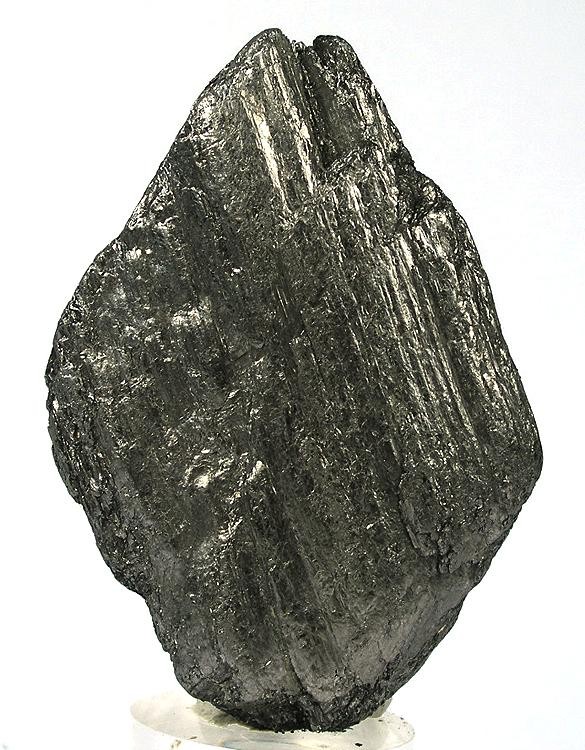
Correct — D, Graphite. Under ordinary conditions — room temperature and one atmosphere — graphite is the allotrope of carbon with the lowest energy, and it is therefore the thermodynamically stable form. Chemistry formalises this by taking graphite as the reference state of the element carbon: the standard enthalpy of formation of graphite is defined as zero, and every other form of carbon is quoted relative to it. Diamond sits about 2 kilojoules per mole ABOVE graphite, which is small but positive, and that positive sign is the whole answer to this question. Anything above the reference state is, strictly speaking, metastable rather than stable. So of the four options, graphite is the one to which the others would convert if energy alone decided the outcome.
Why the others are wrong
- (a)Fullerenes — Fullerenes — the cage molecules of which C60, buckminsterfullerene, is the best known — are genuine allotropes of carbon, but they are markedly higher in energy than graphite. Curving a flat hexagonal sheet into a closed cage forces strain into the carbon–carbon bonds, and that strain energy has to be paid for. They are the least stable of the three true allotropes on this list, not the most stable.
- (b)Diamond — This is the trap the question is built around, and it is a good one, because everything a student knows about diamond says 'stable': it is the hardest natural substance, it is chemically inert, and it lasts indefinitely. But hardness is a mechanical property and inertness at room temperature is a KINETIC fact, not a thermodynamic one. Diamond is about 2 kJ/mol higher in energy than graphite, so it is metastable; it does not turn into graphite in a jeweller's window only because breaking and rearranging its rigid three-dimensional network of carbon–carbon bonds carries an enormous activation barrier. Confusing 'does not change' with 'lowest energy' is precisely the error being tested. (At the very high pressures found deep in the Earth's mantle the balance reverses and diamond becomes the stable phase — which is why diamonds form there and not at the surface.)
- (c)Coal — Coal is not a form of carbon in the sense the question means. It is not an allotrope at all but a heterogeneous sedimentary rock — a fossil fuel made of altered plant matter that is rich in carbon but also contains hydrogen, oxygen, nitrogen, sulphur, moisture and mineral ash in variable proportions. An allotrope must be the pure element in a definite structural arrangement; coal has neither the purity nor a single defined structure, so it cannot be compared with graphite, diamond and fullerenes on a thermodynamic scale at all.
Concept
Allotropes are different structural forms of the same element in the same physical state. Carbon has several, and they differ in how each atom bonds. In diamond every carbon is sp3 hybridised and bonded tetrahedrally to four neighbours in a rigid three-dimensional network — hence extreme hardness, very high thermal conductivity and electrical insulation. In graphite every carbon is sp2 hybridised and bonded to three neighbours within flat hexagonal sheets, leaving one electron per atom delocalised over the sheet; the sheets themselves are held to each other only by weak forces. That structure explains graphite's three familiar properties at once: it is soft and slippery because the sheets slide, it conducts electricity because of the delocalised electrons, and it is the low-energy arrangement because the sp2 sheet packs bonding most efficiently at ordinary pressure. Fullerenes are closed cages of sp2 carbon, and graphene is a single isolated graphite sheet.
The reasoning trap here is the everyday meaning of the word 'stable'. In ordinary speech a diamond is the most stable thing imaginable — it does not burn, tarnish, dissolve or decay. In thermodynamics 'stable' means only 'lowest in free energy', and by that test graphite wins. The bridge between the two is the distinction between thermodynamics and kinetics: a reaction can be strongly favoured energetically and still never happen, because the activation barrier is too high at the temperature available. Diamond turning into graphite is the textbook example of exactly that. A candidate who has internalised this distinction also answers questions about why hydrogen peroxide keeps in a bottle, why petrol does not ignite until sparked, and why a supersaturated solution can sit unchanged for hours.
Key facts
- Graphite is the reference state of the element carbon: its standard enthalpy of formation is defined as zero, and diamond lies about 2 kJ/mol above it.
- Diamond's persistence at room temperature is kinetic, not thermodynamic — the conversion to graphite is favourable but is blocked by a very large activation barrier.
- In graphite each carbon is sp2 hybridised and bonded to three neighbours within hexagonal sheets, leaving one delocalised electron per atom — hence a good electrical conductor and a soft solid lubricant; in diamond each carbon is sp3 hybridised and bonded to four neighbours, making it the hardest natural substance and an electrical insulator.
- Fullerenes such as C60 are true carbon allotropes but are strained cage molecules and are less stable than graphite.
- Coal is not an allotrope of carbon at all — it is a heterogeneous fossil-fuel rock containing carbon along with hydrogen, oxygen, nitrogen, sulphur and mineral matter.
Study next
Common traps
- Reading 'stable' as 'hard' or 'unreactive'. Diamond is the hardest and among the least reactive materials known, yet it is thermodynamically the LESS stable of the two crystalline allotropes.
- Treating coal as an allotrope of carbon. Coal is a rock of variable composition, not a pure structural form of the element, and cannot be ranked on this scale.
- Forgetting the pressure condition. Diamond does become the stable phase at very high pressure; the question's answer holds for ordinary temperature and pressure, which is the default unless a question says otherwise.
Both commissions like carbon because one topic carries chemistry, materials science and current affairs at once. UPPSC has asked candidates to order fullerene, graphene and other engineered materials by date of first synthesis, and has repeatedly asked which substance is used for which purpose. UPSC prefers the applications end — graphene's properties in 2012, carbon nanotubes in 2020, graphite as a battery material in 2025. Learn the four allotropes as a single table of structure, bonding, properties and uses, and both styles are covered.
Related PYQs
Graphene is frequently in news recently. What is its importance? 1. It is a two-dimensional material and has good electrical conductivity. 2. It is one of the thinnest but strongest materials tested so far. 3. It is entirely made of silicon and has high optical transparency. 4. It can be used as conducting electrodes required for touch screens, LCDs and organic LEDs. Which of the statements given above are correct?
- (a) 1 and 2 only
- (b) 3 and 4 only
- (c) 1, 2 and 4 only
- (d) 1, 2, 3 and 4
Answer(c) 1, 2 and 4 only
Graphene is a single sheet of graphite, so this question tests the same structure from the other direction. Its correct statements — two-dimensional, electrically conducting — are exactly the sheet-and-delocalised-electron picture that explains why graphite is the low-energy form of carbon.
With reference to carbon nanotubes, consider the following statements : 1. They can be used as carriers of drugs and antigens in the human body. 2. They can be made into artificial blood capillaries for an injured part of human body. 3. They can be used in biochemical sensors. 4. Carbon nanotubes are biodegradable. Which of the statements given above are correct ?
- (a) 1 and 2 only
- (b) 2, 3 and 4 only
- (c) 1, 3 and 4 only
- (d) 1, 2, 3 and 4
Answer(c) 1, 3 and 4 only
The third member of the same family. Nanotubes are rolled graphite sheets, as fullerenes are closed ones — so a candidate who understands why the sp2 sheet is carbon's favoured arrangement has the structural basis for all of these UPSC nanomaterial questions.
Arrange the following substances in chronological order of their first synthesis in lab : 1. Black gold 2. Fullerene 3. Graphene 4. Kevlar Select correct answer from the codes given below : Codes :
- (a) 1 2 3 4
- (b) 4 2 3 1
- (c) 2 4 3 1
- (d) 4 1 2 3
Answer(b) 4 2 3 1
The same commission testing the same carbon allotropes — fullerene and graphene both appear here — but through their discovery dates rather than their energetics. Between the two papers UPPSC has asked for the stability ranking and the discovery order of the carbon family, so a single table covering structure, date and use answers both.
Practice
- practice — not a real PYQ
Graphite conducts electricity while diamond does not. The reason is that in graphite
- (a)each carbon atom is bonded to four other carbon atoms
- (b)one electron per carbon atom is delocalised and free to move
- (c)the carbon atoms are held together by hydrogen bonds
- (d)the carbon atoms carry a permanent positive charge
Answer(b) one electron per carbon atom is delocalised and free to move — in graphite each carbon uses three of its four valence electrons in sigma bonds within a hexagonal sheet, leaving the fourth delocalised across the sheet. In diamond all four are locked into single bonds, so there are no mobile electrons and it is an insulator. - practice — not a real PYQ
Which one of the following forms of carbon is used as a solid lubricant and as a moderator in some nuclear reactors ?
- (a)Diamond
- (b)Fullerene
- (c)Graphite
- (d)Charcoal
Answer(c) Graphite — its weakly held sheets slide over one another, which makes it a solid lubricant that works at high temperature, and its low atomic mass with low neutron absorption makes it a standard neutron moderator.