
Given below are two statements, one is labelled as Assertion (A) and the other as Reason (R). Assertion (A) : In the Himalayan mountains different types of vegetation are found. Reason (R) : In Himalayas, there are variations in climate with change in altitude. Select the correct answer from the code given below : Code :
- (a)Both (A) and (R) are true, but (R) is not the correct explanation of (A)
- (b)(A) is true, but (R) is false
- (c)(A) is false, but (R) is true
- (d)Both (A) and (R) are true and (R) is the correct explanation of (A)
Correct — D, both (A) and (R) are true and (R) is the correct explanation of (A). The Assertion is true: no other Indian region packs so many vegetation types into so small a horizontal distance. Walking up from the Terai you pass tropical moist deciduous sal forest, then subtropical chir pine, then temperate oak, deodar, fir and spruce, then sub-alpine birch and rhododendron, then alpine meadows, and finally bare rock and permanent snow. The Reason is also true: air temperature falls with height at roughly 6.5 degrees Celsius for every 1,000 metres, so climate changes continuously up a Himalayan slope. And the Reason is precisely why the Assertion holds. Vegetation is controlled above everything else by temperature and moisture, so where climate changes with altitude the plant community must change with it — a climb of three or four thousand metres reproduces the temperature gradient that would otherwise require a journey of thousands of kilometres towards the pole. That is altitudinal zonation, a causal link and not a coincidence, so the answer is not merely 'both true' but 'both true AND R explains A'.
- (a)Both (A) and (R) are true, but (R) is not the correct explanation of (A) — This is the real trap of the question, and it catches two kinds of candidate: the one who assumes by reflex that two true statements must be unconnected, and the one who reads the code in its usual UPSC order and thinks option (a) is the 'R explains A' choice. Both statements are true, but the altitudinal change in climate is not an incidental fact standing beside the variety of vegetation — it is the mechanism that produces it. Remove the temperature and moisture gradient and there is no reason for the vegetation to change at all.
- (b)(A) is true, but (R) is false — The Reason is a plain fact of physical geography. In the troposphere temperature falls with height at the normal lapse rate of about 6.5 degrees Celsius per kilometre, and Himalayan slopes also show sharp changes in precipitation, humidity and length of the growing season with height. There is nothing false in R.
- (c)(A) is false, but (R) is true — The Assertion is not false. Champion and Seth's Revised Survey of the Forest Types of India recognises several forest type groups that occur only in the Himalaya — Himalayan moist temperate, Himalayan dry temperate, sub-alpine, moist alpine scrub and dry alpine scrub — on top of the tropical and subtropical types found at the foot of the range. The diversity of Himalayan vegetation is exactly what the classification records.
Altitudinal zonation is the arrangement of plant communities in horizontal belts up a mountainside, produced because temperature falls and moisture, wind exposure and growing-season length change with height. In the Himalaya the sequence from the foothills upward is broadly: tropical moist deciduous sal forest in the Bhabar, Terai and Shivalik; subtropical pine forest dominated by chir pine at roughly 1,000 to 2,000 metres; Himalayan moist and dry temperate forest of oak, deodar, blue pine, silver fir and spruce from about 1,500 to 3,000 metres; sub-alpine birch, juniper and rhododendron up to the tree line; alpine meadows above it; and finally lichens, mosses and permanent snow. Altitude is the leading control, but rainfall and slope aspect matter too, which is why the wetter eastern Himalaya carries evergreen forest at heights where the drier western Himalaya carries chir pine and deodar.
Handle any assertion-reason item in three steps: is A true on its own, is R true on its own, and only then does R actually cause or account for A. Here both halves are safely true, so the whole decision is between 'both true, unrelated' and 'both true, R explains A'. The test for a correct explanation is whether removing R would leave A unsupported, and it plainly would: take away the change of climate with height and there is nothing left to make the vegetation change. Read the option text before you mark, though — this 2025 booklet lists the codes in a non-standard order, with (a) as 'both true but R is not the explanation' and (d) as 'both true and R is the correct explanation'. A candidate who marks by habit rather than by reading will put down (a) and lose the mark.
- Temperature in the lower atmosphere falls with height at the normal lapse rate of about 6.5 degrees Celsius per 1,000 metres, so a Himalayan slope compresses into a few kilometres of climb the climatic range of a journey of thousands of kilometres in latitude
- The Himalayan vegetation sequence runs tropical moist deciduous sal, subtropical chir pine, temperate oak-deodar-fir-spruce, sub-alpine birch and rhododendron, alpine meadow, and finally permanent snow
- The tree line in the Indian Himalaya generally lies around 3,500 to 4,000 metres; the alpine meadows above it are called bugyals in Uttarakhand and margs in Kashmir
- Champion and Seth's Revised Survey of the Forest Types of India (1968) recognises 16 major forest type groups for the country, and several of them — Himalayan moist temperate, Himalayan dry temperate, sub-alpine, moist alpine scrub and dry alpine scrub — are confined to the Himalaya
- Rainfall and aspect modify the pattern: the heavily watered eastern Himalaya supports evergreen forest at elevations where the drier western Himalaya carries chir pine and deodar
- In this 2025 booklet the assertion-reason codes are printed in a non-standard order: (a) is 'both true, R is NOT the explanation' and (d) is 'both true, R IS the explanation'. Marking from memory of the usual UPSC order costs the mark even when the reasoning is right
- Treating two true statements as automatically unrelated; here the climate gradient is the mechanism behind the vegetation variety, not a fact standing beside it
- Attributing Himalayan vegetation variety to soil or to latitude; within the range it is altitude, and secondarily rainfall and aspect, that does the work
UPPSC likes this topic as an assertion-reason pair or as a species-to-belt match list, because it can be answered from NCERT physical geography without any current data; UPSC asks it obliquely instead — which plants grow naturally in the Himalaya, which national park lies wholly in the alpine zone, or which forest type a named species dominates.
If you travel through the Himalayas, you are likely to see which of the following plants naturally growing there? 1. Oak 2. Rhododendron 3. Sandalwood Select the correct answer using the code given below.
- (a) 1 and 2 only
- (b) 3 only
- (c) 1 and 3 only
- (d) 1, 2 and 3
Answer(a) 1 and 2 only
The same idea tested through species rather than through a stated reason. Oak and rhododendron belong to the temperate and sub-alpine belts of the Himalaya, while sandalwood is a tropical dry-deciduous tree of peninsular India — which is only true because the climate at Himalayan altitudes will not support it. That is the assertion of the 2025 question stated as a plant list.
Which one of the following National Parks lies completely in the temperate alpine zone?
- (a) Manas National Park
- (b) Namdapha National Park
- (c) Neora Valley National Park
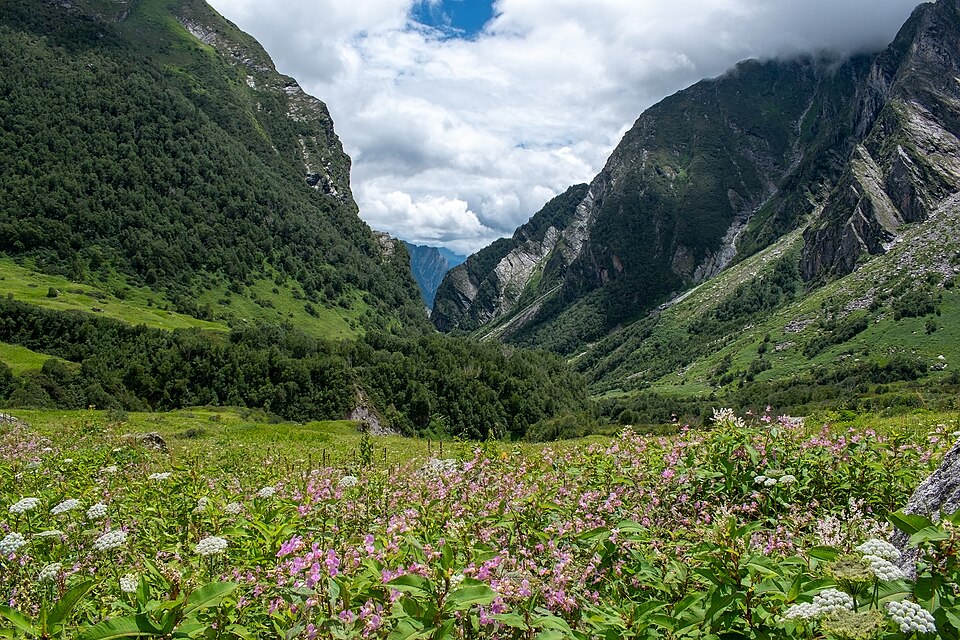
- (d) Valley of Flowers National Park
Answer(d) Valley of Flowers National Park
Altitudinal zonation used as the answering tool. Valley of Flowers lies entirely above about 3,300 metres and is therefore wholly within the temperate-alpine belt, whereas Manas, Namdapha and Neora Valley run down into tropical and subtropical elevations. Deciding it requires exactly the reasoning of Reason (R) — that the vegetation belt follows the height.
Match List - I with List - II and select the correct answer using the codes given below the lists : List - I (Natural Vegetation) A. Epiphytes B. Acacia C. Baobab D. Cedars List - II (Region) 1. Mediterranean 2. Equatorial 3. Sahara 4. Savanna Codes :
- (a) A-2, B-3, C-4, D-1
- (b) A-2, B-3, C-1, D-4
- (c) A-2, B-4, C-3, D-1
- (d) A-2, B-4, C-1, D-3
Answer(a) A-2, B-3, C-4, D-1
The same underlying principle applied to the world instead of to one mountain range: epiphytes to the equatorial belt, acacia to the Sahara, baobab to the savanna and cedars to the Mediterranean. Vegetation type is read off the climate, which is exactly why a Himalayan slope with climate changing by height carries a different vegetation type at every level.
- practice — not a real PYQ
The alpine meadows lying above the tree line in the Uttarakhand Himalaya are locally known as
- (a)Bugyal
- (b)Bhabar
- (c)Duar
- (d)Terai
Answer(a) Bugyal — the high-altitude grasslands above the tree line in Uttarakhand; Bhabar and Terai are belts at the foot of the mountains and the Duars are the plains of north Bengal and Assam.
- practice — not a real PYQ
Chir pine (Pinus roxburghii) is the characteristic tree of which vegetation belt of the Himalaya?
- (a)The tropical moist deciduous belt of the Terai
- (b)The subtropical belt at roughly 1,000 to 2,000 metres
- (c)The sub-alpine belt just below the tree line
- (d)The alpine meadow belt above the tree line
Answer(b) The subtropical belt at roughly 1,000 to 2,000 metres — chir pine forms the Himalayan subtropical pine forests; sal holds the Terai belt, birch and rhododendron the sub-alpine belt, and grasses and herbs the alpine meadows.