
Which of the following Wildlife Sanctuaries of U.P. was established in 1975 ?
- (a)Katarniaghat
- (b)Kishanpur
- (c)Chambal
- (d)Raipur
Answer
Why
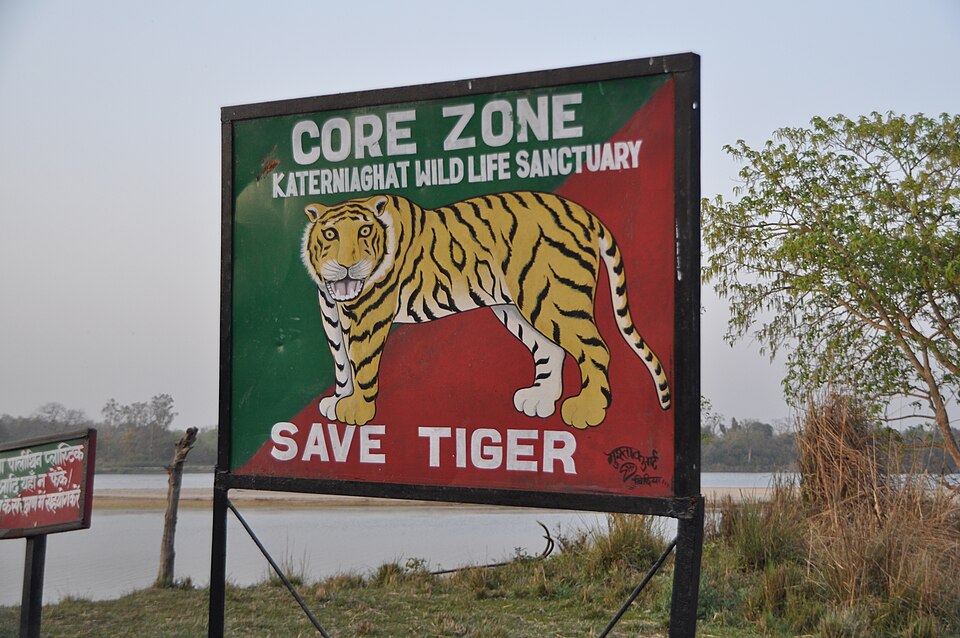
Correct — A, Katarniaghat. Katarniaghat Wildlife Sanctuary lies in the Terai of Bahraich district, on the Indo-Nepal border, and covers 400.6 sq km. The standard reference date for its notification is 1975, and that is the year the commission's paper is working from. One honest caution for a student: the year is not perfectly stable across sources — the widely used encyclopaedic entry states plainly that it was established in 1975, while some State forest listings put Katarniaghat at 1976. The key marks Katarniaghat, and no other option is close to the mid-1970s, so the item is safe even if you carry the 1975/1976 wobble in your notes. What is not in doubt is the rest of its profile: Katarniaghat was brought under Project Tiger in 1987 and, together with Kishanpur Wildlife Sanctuary and Dudhwa National Park, it forms the Dudhwa Tiger Reserve.
Why the others are wrong
- (b)Kishanpur — Kishanpur Wildlife Sanctuary, 227 sq km in Lakhimpur Kheri district, is recorded as founded in 1972 — three years earlier than the date the question asks for. It is the sharpest distractor because Kishanpur is Katarniaghat's partner in the Dudhwa Tiger Reserve, so the two are always studied together and their dates get swapped.
- (c)Chambal — The National Chambal Sanctuary was first declared in 1978, with the portions in the three States it spans — Rajasthan, Madhya Pradesh and Uttar Pradesh — notified between December 1978 and December 1979. It is therefore later than 1975, and it is also not a purely UP sanctuary: it is a tri-State protected area along the Chambal, created for the gharial, the red-crowned roof turtle and the Ganges river dolphin.
- (d)Raipur — No wildlife sanctuary of this name appears in the standard lists of Uttar Pradesh's protected areas; the nearest name in UP is the Ranipur Sanctuary in the Banda–Chitrakoot area of Bundelkhand, which is a different place with a different history. Whatever the printed name is meant to be, it is not the sanctuary the official key marks.
Concept
Uttar Pradesh has one national park — Dudhwa, notified in January 1977 in Lakhimpur Kheri — and about twenty-five wildlife sanctuaries. The set that examiners come back to is the Terai cluster along the Nepal border, because it is the State's tiger landscape. Dudhwa National Park, Kishanpur Wildlife Sanctuary (Lakhimpur Kheri) and Katarniaghat Wildlife Sanctuary (Bahraich) were combined into the Dudhwa Tiger Reserve, Katarniaghat itself having come under Project Tiger in 1987. Away from the Terai, UP's other well-known protected areas are the National Chambal Sanctuary on the Agra–Etawah stretch of the Chambal, Chandraprabha Wildlife Sanctuary in Chandauli in the Vindhyan south, and Ranipur in Bundelkhand.
This is a pure date-recall item, and the efficient way to handle such questions is not to memorise every sanctuary's year but to anchor a decade to each cluster. UP's Terai protected areas belong to the 1970s (Kishanpur 1972, Katarniaghat 1975, Dudhwa upgraded to a national park in 1977), while the Chambal sanctuary belongs to the very end of that decade (1978–79). Since the question asks for 1975 and only the Terai pair is in that window, the real contest is Katarniaghat versus Kishanpur — and the key marks Katarniaghat. Be aware that establishment years for State sanctuaries are one of the least stable classes of fact in Indian environment GK: forest-department listings, State gazetteers and encyclopaedic sources routinely differ by a year, so treat a single-year claim as an exam convention rather than a hard fact.
Key facts
- Katarniaghat Wildlife Sanctuary — Bahraich district, Terai, 400.6 sq km; the widely cited establishment year is 1975, though some State listings give 1976.
- Katarniaghat was brought under Project Tiger in 1987 and, with Kishanpur Wildlife Sanctuary and Dudhwa National Park, constitutes the Dudhwa Tiger Reserve.
- Kishanpur Wildlife Sanctuary — Lakhimpur Kheri district, 227 sq km, founded in 1972; it is part of the Dudhwa Tiger Reserve.
- The National Chambal Sanctuary was first declared in 1978, the three States' portions being notified between December 1978 and December 1979; it is a tri-State (Rajasthan, Madhya Pradesh, Uttar Pradesh) reserve for the gharial, the red-crowned roof turtle and the Ganges river dolphin.
- Dudhwa National Park, in Lakhimpur Kheri, was notified a national park in January 1977 and is known for swamp deer (barasingha) and the one-horned rhino reintroduced there in 1984.
Study next
Common traps
- Swapping Katarniaghat and Kishanpur. They are neighbours inside the same tiger reserve, but Kishanpur is the older sanctuary (1972) and Katarniaghat is the 1975 one.
- Assuming the Chambal sanctuary is a UP-only protected area. It is a tri-State sanctuary shared with Rajasthan and Madhya Pradesh, and it dates from 1978–79, not 1975.
- Treating a sanctuary's establishment year as a settled fact. Forest-department and encyclopaedic sources often differ by a year — Katarniaghat itself is cited as both 1975 and 1976.
UPPSC leans on Uttar Pradesh's own protected areas — which district a sanctuary is in, which Ramsar site is or is not in UP, which sanctuary was set up when — while UPSC prefers the conceptual side, testing what legally distinguishes a national park from a sanctuary or which species is found where.
Related PYQs
Consider the following statements: 1. The boundaries of a National Park are defined by legislation. 2. A Biosphere Reserve is declared to conserve a few specific species of flora and fauna. 3. In a Wildlife Sanctuary, limited biotic interference is permitted. Which of the statements given above is/are correct?
- (a) 1 only
- (b) 2 and 3 only
- (c) 1 and 3 only
- (d) 1, 2 and 3
Answer(c) 1 and 3 only
Same underlying idea — what a 'wildlife sanctuary' is as a legal category under the Wildlife (Protection) Act, 1972, which is the status Katarniaghat was given in the mid-1970s.
Chandraprabha Wildlife Sanctuary is situated in which district of Uttar Pradesh?
- (a) Chandauli
- (b) Baharaich
- (c) Sonbhadra
- (d) Lakhimpur Khiri
Answer(a) Chandauli
The same recall habit UPPSC rewards — knowing Uttar Pradesh's individual wildlife sanctuaries by district and by date; note that Bahraich, the Katarniaghat district, is a distractor there.
Which of the following Ramsar site is NOT situated in Uttar Pradesh?
- (a) Sur Sarovar
- (b) Samaspur Bird Sanctuary
- (c) Sansai Nawar Jheel
- (d) Surinsar-Mansar Lakes
Answer(d) Surinsar-Mansar Lakes
The companion list to UP's sanctuaries — the State's protected wetlands, asked in the same 'which one belongs to UP' format.
Practice
- practice — not a real PYQ
Katarniaghat Wildlife Sanctuary, Kishanpur Wildlife Sanctuary and Dudhwa National Park together constitute which one of the following?
- (a)Pilibhit Tiger Reserve
- (b)Dudhwa Tiger Reserve
- (c)Amangarh Tiger Reserve
- (d)Ranipur Tiger Reserve
Answer(b) Dudhwa Tiger Reserve — Katarniaghat came under Project Tiger in 1987 and the three units together form the reserve. - practice — not a real PYQ
The National Chambal Sanctuary, known for the gharial, extends over which of the following groups of States?
- (a)Uttar Pradesh, Bihar and Jharkhand
- (b)Rajasthan, Madhya Pradesh and Uttar Pradesh
- (c)Madhya Pradesh, Chhattisgarh and Odisha
- (d)Uttar Pradesh, Uttarakhand and Haryana
Answer(b) Rajasthan, Madhya Pradesh and Uttar Pradesh — it is a tri-State sanctuary along the Chambal, first declared in 1978.