Which of the following Rock Edict of Ashoka speaks of religious synthesis ?
- (a)Rock Edict – XII
- (b)Rock Edict – II
- (c)Rock Edict – XI
- (d)Rock Edict – XIII
Correct — A, Rock Edict – XII. Major Rock Edict XII is Ashoka's single most explicit statement on concord between religious sects, and it is the only one of the four options that is about sects at all. In it the emperor says he wishes that all sects may dwell in all places, because all of them seek self-control and purity of mind; that a man who praises his own sect and disparages other sects out of devotion to his own in fact damages his own sect very severely; and that concord is meritorious, so that the followers of different sects should both hear and obey each other's morals. That combination — official respect for every sect, restraint in speech about others, and a positive duty to listen to another sect's teaching — is exactly what an examiner means by 'religious synthesis'. Note that the edict is about harmony between sects (pasanda), not the merging of doctrines: Ashoka is asking for mutual restraint and 'growth in essentials', not for a single blended faith.
- (b)Rock Edict – II — Rock Edict II is Ashoka's welfare edict, not a religious one. It records arrangements for medical treatment of humans and of animals both within his realm and in the neighbouring territories, the planting of medicinal herbs, roots and fruit trees where they did not exist, and the digging of wells and planting of trees along the roads for travellers and cattle. It has nothing to say about sects.
- (c)Rock Edict – XI — Rock Edict XI is about the gift of Dhamma itself — Ashoka argues that no gift is equal to the gift of Dhamma and its distribution, and lists the conduct it involves (proper treatment of servants, obedience to parents, generosity to friends and ascetics, abstention from killing). It is moral instruction addressed to individuals, not a rule for how sects should treat one another. It sits immediately before XII, which is why it is the most tempting wrong answer here.
- (d)Rock Edict – XIII — Rock Edict XIII is the famous Kalinga edict — the war, the deportations and deaths, Ashoka's remorse, and his turn from conquest by arms to Dhammavijaya (conquest by Dhamma), naming the Hellenistic kings Antiochus, Ptolemy, Antigonus, Magas and Alexander among those to whom Dhamma was sent. Most candidates reach for XIII because it is the edict they know best, but its subject is war and remorse, not concord among sects.
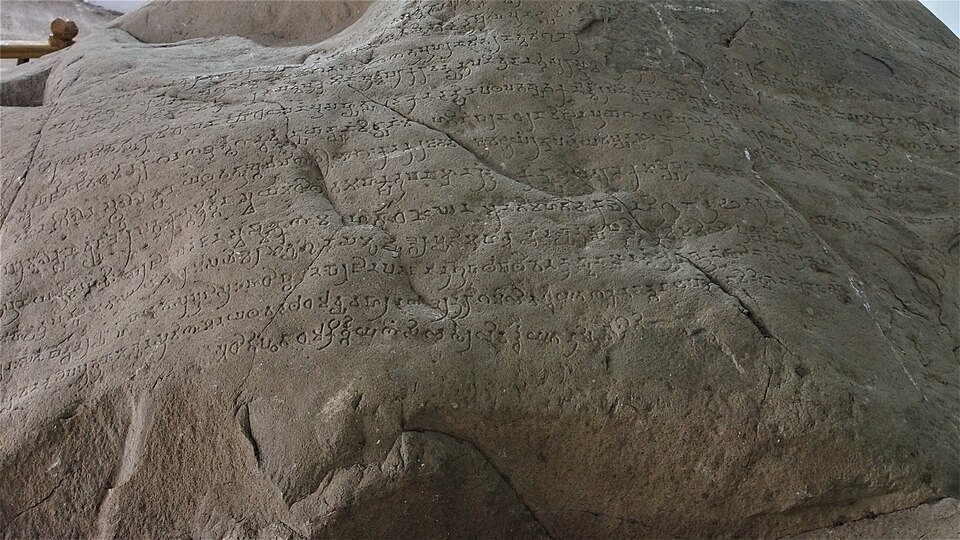
Ashoka's inscriptions fall into groups — 14 Major Rock Edicts, the Minor Rock Edicts, the Separate (Kalinga) Edicts, the Pillar Edicts and the cave inscriptions — and prelims questions almost always turn on matching one numbered edict to its single distinctive theme. The 14 Major Rock Edicts were engraved in Brahmi (and, on the north-west frontier, in Kharoshthi, Greek and Aramaic) on rock faces near the borders of the empire, at sites such as Girnar in Gujarat, Dhauli and Jaugada in Odisha, Kalsi in Uttarakhand, Erragudi in Andhra Pradesh, Sopara in Maharashtra and Shahbazgarhi and Mansehra in the north-west. Within that set, Rock Edict XII is the edict on relations between religious sects, and it is the standard citation for Ashoka's policy of tolerance.
The trap in this question is the pull of Rock Edict XIII. Students associate Ashoka's religious turn with Kalinga, so 'religious' plus 'Ashoka' pulls the memory towards XIII. The discriminator to fix in your head is one line per number: XII = concord among sects; XIII = Kalinga war, remorse and conquest by Dhamma; XI = the gift of Dhamma; II = medical care for humans and animals, wells and trees. Once those four are separate in your mind, the question answers itself. A second, subtler trap is the word 'synthesis': Ashoka nowhere proposes to fuse religions. What XII asks for is that sects hear each other and refrain from disparagement, which the paper is loosely calling synthesis.
- Major Rock Edict XII is Ashoka's edict on concord (samavaya) between religious sects: he honours all sects, warns that extolling one's own sect while disparaging others injures one's own sect, and asks that followers of different sects hear and respect each other's teaching.
- Major Rock Edict II records medical treatment for humans and animals in Ashoka's realm and in neighbouring territories, the planting of medicinal herbs and fruit trees, and wells and shade trees along the roads.
- Major Rock Edict XI declares that there is no gift equal to the gift of Dhamma, and lists the everyday conduct that Dhamma consists of.
- Major Rock Edict XIII describes the conquest of Kalinga, Ashoka's remorse at the killing and deportation it caused, and his adoption of Dhammavijaya; it also names the contemporary Hellenistic kings to whom he says Dhamma envoys were sent.
- The Ashokan edicts were written in Brahmi and Kharoshthi (with Greek and Aramaic versions in the far north-west); the Brahmi script was deciphered by James Prinsep in 1837, which is how the edicts became readable at all.
- Reaching for Rock Edict XIII because it is the famous one. XIII is about Kalinga and Dhammavijaya; the sect-tolerance edict is XII.
- Confusing Rock Edict XI (the gift of Dhamma, addressed to individuals) with Rock Edict XII (relations between sects) — they are adjacent in number and both sound 'religious'.
- Reading 'religious synthesis' as a merger of faiths. Ashoka asks for mutual respect and restraint between sects; he does not propose one blended religion.
Both UPPSC and UPSC ask this area as 'which edict says what' — sometimes by quoting a line from an edict and asking who issued it or which edict it is, sometimes by pairing edict numbers with themes (tolerance, Kalinga, medical welfare, the southern kingdoms), and sometimes through the Dhamma-mahamatras and the decipherment of Brahmi.
The Asokan major rock edicts which tell us about the Sangam Kingdom include rock edicts
- (a) I and X
- (b) I and XI
- (c) II and XIII
- (d) II and XIV
Answer(c) II and XIII
The same skill exactly — matching a numbered Major Rock Edict to its distinctive content, here the edicts that name the southern kingdoms.
Assertion (A): According to Asoka’s edicts, social harmony among the people was more important than religious devotion. Reason (R): He spread ideas of equity instead of promotion of religion.
- (a) Both A and R are true, and R is the correct explanation of A
- (b) Both A and R are true, but R is NOT a correct explanation of A
- (c) A is true, but R is false
- (d) A is false, but R is true
Answer(a) Both A and R are true, and R is the correct explanation of A
Tests the same idea from the other side — that Ashoka's edicts put harmony between people and sects above sectarian devotion, which is the substance of Rock Edict XII.
Consider the following statements with respect to Ashoka : 1. The definition of Dhamma given by Ashoka is taken from "Rahulovada-sutta". 2. In the 14th year of his coronation, Ashoka appointed a new type of staff, called Dhamma-mahamatras. Which of the above statements is/are correct ?
- (a) Both 1 and 2
- (b) Neither 1 nor 2
- (c) Only 1
- (d) Only 2
Answer(a) Both 1 and 2
The same Ashokan Dhamma material two years later — the content of the edicts and the machinery Ashoka created to spread the ethic that Rock Edict XII sets out.
- practice — not a real PYQ
Which one of the following Ashokan edicts states that there is no gift equal to the gift of Dhamma?
- (a)Major Rock Edict II
- (b)Major Rock Edict XI
- (c)Major Rock Edict XII
- (d)Major Rock Edict XIII
Answer(b) Major Rock Edict XI — it declares the gift of Dhamma superior to every other gift and lists the conduct that Dhamma consists of.
- practice — not a real PYQ
Consider the following statements about Ashoka's Major Rock Edict XII: 1. It asks that a person should not disparage other sects while praising his own. 2. It records Ashoka's remorse over the Kalinga war. Which of the statements given above is/are correct?
- (a)Only 1
- (b)Only 2
- (c)Both 1 and 2
- (d)Neither 1 nor 2
Answer(a) Only 1 — the injunction against disparaging other sects is Rock Edict XII; the Kalinga remorse belongs to Rock Edict XIII.