
In which of the following types of heat engines carburetor is used ?
- (a)Steam engine
- (b)Diesel engine
- (c)Both diesel and petrol engines
- (d)Petrol engine
Answer
Why
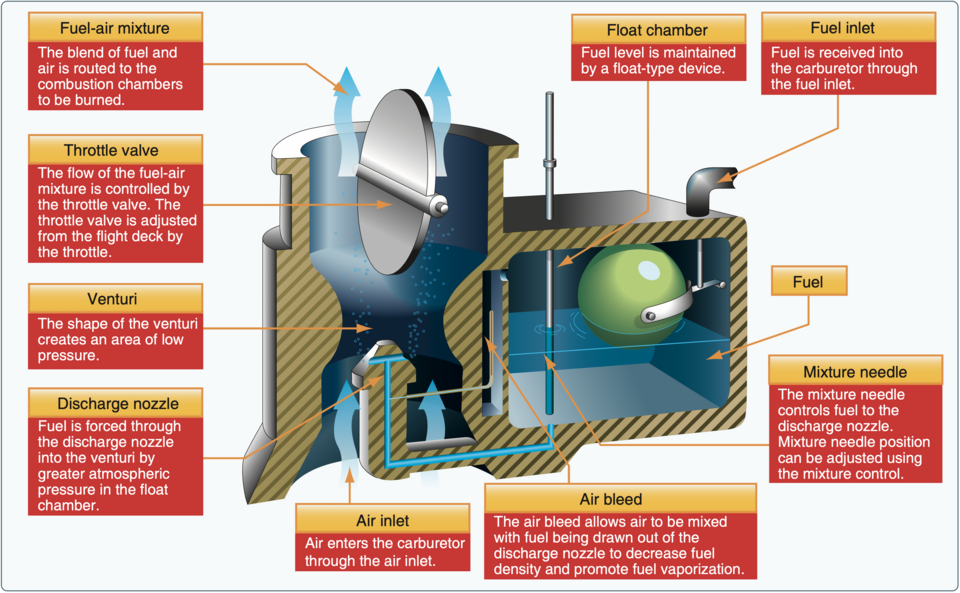
Correct — D, Petrol engine. A carburettor is a device that draws in air, uses the pressure drop across a venturi to pull petrol into that airstream, and delivers a combustible air-fuel mixture to the cylinder before the compression stroke. That premixing is only possible in a spark-ignition engine, which is what a petrol engine is: the mixture is compressed at a relatively modest ratio and then ignited at the right instant by a spark plug. The carburettor's whole job — metering fuel into air ahead of induction — belongs to that cycle and to no other. Historically every petrol car and motorcycle used one; since the late 1980s in the United States and the 1990s more widely, electronic fuel injection has replaced the carburettor in cars and trucks, so the correct statement today is that the carburettor is the classic petrol-engine device and survives mainly in small engines such as lawnmowers, generators, pumps and some motorcycles.
Why the others are wrong
- (a)Steam engine — A steam engine is an external-combustion engine. Fuel is burned in a furnace outside the cylinder to boil water, and what enters the cylinder is steam, not an air-fuel mixture. There is no induction of fuel and air into the working cylinder at all, so there is nothing for a carburettor to do.
- (b)Diesel engine — A diesel is a compression-ignition engine. It draws in and compresses air alone, to a high ratio of roughly 14:1 to 23:1, until the air is hot enough to ignite fuel sprayed into it by an injector near the end of the compression stroke. Premixing fuel with the intake air would cause uncontrolled pre-ignition long before top dead centre, so a carburettor is not merely unused in a diesel — it is impossible in principle. Diesels have used fuel injection from the beginning.
- (c)Both diesel and petrol engines — The tempting middle option, and it fails for the same reason (b) does. It would be right only if a diesel could take a premixed charge, which its compression-ignition cycle forbids. Only the petrol half of this pair is true, and a partly true option is a wrong option.
Concept
Heat engines split first into external-combustion types, where the fuel burns outside the working cylinder (the steam engine), and internal-combustion types, where it burns inside. Internal-combustion engines then split by how the charge is ignited. A spark-ignition engine — the petrol engine, running on the Otto cycle — takes in a premixed charge of air and fuel vapour, compresses it moderately, and fires it with a spark plug at a controlled moment; the mixing device is the carburettor, or in modern engines a fuel injector. A compression-ignition engine — the diesel, running on the Diesel cycle — takes in air alone, compresses it hard enough that its temperature exceeds the fuel's auto-ignition point, and injects fuel at the end of that stroke, so combustion begins the moment fuel meets hot air. The carburettor therefore belongs to exactly one of these families.
Candidates lose this question by treating the carburettor as a generic 'fuel part of an engine' and choosing the safe-looking (c) 'both'. The way to lock the answer is to reason from ignition rather than from fuel: ask what ignites the charge. If a spark plug does it, the charge must already be a mixture, so something must have mixed it — the carburettor. If heat of compression does it, the cylinder must contain air only until the last moment, so the fuel must arrive by injection and mixing beforehand would wreck the cycle. That single test also explains the associated facts examiners like — why diesels need much higher compression ratios, why diesel fuel is rated by cetane number (ease of auto-ignition) while petrol is rated by octane number (resistance to auto-ignition, i.e. resistance to knocking), and why a spark plug is found in a petrol engine but a glow plug, used only for cold starting, in a diesel.
Key facts
- A carburettor uses the venturi effect: air accelerating through a narrowing draws petrol out of the float chamber and atomises it into the airstream, delivering a combustible mixture before compression.
- Petrol engines are spark-ignition and use a comparatively low compression ratio; diesel engines are compression-ignition, compressing air alone at roughly 14:1 to 23:1 until it is hot enough to ignite injected fuel.
- Diesel engines have used fuel injection from the outset — a carburettor is ruled out by the cycle itself, not merely by design preference.
- A steam engine is an external-combustion engine: combustion happens in the furnace, and only steam enters the cylinder, so no air-fuel induction device exists.
- Carburettors were displaced by electronic fuel injection in cars and trucks from the late 1980s (USA) and the 1990s elsewhere, but survive in small engines such as lawnmowers, generators and some motorcycles.
Study next
Common traps
- Choosing 'both diesel and petrol engines' because a carburettor feels like a general engine component. It is specific to spark-ignition engines.
- Mixing up the spark plug and the glow plug. A petrol engine fires its charge with a spark plug; a diesel uses a glow plug only as a cold-start aid, and combustion still begins from compression heat.
- Assuming the carburettor is still standard in cars. It has been superseded by electronic fuel injection in modern vehicles, so 'is used' is best read as the classic petrol-engine arrangement.
Both examinations treat this as everyday-science recall — which engine uses which device, which engine is external-combustion, which fuel is rated by octane and which by cetane. UPPSC prefers the single-fact 'in which type of engine is X used'; UPSC tends to embed the same physics inside a statement set about fuels, emissions or alternative-fuel technology.
Related PYQs
Practice
- practice — not a real PYQ
Which one of the following is an external combustion engine?
- (a)Petrol engine
- (b)Diesel engine
- (c)Steam engine
- (d)Gas turbine
Answer(c) Steam engine — fuel burns in a furnace outside the working cylinder, which receives only steam; the other three burn fuel inside the working chamber. - practice — not a real PYQ
In a diesel engine, ignition of the fuel takes place because of
- (a)a spark produced by the spark plug
- (b)the high temperature of air produced by compression
- (c)the catalytic action of the glow plug throughout the cycle
- (d)the electric arc across the injector nozzle
Answer(b) the high temperature of air produced by compression — the diesel is a compression-ignition engine, and the glow plug only assists cold starting.