
Which one of the following is a land locked country ?
- (a)Surinam
- (b)Bolivia
- (c)Uruguay
- (d)Peru
Answer
Why
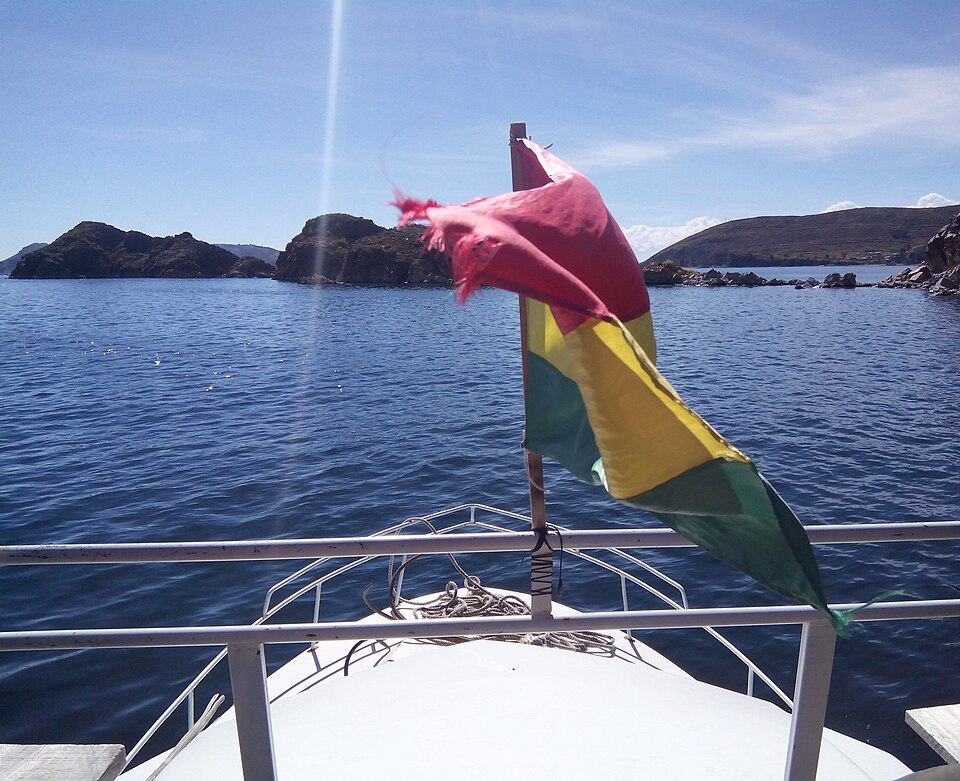
Correct — B, Bolivia. All four options are South American states, and South America has exactly two landlocked countries — Bolivia and Paraguay. Bolivia is the one on this list. It was not always landlocked: it held a stretch of Pacific coast in the Atacama, including the port of Antofagasta, until it lost that littoral to Chile in the War of the Pacific (1879-83), a loss formalised by the truce of 1884 and the treaty of 1904. Bolivia has never accepted the loss as final in political terms — it still observes 'Día del Mar' (Day of the Sea) every 23 March, keeps a navy that patrols Lake Titicaca and the river system rather than an ocean, and took its claim to sovereign access to the Pacific to the International Court of Justice, which ruled against it in 2018. The country's two capitals, Sucre (constitutional) and La Paz (seat of government), are both far inland on the Altiplano.
Why the others are wrong
- (a)Surinam — Suriname, on the north-eastern shoulder of South America between Guyana and French Guiana, faces the Atlantic Ocean. Its capital and main port, Paramaribo, stands on the Suriname River a short distance from the Atlantic coast, so the country is emphatically not landlocked.
- (c)Uruguay — Uruguay has an Atlantic coastline and, in addition, the whole northern shore of the Río de la Plata estuary. Its capital Montevideo is one of the major ports of the South Atlantic — UPPSC itself has tested the Montevideo-Uruguay port pairing in a later paper.
- (d)Peru — Peru has a long Pacific coastline running the length of its western side, with Callao (the port of Lima) as its principal harbour. Indeed Peru fought the War of the Pacific alongside Bolivia against Chile — Peru kept a coast, Bolivia did not, which is precisely the contrast this question turns on.
Concept
A landlocked country is a sovereign state with no coastline on an ocean or on a sea connected to the ocean; it can reach the sea only across another state's territory, which makes transit rights, port access and freight costs a permanent feature of its foreign policy. There are more than forty such states in the world, but they are very unevenly distributed: Africa, Europe and Asia have many, while the Americas have only two, both in South America — Bolivia and Paraguay. Australia has none, and a handful of states (Uzbekistan and Liechtenstein) are 'doubly landlocked', meaning every neighbour is landlocked as well. Being landlocked is a legal-geographic status, not a statement about how far inland a place is: Suriname's interior is remote, but the state has a coast, so it does not qualify.
The trap in this item is that all four options are South American, so a candidate who has memorised 'the landlocked countries of Africa' gets no help. The reliable route is the small, closed fact that South America has only two landlocked states, Bolivia and Paraguay — and Paraguay is not on the list, so the answer must be Bolivia if it is on the list at all. A second route is to eliminate by port: Montevideo for Uruguay, Callao for Peru, Paramaribo for Suriname are all well-known harbours, which knocks out three options directly. Notice also the geographic irony worth remembering — the coast Bolivia lost sits on the same Atacama copper belt that makes Chile the world's largest copper producer, so Bolivia gave up both its sea access and some of the richest copper ground on Earth in one war.
Key facts
- South America has exactly two landlocked countries — Bolivia and Paraguay; every other state on the continent has an Atlantic, Pacific or Caribbean coast.
- Bolivia lost its Pacific littoral, including the port of Antofagasta, to Chile in the War of the Pacific (1879-83); the loss was fixed by the truce of 1884 and the treaty of 1904.
- Bolivia still marks 'Día del Mar' (Day of the Sea) on 23 March and maintains a navy, which operates on Lake Titicaca and the inland waterways.
- Bolivia took its claim to sovereign access to the Pacific to the International Court of Justice; the Court ruled against it in 2018.
- Bolivia has two capitals — Sucre is the constitutional capital and seat of the judiciary, La Paz the seat of government and legislature.
Study next
Common traps
- Assuming a country deep in the interior of a continent must be landlocked. Suriname's territory is largely forested interior, but it has an Atlantic frontage and so is not landlocked.
- Confusing Uruguay with Paraguay. Paraguay is the other landlocked South American state; Uruguay is coastal, and the two names are close enough that examiners rely on the slip.
- Treating a river port or a lake navy as evidence of a coast. Bolivia has both, and is still landlocked.
This is a classic single-fact world-geography recall item. UPPSC asks it as a straight 'which one is landlocked' or as a port-country / country-capital match; UPSC has asked the near-identical question and also builds around it — which sea does a country border, which countries does a range or river pass through, which states share a named lake.
Related PYQs
Which one of the following countries is land locked?
- (a) Bolivia
- (b) Peru
- (c) Suriname
- (d) Uruguay
Answer(a) Bolivia
The same question with the same four countries, asked by UPSC nineteen years earlier — only the option order differs, which is a reminder that state commissions recycle UPSC's older geography items almost verbatim.
Which of the following (Port-Country) is not correctly matched?
- (a) Montevideo – Uruguay
- (b) Rotterdam – Netherland
- (c) Igarka – China
- (d) Jakarta – Indonesia
Answer(c) Igarka – China
Approaches the same knowledge from the port side — the Montevideo-Uruguay pairing that UPPSC treats as correct here is exactly what rules Uruguay out of being landlocked in the 2022 item.
Practice
- practice — not a real PYQ
Which one of the following pairs of South American countries is landlocked?
- (a)Bolivia and Ecuador
- (b)Paraguay and Uruguay
- (c)Bolivia and Paraguay
- (d)Guyana and Paraguay
Answer(c) Bolivia and Paraguay — the only two landlocked states on the continent; Ecuador, Uruguay and Guyana all have coasts. - practice — not a real PYQ
Bolivia lost its access to the Pacific Ocean as a result of which of the following?
- (a)The Chaco War
- (b)The War of the Pacific
- (c)The Treaty of Tordesillas
- (d)The Falklands conflict
Answer(b) The War of the Pacific (1879-83) — Chile took Bolivia's Atacama littoral including Antofagasta, a loss confirmed by the 1904 treaty.