
Which Mughal ruler patronaged Kavindra Acharya Saraswati of Banaras, a great scholar of Sanskrit and Hindi ?
- (a)Jahangir
- (b)Humayun
- (c)Shahjahan
- (d)Akbar
Correct — C, Shahjahan. The official key marks Shah Jahan (reigned 1628-1658) as the emperor who patronised Kavindracharya Saraswati, the Banaras scholar of Sanskrit and Hindi. Be clear about how well sourced this is: the account taught in Indian history writing is that Kavindracharya was honoured at Shah Jahan's court with the title 'Sarvavidyanidhana' (treasury of all learning), that the anthologies Kavindrachandrodaya and Kavindrachandrika collect verses by many poets praising him, and that the Kavindracharya Suchipatram is the catalogue of his very large Sanskrit library. He is also traditionally credited with persuading Shah Jahan to remit the pilgrim tax levied on Hindus at Banaras and Prayag — but that is a traditional credit, not something this card can source to a primary record, and no standard encyclopaedic article on him could be traced when this card was prepared. So take the answer from the key and from the settled textbook account, and treat the pilgrim-tax episode as tradition rather than as an established date-and-document fact. The elimination of the other three, by contrast, is straightforward chronology and does not depend on any of that detail.
- (a)Jahangir — Jahangir reigned 1605-1627 and his patronage is remembered above all for painting and for his own memoir, the Tuzuk-i-Jahangiri, with its close observation of natural history. He is not the emperor associated with the Banaras Sanskrit scholar in any account, and the key does not mark him.
- (b)Humayun — Chronologically the weakest option. Humayun ruled 1530-1540, lost his throne to Sher Shah Suri, spent the following years in exile in Persia, regained Delhi in 1555 and died in 1556. He held power for barely a year after his return and was in no position to run a court of Sanskrit learning at Agra or Delhi.
- (d)Akbar — The genuinely tempting option, because Akbar (1556-1605) is the emperor most identified with Sanskrit scholarship at the Mughal court — his translation establishment produced Persian versions of the Mahabharata as the Razmnama, of the Ramayana, and of the Yogavasistha, the last by Nizamuddin Panipati, a fact UPSC has itself tested. But that reputation attaches to Akbar's reign, and both the official key and the standard account place Kavindracharya at Shah Jahan's court a generation later.
Mughal patronage of Indian learning ran in two related channels. One was translation: from Akbar's reign onward a court establishment rendered Sanskrit works into Persian — the Mahabharata as the Razmnama, the Ramayana, the Yogavasistha — so that Persian-reading elites could access Indian philosophy and epic. The other was direct patronage of individual pandits, who were given titles, stipends and access to the emperor and who in turn spoke for Hindu religious interests at court. Under Shah Jahan the second channel is the one that matters for this question, and the intellectual current continued through his eldest son Dara Shikoh, whose Majma-ul-Bahrain sought common ground between Sufi and Vedantic thought and whose Persian rendering of the Upanishads, the Sirr-i-Akbar, was completed in the 1650s.
The trap is the reflex 'Sanskrit scholar at the Mughal court, therefore Akbar'. Akbar owns that association in most students' memory because of the Razmnama and the wider translation programme, and an examiner who wants a wrong answer only has to name a Sanskrit pandit and wait. Two things break the reflex. First, hold the reigns in order — Humayun to about 1556, Akbar to 1605, Jahangir to 1627, Shah Jahan 1628-1658 — and ask which reign the person belongs to rather than which emperor 'liked Sanskrit'. Second, note that this figure is specifically a Banaras man and specifically a scholar of Sanskrit and Hindi, and that his standard association is with the pilgrim-tax remission at Banaras and Prayag, an episode placed in Shah Jahan's reign. Where a card like this must lean on textbook tradition, the honest position is to answer as the key does and to say so rather than to dress the tradition up as documented fact.
- Shah Jahan reigned 1628-1658; Jahangir 1605-1627; Akbar 1556-1605; Humayun 1530-1540 and again 1555-1556.
- The standard account gives Kavindracharya Saraswati the court title 'Sarvavidyanidhana' under Shah Jahan and remembers him through the Kavindrachandrodaya and Kavindrachandrika anthologies and the Kavindracharya Suchipatram library catalogue; no encyclopaedic article on him could be traced for this card, so treat these as the textbook account.
- His role in securing the remission of the pilgrim tax on Hindus at Banaras and Prayag is traditionally credited to him and should be stated as tradition, not as a sourced event with a date.
- Akbar's reign produced the Persian Mahabharata (Razmnama) and the Persian Yogavasistha by Nizamuddin Panipati — the body of work that makes Akbar the tempting wrong answer here.
- Shah Jahan's reign is documented by his official historian Abdul Hamid Lahori, author of the Padshahnama, and saw Dara Shikoh's Majma-ul-Bahrain and his Persian Upanishads, the Sirr-i-Akbar.
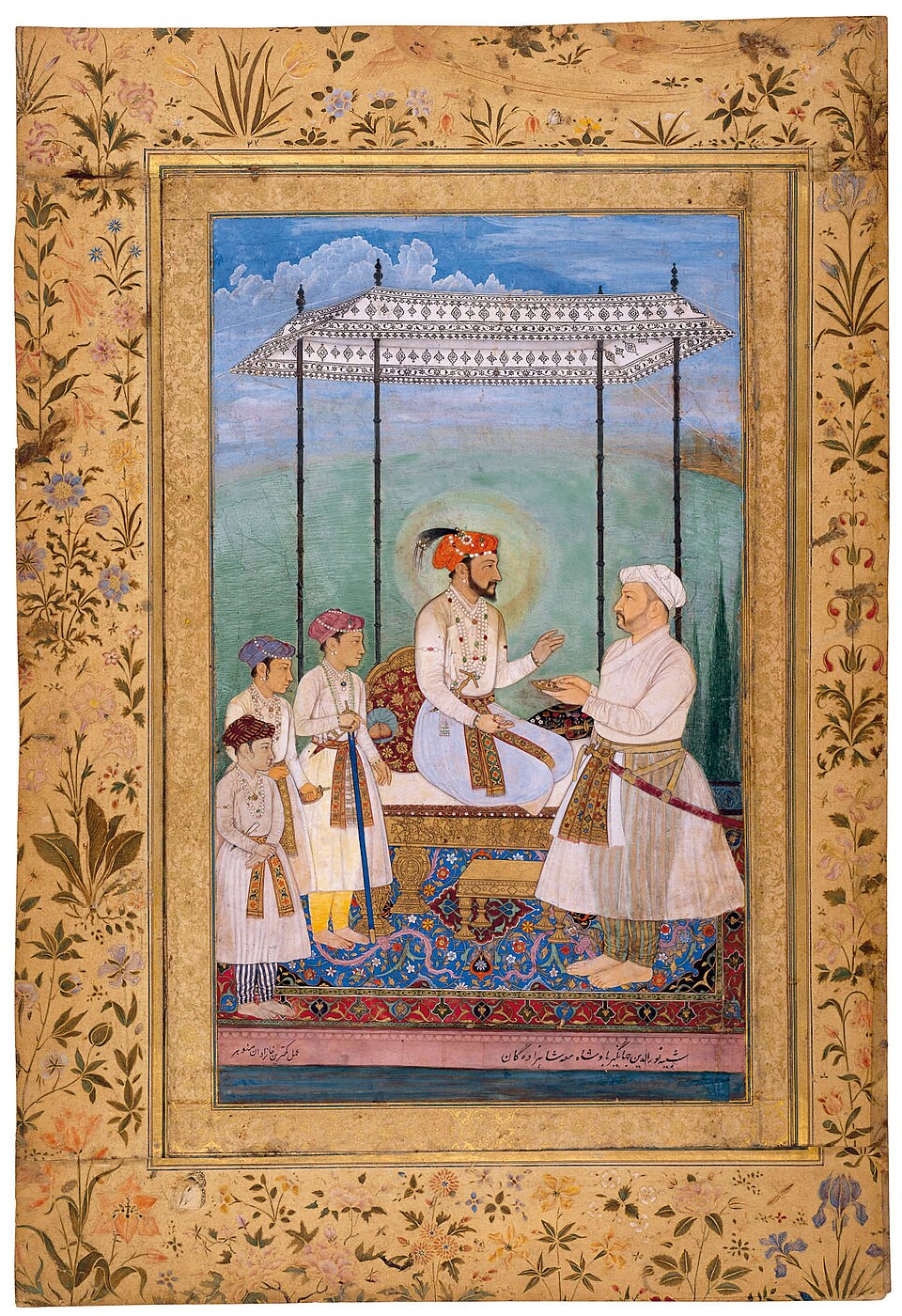
- Answering 'Akbar' by reflex whenever a Sanskrit scholar or a Sanskrit-to-Persian translation appears in the stem. Check whose reign the individual belongs to.
- Choosing Humayun for any early-Mughal cultural question. His effective rule was short and interrupted by a long exile, so sustained court patronage under him is rarely the answer.
- Repeating the pilgrim-tax story as an established fact with a date. It is a traditional credit, and this card deliberately does not give it one.
UPPSC likes the direct 'which ruler patronised X' or 'X was in whose court' format, often with all four Mughals as options. UPSC asks the same relationship from the other end — who was Abdul Hamid Lahori, who translated the Yogavasistha and in whose reign — so the useful revision unit is a table of scholar, work and reign rather than a list of emperors.
In Indian history, who was Abdul Hamid Lahori?
- (a) An important military commander during Akbar’s reign
- (b) An official historian of the reign of Shah Jahan
- (c) An important noble and confidant of Aurangzeb
- (d) A chronicler and poet during the reign of Muhammad Shah
Answer(b) An official historian of the reign of Shah Jahan
The same skill in the same reign — attaching a named scholar to the Mughal emperor who patronised him, with the four reigns supplied as the options.
"YogaVasistha" was translated into Persian by Nizamuddin Panipati during the reign of:
- (a) Akbar
- (b) Humayun
- (c) Shahjahan
- (d) Aurangzeb
Answer(a) Akbar
Explains exactly why Akbar is the tempting distractor here — the Sanskrit-to-Persian translation programme belongs to his reign, so 'Sanskrit scholarship at the Mughal court' points to Akbar unless the individual is placed in time.
Tappa style of music was refined and developed in which of the following Mughal Emperor's Court?
- (a) Jahangir
- (b) Akbar
- (c) Shahjahan
- (d) Muhammad Shah
Answer(d) Muhammad Shah
UPPSC's standing habit of asking which Mughal court nurtured a named art or scholar, with the emperors as options — and again the answer is not the emperor a candidate would guess first.
- practice — not a real PYQ
The Persian translation of the Upanishads, the 'Sirr-i-Akbar', was the work of
- (a)Abul Fazl
- (b)Dara Shikoh
- (c)Abdul Hamid Lahori
- (d)Nizamuddin Panipati
Answer(b) Dara Shikoh — Shah Jahan's eldest son, who also wrote the Majma-ul-Bahrain on the common ground between Sufi and Vedantic thought.
- practice — not a real PYQ
The Mahabharata was rendered into Persian as the 'Razmnama' under which Mughal emperor?
- (a)Humayun
- (b)Akbar
- (c)Jahangir
- (d)Aurangzeb
Answer(b) Akbar — the Razmnama came out of the translation establishment of his reign, which also produced a Persian Ramayana and Yogavasistha.