
Which of the following statements with reference to crops cultivated in India is/are correct? 1. Bajra grows well in sandy and shallow black soils, whereas red and shallow black soil is suited for Ragi 2. Bajra is predominantly grown in states like Rajasthan, Uttar Pradesh and Maharashtra, while Ragi is mainly cultivated in Karnataka, Tamil Nadu and Himachal Pradesh Select the answer using the code given below:
- (a)1 only
- (b)2 only
- (c)Both 1 and 2
- (d)Neither 1 nor 2
Answer
Why
Correct — C, both statements are correct. Statement 1 matches the textbook soil associations — bajra (pearl millet) does well on sandy soils and shallow black soil, while ragi (finger millet) grows on red and shallow black soils. Statement 2 matches the leading-state picture — bajra is grown mainly in Rajasthan, Uttar Pradesh and Maharashtra, and ragi is grown mainly in Karnataka and Tamil Nadu, with Himachal Pradesh also among the ragi-growing states. Since both the soil and the state descriptions are accurate, the answer is both 1 and 2.
Why the others are wrong
- (a)1 only — It rejects statement 2, but the state pattern is correct — bajra dominates in Rajasthan, Uttar Pradesh and Maharashtra, and ragi in Karnataka, Tamil Nadu and Himachal Pradesh.
- (b)2 only — It rejects statement 1, but the soil pattern is correct — bajra suits sandy and shallow black soils and ragi suits red and shallow black soils.
- (d)Neither 1 nor 2 — Both statements are accurate, so rejecting both is wrong.
Concept
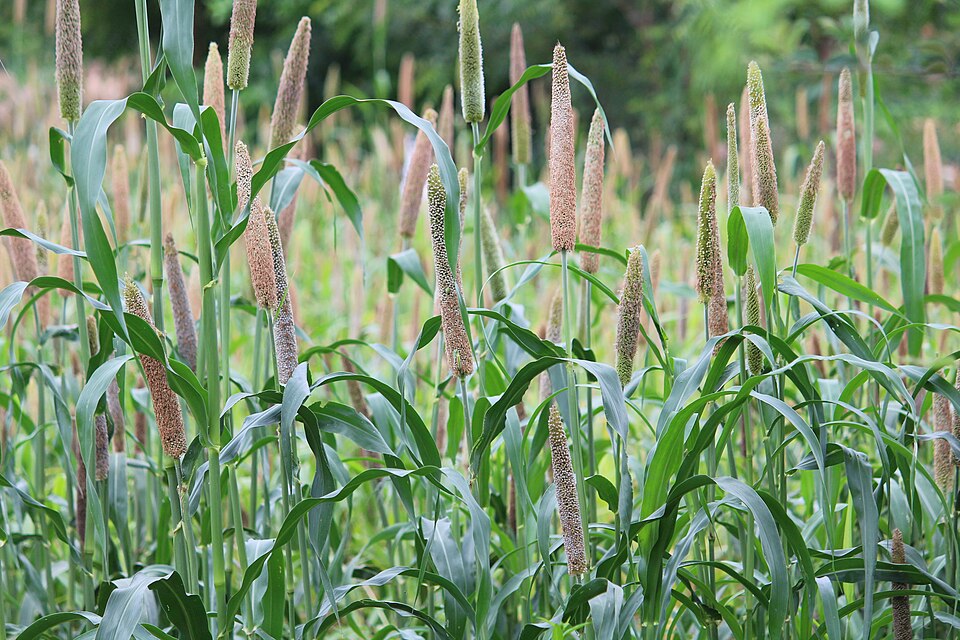
Bajra (pearl millet) and ragi (finger millet) are millets, a group of hardy coarse grains grown mainly in the kharif season on dry, less fertile land with little irrigation. They are drought-tolerant and nutritious, which is why India promoted them heavily during the International Year of Millets in 2023 under the name Shree Anna.
The item pairs each millet with its typical soils and leading states, and both pairings follow the standard geography. Bajra belongs to the drier north-west and Deccan margins on sandy or shallow black soils, while ragi belongs to the red-soil tracts of the south, with Himachal Pradesh and other hill states also growing it. Checking each half against these facts confirms both statements.
Key facts
- Bajra (pearl millet) grows well on sandy soils and shallow black soil.
- Ragi (finger millet) grows well on red, black, sandy and shallow black soils.
- Bajra is grown mainly in Rajasthan, Uttar Pradesh, Maharashtra, Gujarat and Haryana; ragi mainly in Karnataka and Tamil Nadu, with Himachal Pradesh, Uttarakhand and Sikkim also growing it.
- Both are kharif millets and are drought-resistant, needing far less water than rice or wheat.
Study next
Common traps
- Swapping the soils or leading states of bajra and ragi.
- Assuming ragi is grown only in the south — Himachal Pradesh, Uttarakhand and Sikkim also grow it.
Asked as statement pairs on millet soils and states, or as a match of a millet to its soil or leading state.
Related PYQs
Consider the following crops of India: 1. Groundnut 2. Sesamum 3. Pearl millet Which of the above is/are predominantly rainfed crop/crops?
- (a) 1 and 2 only
- (b) 2 and 3 only
- (c) 3 only
- (d) 1, 2 and 3
Answer(d) 1, 2 and 3 — all three are hardy, predominantly rainfed kharif crops.
Turns on the same crop as this item — pearl millet (bajra) as a hardy, rainfed dryland crop, matching its sandy-soil, low-water profile.
Practice
- practice — not a real PYQ
Bajra (pearl millet) is predominantly grown in which one of the following states?
- (a)Kerala
- (b)Rajasthan
- (c)Assam
- (d)West Bengal
Answer(b) Rajasthan — the leading bajra-growing state on its sandy, dry soils. - practice — not a real PYQ
Which one of the following crops is a millet (coarse grain)?
- (a)Ragi
- (b)Mustard
- (c)Gram
- (d)Groundnut
Answer(a) Ragi — finger millet is a coarse grain, unlike the oilseed and pulse in the other options.