
Consider the following conditions favourable for the formation and intensification of Tropical Storms: 1. Presence of the Coriolis force 2. Upper divergence above the sea level system 3. High variations in the vertical wind speed Which of the conditions given above is/are correct?
- (a)1 only
- (b)2 only
- (c)1 and 2
- (d)2 and 3
Answer
Why
Correct — C, 1 and 2. Two of the listed conditions genuinely favour the formation and intensification of a tropical storm. Condition 1, the presence of the Coriolis force, gives the converging air its spin and lets a low-pressure centre organise — this is why cyclones do not form right on the equator, where the Coriolis force is zero. Condition 2, upper-level divergence above the surface low, draws rising air away at the top of the system and keeps the inflow and convection going. Condition 3 is wrong as worded: cyclones need SMALL variation in vertical wind speed (low vertical wind shear); HIGH variation tears a developing storm apart, so it hinders formation rather than helping it. Hence only 1 and 2 are correct.
Why the others are wrong
- (a)1 only — It keeps the Coriolis force but drops upper-level divergence, which is a genuine favourable condition that vents the rising air aloft.
- (b)2 only — It omits the Coriolis force, yet without it converging air cannot acquire the spin needed to organise into a cyclone.
- (d)2 and 3 — It includes condition 3, which is false — cyclones require small (low), not high, variation in vertical wind speed — and it drops the correct Coriolis condition.
Concept
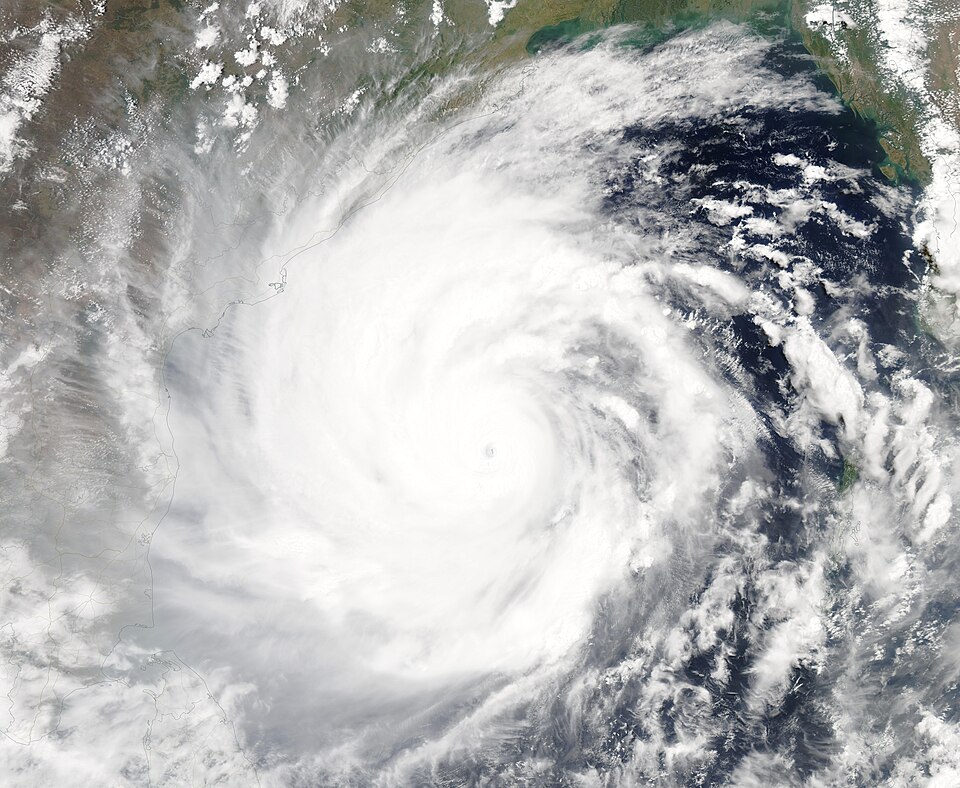
A tropical cyclone forms only where several ingredients come together: a large ocean area with surface water warmer than about 27 degrees Celsius to supply heat and moisture, the Coriolis force to give the system spin, a pre-existing weak low-pressure disturbance, low vertical wind shear (small variation of wind with height) so the storm can grow vertically without being sheared apart, and upper-level divergence that pumps away the air rising in the core. Take away any of these and the storm weakens or fails to form.
Two of the three statements are textbook favourable conditions; the trap is statement 3, which inverts the truth. Cyclones need LOW wind shear, so a condition demanding 'high variation in vertical wind speed' is the wrong one — catching that inversion isolates the answer.
Key facts
- The Coriolis force is essential for cyclonic rotation, which is why cyclones do not form within a few degrees of the equator.
- Upper-level (tropospheric) divergence removes the rising air and sustains the surface inflow and convection.
- Tropical cyclones need LOW vertical wind shear (small variation of wind speed with height) to intensify.
- Other favourable conditions include sea-surface temperature above about 27 degrees Celsius and a pre-existing low-pressure disturbance.
Study next
Common traps
- Cyclones need LOW vertical wind shear — a statement asking for 'high variation in vertical wind speed' is the false one.
- The Coriolis force is necessary, so cyclones are absent in the narrow equatorial belt where it is negligible.
Usually asked by listing favourable conditions and slipping in one inverted condition (high wind shear) or by asking why cyclones avoid the equator.
Related PYQs
In the South Atlantic and South-Eastern Pacific regions in tropical latitudes, cyclone does not originate. What is the reason?
- (a) Sea surface temperatures are low
- (b) Inter-Tropical Convergence Zone seldom occurs
- (c) Coriolis force is too weak
- (d) Absence of land in those regions
Answer(b) Inter-Tropical Convergence Zone seldom occurs — without it the seed disturbances and low-level cyclonic vorticity for cyclone formation are missing.
Same concept — the conditions that a tropical cyclone needs to form. Where those conditions are absent (no ITCZ), cyclones do not originate.
Which of the following statements regarding tropical cyclones is/are correct? 1. These storms develop during the summer and autumn in every tropical ocean except the South Atlantic and eastern South Pacific Oceans. 2. Tropical cyclones that occur in the North Atlantic and eastern North Pacific Oceans are known as typhoons. 3. Tropical cyclones that occur in the Indian and South Pacific Oceans are called cyclones. Select the answer using the code given below:
- (a) 3 only
- (b) 1 and 2 only
- (c) 1 and 3 only
- (d) 1, 2 and 3
Answer(c) 1 and 3 only
A previous NDA GAT item on tropical cyclones — the same body of knowledge (where and how tropical storms form and what they are called).
Practice
- practice — not a real PYQ
Tropical cyclones do not usually form within about 5 degrees of the equator because there:
- (a)the sea is too cold
- (b)the Coriolis force is negligible
- (c)there is too much land
- (d)the air is too dry
Answer(b) the Coriolis force is negligible near the equator, so converging air cannot acquire the spin needed to organise a cyclone. - practice — not a real PYQ
For a tropical cyclone to intensify, the vertical wind shear should be:
- (a)very high
- (b)low (small variation of wind with height)
- (c)exactly reversed with height
- (d)irrelevant to the storm
Answer(b) low — small variation of wind speed with height lets the storm build vertically without being torn apart.