
Which of the following statements regarding tropical cyclones is/are correct? 1. These storms develop during the summer and autumn in every tropical ocean except the South Atlantic and eastern South Pacific Oceans. 2. Tropical cyclones that occur in the North Atlantic and eastern North Pacific Oceans are known as typhoons. 3. Tropical cyclones that occur in the Indian and South Pacific Oceans are called cyclones. Select the answer using the code given below:
- (a)3 only
- (b)1 and 2 only
- (c)1 and 3 only
- (d)1, 2 and 3
Answer
Why
Correct — C, statements 1 and 3 only. Tropical cyclones need warm ocean water (about 27 degrees C or more) and a suitable seed disturbance, so they form in summer and autumn over all tropical oceans except the South Atlantic and the eastern South Pacific, where cooler waters and a rarely-present ITCZ starve them of energy — statement 1 is right. The regional names differ by basin: storms of the Indian Ocean and the South Pacific are called cyclones, which makes statement 3 right. Statement 2 is wrong on the name: the storms of the North Atlantic and eastern North Pacific are called hurricanes, while 'typhoon' is reserved for the north-west Pacific. Dropping statement 2 leaves 1 and 3 only.
Why the others are wrong
- (a)3 only — Statement 1 is also true — tropical cyclones do form over every tropical ocean except the South Atlantic and eastern South Pacific, so limiting the answer to statement 3 alone is incomplete.
- (b)1 and 2 only — Statement 2 is false — North Atlantic and eastern North Pacific storms are hurricanes, not typhoons; this option keeps the wrong name and drops the correct statement 3.
- (d)1, 2 and 3 — Wrongly includes statement 2; those storms are hurricanes (typhoons belong to the north-west Pacific), so all three cannot be correct.
Concept
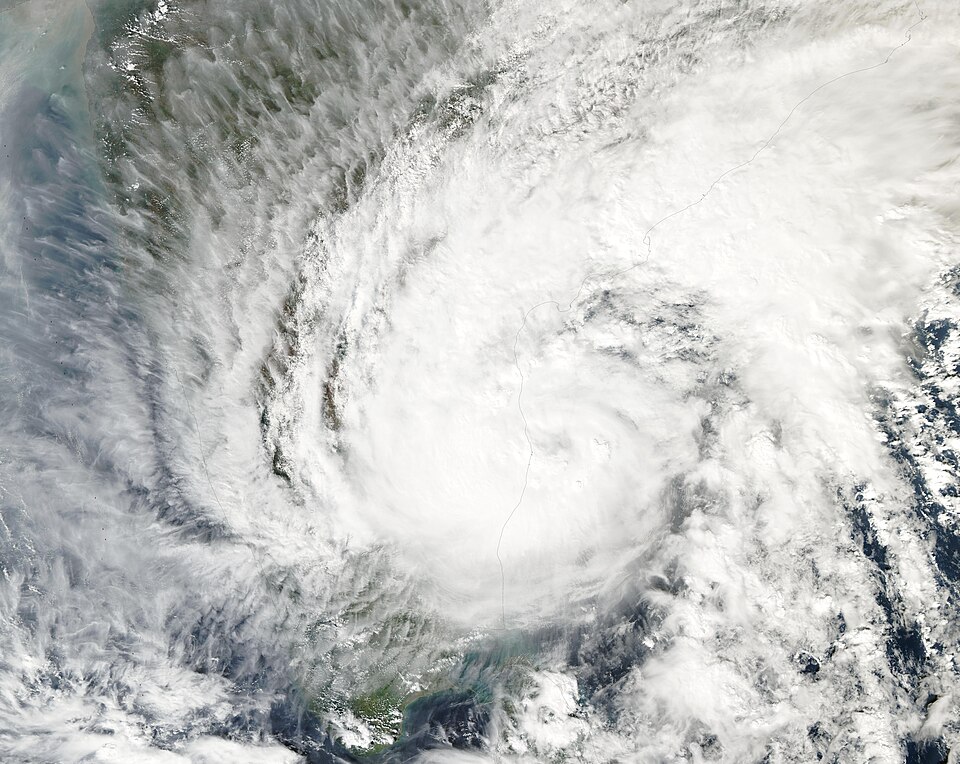
Tropical cyclones are intense low-pressure storm systems that form over warm tropical seas, with a calm central eye ringed by an eyewall of the strongest winds and spiralling rainbands. The same phenomenon carries different regional names: hurricane in the North Atlantic and eastern North Pacific, typhoon in the north-west Pacific, and cyclone over the Indian and South Pacific Oceans.
The trap is the naming in statement 2. Students who remember that the Pacific has 'typhoons' may wrongly attach that name to the eastern North Pacific too, but that basin's storms are hurricanes. The South Atlantic and eastern South Pacific are famously almost cyclone-free because their waters are cool and the ITCZ seldom shifts there.
Key facts
- Tropical cyclones form over warm oceans (about 27 degrees C or more) in the summer-autumn season.
- They almost never form in the South Atlantic or the eastern South Pacific, where waters are cool and the ITCZ seldom occurs.
- North Atlantic and eastern North Pacific storms are called hurricanes; north-west Pacific storms are typhoons.
- Storms over the Indian Ocean and the South Pacific are called cyclones (and willy-willies near Australia).
Study next
Common traps
- Calling North Atlantic or eastern North Pacific storms 'typhoons' — they are hurricanes; typhoons are the north-west Pacific name.
- Thinking cyclones form right on the equator — the Coriolis force is too weak within about 5 degrees of it.
A statement-code question on cyclone geography and naming — the decisive trap is the hurricane-versus-typhoon mix-up in statement 2.
Related PYQs
In the South Atlantic and South-Eastern Pacific regions in tropical latitudes, cyclone does not originate. What is the reason?
- (a) Sea surface temperatures are low
- (b) Inter-Tropical Convergence Zone seldom occurs
- (c) Coriolis force is too weak
- (d) Absence of land in those regions
Answer(b) Inter-Tropical Convergence Zone seldom occurs — without the ITCZ to seed easterly-wave disturbances, tropical cyclones do not originate in the South Atlantic or south-eastern Pacific.
Directly explains statement 1 of this NDA question — why the South Atlantic and eastern South Pacific are the two tropical oceans that stay almost cyclone-free.
Assertion (A): The surface winds spiral inwards upon the centre of the cyclone. Reason (R): Air descends in the centre of the cyclone.
- (a) Both A and R are individually true and R is the correct explanation of A
- (b) Both A and R are individually true but R is not a correct explanation of A
- (c) A is true but R is false
- (d) A is false but R is true
Answer(b) Both true but R is not the explanation — surface winds spiral in because of the pressure gradient and Coriolis force; the subsiding air in the eye does not cause that inflow.
Tests the internal structure and wind pattern of the same tropical cyclones this NDA question is about — the inward-spiralling winds and calm subsiding eye.
Practice
- practice — not a real PYQ
Tropical cyclones of the north-west Pacific Ocean, affecting countries such as Japan and the Philippines, are called
- (a)hurricanes
- (b)typhoons
- (c)willy-willies
- (d)tornadoes
Answer(b) typhoons — the north-west Pacific name; the North Atlantic uses 'hurricane' and the Indian Ocean 'cyclone'. - practice — not a real PYQ
In which ocean region do tropical cyclones almost never form?
- (a)Bay of Bengal
- (b)North-west Pacific
- (c)South Atlantic
- (d)Caribbean Sea
Answer(c) South Atlantic — cool waters and a rarely-present ITCZ make tropical cyclones extremely rare there.