
Consider the following statements with reference to structure of the Earth's atmosphere: 1. Thickness of the troposphere is greatest at the equator 2. The air temperature of the tropopause is highest above the poles 3. The temperature in troposphere decreases at the rate of 1 °F for every 165 m of height Which of the statements given above is/are correct?
- (a)1 only
- (b)1 and 2 only
- (c)2 and 3 only
- (d)1, 2 and 3
Answer
Why
Correct — B, 1 and 2 only. Statement 1 is true: the troposphere is thickest over the equator (about 16-18 km) and thinnest over the poles (about 8-9 km), because vigorous equatorial convection pushes its top higher. Statement 2 is true: the tropopause is warmest over the poles — because the equatorial troposphere extends so much higher, its top cools to around minus 80 degrees Celsius, whereas the lower polar tropopause tops out at only about minus 45 degrees Celsius, so the tropopause is warmer over the poles. Statement 3 is the error: temperature in the troposphere falls by about 1 degree Celsius, not 1 degree Fahrenheit, for every 165 m of ascent (the normal lapse rate of roughly 6.5 degrees Celsius per km). So only 1 and 2 are correct.
Why the others are wrong
- (a)1 only — It drops statement 2, but the tropopause really is warmer over the poles than over the equator, so statement 2 is also correct.
- (c)2 and 3 only — It wrongly accepts statement 3 (which has the temperature unit wrong — it should read 1 degree Celsius, not 1 degree Fahrenheit) and omits the correct statement 1.
- (d)1, 2 and 3 — It includes statement 3, which is false because of the Fahrenheit-for-Celsius error in the lapse rate.
Concept
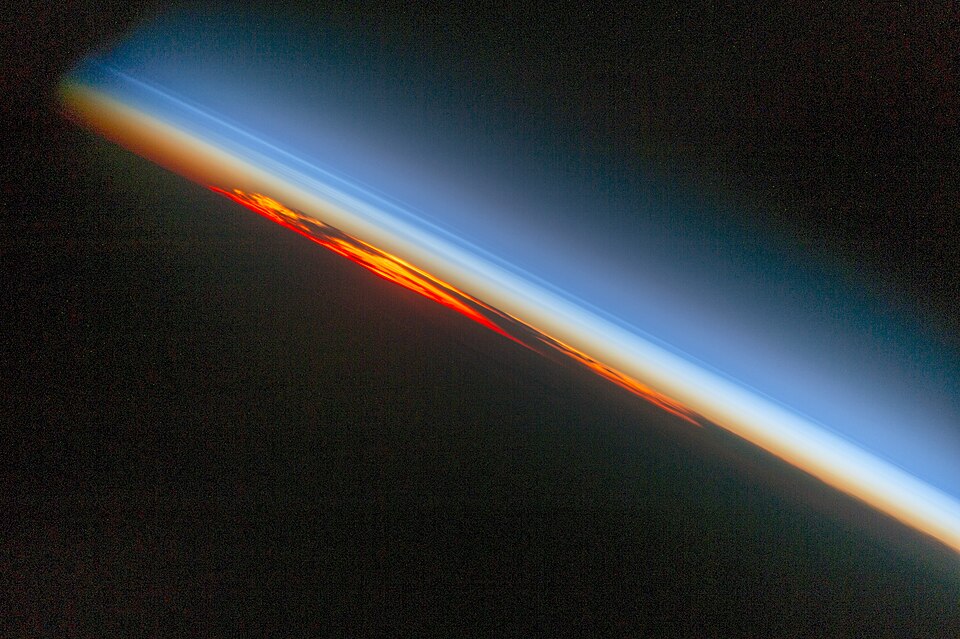
The atmosphere is layered by its temperature behaviour: troposphere, stratosphere, mesosphere and thermosphere. The troposphere is the lowest, weather-bearing layer, and its temperature falls with height. Its thickness is not uniform — strong convection over the hot equator lifts its top to about 16-18 km, while over the cold poles it is only about 8-9 km. The tropopause is the boundary at the top of the troposphere; because the equatorial troposphere reaches so much higher, its tropopause is far colder than the lower, warmer polar tropopause.
Statements 1 and 2 are linked by the same cause — deep equatorial convection. The trap is statement 3, which quotes the familiar 'about 1 degree per 165 m' lapse rate but swaps Celsius for Fahrenheit; catching that unit error is the key to rejecting it.
Key facts
- The troposphere is about 16-18 km thick over the equator and about 8-9 km over the poles.
- The tropopause is colder over the equator (about minus 80 degrees Celsius) than over the poles (about minus 45 degrees Celsius).
- The normal (environmental) lapse rate is roughly 6.5 degrees Celsius per km, i.e. about 1 degree Celsius per 165 m.
- The troposphere holds almost all the atmosphere's water vapour and weather; the tropopause caps it.
Study next
Common traps
- Watch the units in lapse-rate statements — about 1 degree Celsius (not Fahrenheit) per 165 m.
- The tropopause is colder over the equator and warmer over the poles, which feels counter-intuitive.
Usually asked as a statements-based item mixing tropospheric thickness, tropopause temperature and the lapse-rate figure, with a hidden unit error.
Related PYQs
Assertion (A): The thickness of the atmosphere is maximum over the Equator. Reason (R): High insolation and strong convection currents occur over the Equator.
- (a) Both A and R are individually true and R is the correct explanation of A
- (b) Both A and R are individually true but R is not the correct explanation of A
- (c) A is true but R is false
- (d) A is false but R is true
Answer(d) A is false but R is true — high insolation and strong convection do occur over the equator, but it is only the troposphere that bulges upward there, not the whole atmosphere.
Same physics — equatorial convection lifts the troposphere higher over the equator. UPSC marks the whole-atmosphere claim false while confirming the troposphere bulges (exactly statement 1 here).
Practice
- practice — not a real PYQ
The troposphere is thickest over which one of the following?
- (a)The poles
- (b)The equator
- (c)The Tropic of Cancer
- (d)The Arctic Circle
Answer(b) The equator — strong equatorial convection lifts the tropopause to about 16-18 km. - practice — not a real PYQ
The normal (environmental) lapse rate in the troposphere is approximately:
- (a)1 degree Celsius per 100 m
- (b)6.5 degrees Celsius per km
- (c)10 degrees Celsius per km
- (d)1 degree Celsius per km
Answer(b) 6.5 degrees Celsius per km — that is about 1 degree Celsius for every 165 m of ascent.