
Which of the following statements with reference to soil forming processes is/are correct? 1. Translocation, enrichment, removal and transformation are different classes of soil forming processes 2. In translocation, fine particles are transported downward by eluviation and accumulate in lower horizons by illuviation Select the answer using the code given below:
- (a)1 only
- (b)2 only
- (c)Both 1 and 2
- (d)Neither 1 nor 2
Answer
Why
Correct — C, Both 1 and 2. Statement 1 correctly lists the four broad classes of soil-forming processes recognised in pedology (Simonson's model): translocation, enrichment (additions), removal (losses) and transformation. Statement 2 correctly describes translocation itself — fine material such as clay, humus and iron and aluminium oxides is washed downward out of an upper horizon by eluviation and re-deposited, building up in a lower horizon by illuviation. Both statements are accurate, so the answer is both.
Why the others are wrong
- (a)1 only — It accepts the four-class scheme but wrongly rejects statement 2, which gives a textbook-correct description of translocation by eluviation and illuviation.
- (b)2 only — It accepts the eluviation-illuviation description but wrongly rejects statement 1 — translocation, enrichment, removal and transformation really are the four recognised classes.
- (d)Neither 1 nor 2 — Both statements are in fact correct, so rejecting both is wrong.
Concept
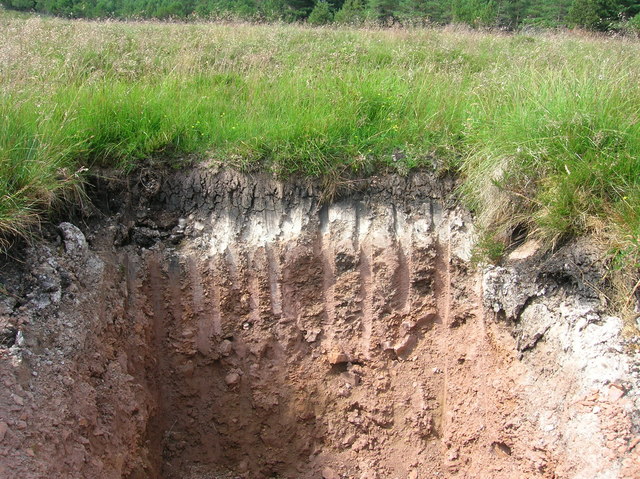
Soil formation (pedogenesis) is the sum of many reactions, which pedologists group into four broad classes: additions (enrichment) of material to the soil, losses (removal) from it, translocation of material within the profile, and transformation of material into new forms. Translocation is the movement of substances between horizons: eluviation is the washing-out of clay, humus and iron/aluminium oxides from an upper horizon, and illuviation is their accumulation in a lower horizon — the process that builds distinct soil horizons.
The question pairs a definition of the four process classes with a description of one of them. Since both are standard textbook statements, the reasoning is simply to verify each is accurate — and both are — which rules out the 'only one' and 'neither' options.
Key facts
- The four broad classes of soil-forming processes are additions (enrichment), losses (removal), translocation and transformation.
- Eluviation is the downward washing-out of fine material from an upper (eluvial) horizon.
- Illuviation is the accumulation of that material in a lower (illuvial) horizon.
- Together, eluviation and illuviation are the translocation process that creates layered soil horizons (e.g. the bleached E horizon over the B horizon in a podzol).
Study next
Common traps
- Eluviation is removal FROM a horizon; illuviation is accumulation IN a horizon — do not swap the two.
- Translocation is movement within the profile, distinct from additions, losses and transformation.
Usually asked by testing the definitions of the soil-forming process classes or the eluviation-versus-illuviation distinction.
Related PYQs
No directly related past PYQ was found.
Practice
- practice — not a real PYQ
The downward washing-out of clay and soluble material from an upper soil horizon is called:
- (a)illuviation
- (b)eluviation
- (c)enrichment
- (d)transformation
Answer(b) eluviation — the removed material later accumulates lower down by illuviation. - practice — not a real PYQ
Which one of the following is NOT one of the four broad classes of soil-forming processes?
- (a)Additions (enrichment)
- (b)Losses (removal)
- (c)Translocation
- (d)Sublimation
Answer(d) Sublimation — the four classes are additions, losses, translocation and transformation.