
Which one among the following separation techniques is used for blood tests in diagnostic laboratories?
- (a)Filtration
- (b)Chromatography
- (c)Centrifugation
- (d)Crystallization
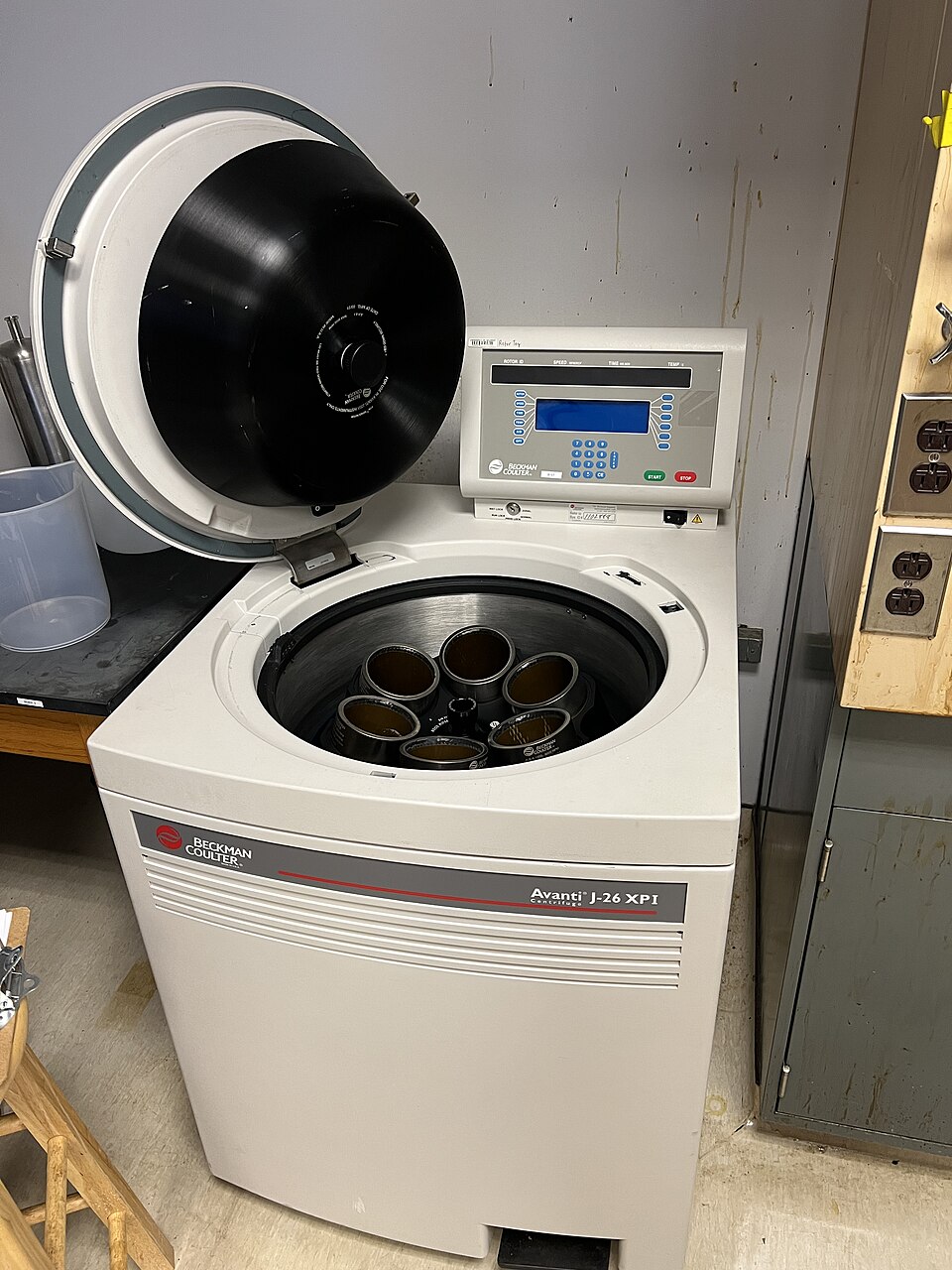
Correct — C, Centrifugation. A blood sample is spun at high speed in a centrifuge; the denser red and white cells are driven to the bottom while the lighter plasma (or serum, if the blood has clotted) rises as a clear supernatant that is then drawn off for testing. This density-based separation is the routine first step for almost every biochemical blood test.
- (a)Filtration — Filtration separates an insoluble solid from a liquid by particle size through filter pores. Blood cells would simply clog the filter, and it cannot cleanly split plasma from cells by density — so it is not the laboratory method for blood.
- (b)Chromatography — Chromatography separates the dissolved components of a mixture by their differing affinity for a stationary versus a mobile phase (used for pigments, amino acids, drugs). It is an analytical tool, not the technique used to split whole blood into cells and plasma.
- (d)Crystallization — Crystallization purifies a soluble solid by forming crystals from a solution on cooling or evaporation (e.g., purifying salt or sugar). It has nothing to do with separating the physical components of blood.
Each separation technique exploits a different physical property. Centrifugation separates components that differ in density by spinning them at high speed, so denser particles move outward and settle. In a clinical laboratory, a tube of whole blood is centrifuged so the formed elements (RBCs, WBCs, platelets) pack at the bottom and the plasma or serum can be pipetted off for analysis.
Match the technique to the property being exploited: particle size favours filtration, density favours centrifugation, differential affinity favours chromatography, and solubility/temperature favours crystallization. Blood must be split by density without damaging the sample, which points straight to centrifugation.
- Centrifugation separates components by density difference under high-speed rotation.
- Centrifuged blood gives plasma/serum on top and packed cells below; serum is plasma minus the clotting factors.
- Filtration separates by particle size; crystallization purifies solids from solution; chromatography separates dissolved components by differential affinity.
- The packed-cell fraction after centrifugation gives the haematocrit (PCV).
- Confusing centrifugation with filtration — filtration works on size, not density.
- Choosing chromatography because it 'sounds like a diagnostic lab technique' — it separates molecules, not blood into cells and plasma.
NDA and UPSC ask 'which separation technique is used for X' — match the method to the physical property it exploits (size, density, affinity, solubility).
The working principle of a washing machine is
- (a) centrifugation
- (b) dialysis
- (c) reverse osmosis
- (d) diffusion
Answer(a) centrifugation
UPSC has tested centrifugation as a working principle — a spinning drum throws water out of wet clothes by centrifugal force, the same density/inertia-based separation that spins blood into cells and plasma.
- practice — not a real PYQ
Which technique is used in a cream separator to separate cream from milk?
- (a)Filtration
- (b)Distillation
- (c)Centrifugation
- (d)Crystallization
Answer(c) Centrifugation — spinning milk throws the denser skimmed portion outward, leaving the lighter fat-rich cream, exactly the density-based principle used for blood.
- practice — not a real PYQ
Serum differs from plasma in that serum lacks:
- (a)Glucose
- (b)Clotting factors such as fibrinogen
- (c)Antibodies
- (d)Electrolytes
Answer(b) Clotting factors such as fibrinogen — serum is the fluid left after blood has clotted, i.e., plasma minus the clotting proteins.