
Which of the following statements regarding Barchan is/are correct? 1. It is a crescent-shaped mound of sand, which is deposited by the wind blowing constantly from one direction in a desert. 2. The windward side has a convex steep slope with maximum height at the centre. 3. Two ends of Barchan are called horns and point opposite to the direction the wind blows. Select the answer using the code given below:
- (a)1 only
- (b)1 and 2 only
- (c)2 and 3 only
- (d)1, 2 and 3
Answer
Why
Correct — A, 1 only. Statement 1 is a good definition of a barchan: a crescent-shaped mound of sand built up where the wind blows steadily from a single direction across a desert. Statement 2 is wrong because a barchan's windward side is a gentle, sloping ramp up which sand is pushed, while the steep face is on the leeward (sheltered) side, where sand slips down at the angle of repose. Statement 3 is wrong because the two horns of the crescent point downwind, that is, in the same direction the wind blows, not opposite to it. Only statement 1 stands, so the answer is 1 only.
Why the others are wrong
- (b)1 and 2 only — It accepts statement 2, but the windward slope of a barchan is gentle, not steep; the steep slope is on the leeward side, so statement 2 is false.
- (c)2 and 3 only — Both statements chosen here are false — the windward slope is gentle (not steep) and the horns point downwind (not opposite to the wind).
- (d)1, 2 and 3 — Statements 2 and 3 are both wrong, so all three cannot be correct; only statement 1 is true.
Concept
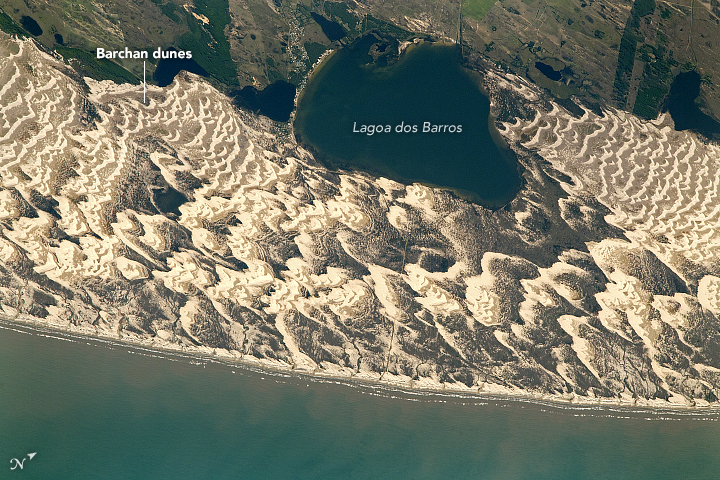
A barchan is a crescent- or moon-shaped sand dune formed by wind blowing steadily from one direction where sand supply is limited. Wind pushes sand up a long, gentle windward slope to the crest; the sand then avalanches down the short, steep leeward slip face. The two tips (horns) of the crescent extend forward on either side and point downwind.
The safe way through this question is to picture how the wind shapes the dune. Sand climbs the gentle windward ramp and drops down the steep leeward face, so a 'steep windward slope' in statement 2 is the wrong way round. The horns are dragged forward by the wind and therefore point downwind, which makes statement 3's 'opposite to the wind' incorrect. Only the crescent-shape-and-one-direction-of-wind definition in statement 1 survives.
Key facts
- A barchan forms where the wind blows constantly from one direction and sand is in limited supply.
- Its windward slope is gentle while its leeward (slip face) slope is steep.
- The two horns of the crescent point downwind, in the direction the wind is blowing.
- Barchans slowly migrate downwind as sand is transferred from the windward side to the leeward face.
Study next
Common traps
- Reversing the slopes — the windward side is gentle and the leeward side is steep, not the other way round.
- Getting the horns backwards — they point downwind, in the direction the wind blows.
- Confusing a barchan (crescent, one wind direction) with a longitudinal or star dune.
Exams describe a dune's shape, slopes or horn direction and ask you to name it or judge the statements — anchor to a gentle windward slope, a steep leeward face and horns pointing downwind.
Related PYQs
No directly related past PYQ was found.
Practice
- practice — not a real PYQ
In a barchan sand dune, the steep slip face is found on the
- (a)windward side
- (b)leeward side
- (c)both sides equally
- (d)top of the horns
Answer(b) leeward side — sand climbs the gentle windward slope and avalanches down the steep leeward slip face. - practice — not a real PYQ
A crescent-shaped sand dune formed by wind blowing from a single constant direction is called a
- (a)seif (longitudinal) dune
- (b)star dune
- (c)barchan
- (d)transverse ridge
Answer(c) barchan — a crescent-shaped dune produced by a steady one-directional wind with limited sand supply.