
Which of the following statements regarding 'aurora' is/are correct? 1. The solar wind upon reaching the Earth's atmosphere is directed towards two magnetic poles and a colourful display of lights is seen in the night sky. 2. The particles interact with the different gases of the atmosphere and each gas glows with a particular colour. 3. In April 2023, aurora was captured in the night sky in India by the Indian Astronomical Observatory at Hanle, Ladakh. Select the answer using the code given below:
- (a)1 only
- (b)2 and 3 only
- (c)1 and 3 only
- (d)1, 2 and 3
Answer
Why
Correct — D, all three (1, 2 and 3). Statement 1 is true: charged particles carried by the solar wind are steered by Earth's magnetic field towards the two magnetic poles, where they light up the night sky. Statement 2 is true: as those particles strike atmospheric gases, each gas emits its own colour — oxygen gives greens and reds, nitrogen gives blues and purples. Statement 3 is also true: in April 2023 a rare low-latitude red aurora (a stable auroral red arc) was captured over Hanle, Ladakh, by the all-sky camera of the Indian Astronomical Observatory during a geomagnetic storm. All three are correct, so the answer is 1, 2 and 3.
Why the others are wrong
- (a)1 only — It drops statements 2 and 3, but both are true — different gases do glow in different colours, and the April 2023 Hanle observation really happened.
- (b)2 and 3 only — It drops statement 1, yet statement 1 correctly describes how the solar wind is guided to the magnetic poles to create the display.
- (c)1 and 3 only — It drops statement 2, but statement 2 is true — the colours of an aurora come from different atmospheric gases each emitting a characteristic colour.
Concept
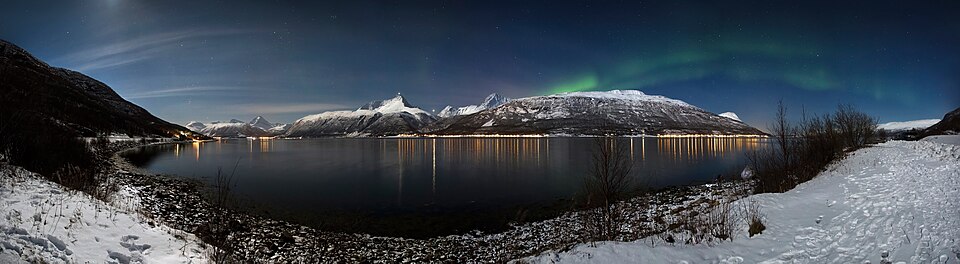
An aurora is a natural light display in the sky caused by charged particles from the Sun. The solar wind and material from solar storms carry these particles to Earth, where the planet's magnetic field funnels them towards the magnetic poles. There they collide with atmospheric gases at high altitude, exciting the atoms so they emit light — the aurora borealis in the north and aurora australis in the south.
Read each statement against the physics and the news. Statements 1 and 2 are textbook facts about how auroras form and why they are coloured. Statement 3 is a current-affairs item: auroras are normally confined to high latitudes, so the April 2023 low-latitude red display recorded from Hanle in Ladakh made news precisely because it was unusual for the Indian region. Recognising all three as true gives option D.
Key facts
- Auroras are produced by charged particles from the solar wind guided by Earth's magnetic field to the polar regions.
- Oxygen typically emits green and red light and nitrogen blue and purple, so each gas contributes a characteristic colour.
- A rare low-latitude red aurora (a stable auroral red arc) was imaged at the Indian Astronomical Observatory, Hanle, Ladakh, during the 22-23 April 2023 geomagnetic storm.
- The Indian Astronomical Observatory at Hanle, operated by the Indian Institute of Astrophysics, sits at about 4,500 metres and is one of the world's highest observing sites.
Study next
Common traps
- Thinking auroras occur only at the poles and dismissing the low-latitude Hanle sighting as impossible.
- Assuming a single colour rather than colours set by different atmospheric gases.
- Confusing the aurora borealis (northern) with the aurora australis (southern).
Exams pair the physics of auroras (solar wind, magnetic poles, gas colours) with a recent event such as the Hanle sighting — verify each statement separately.
Related PYQs
If a major solar storm (solar flare) reaches the Earth, which of the following are the possible effects on the Earth? 1. GPS and navigation systems could fail. 2. Tsunamis could occur at equatorial regions. 3. Power grids could be damaged. 4. Intense auroras could occur over much of the Earth. 5. Forest fires could take place over much of the planet. 6. Orbits of the satellites could be disturbed. 7. Shortwave radio communication of the aircraft flying over polar regions could be interrupted. Select the correct answer using the code given below:
- (a) 1, 2, 4 and 5 only
- (b) 2, 3, 5, 6 and 7 only
- (c) 1, 3, 4, 6 and 7 only
- (d) 1, 2, 3, 4, 5, 6 and 7
Answer(c) 1, 3, 4, 6 and 7 only
Same driver — solar activity. This UPSC question lists the effects of a major solar storm, and intense auroras are among them, the same solar-wind-to-aurora link tested here.
Practice
- practice — not a real PYQ
The colours of an aurora are mainly produced by the excitation of which atmospheric gases?
- (a)Carbon dioxide and argon
- (b)Oxygen and nitrogen
- (c)Hydrogen and helium
- (d)Ozone and methane
Answer(b) Oxygen and nitrogen — oxygen emits green and red light and nitrogen blue and purple, giving the aurora its colours. - practice — not a real PYQ
The Indian Astronomical Observatory that recorded a rare aurora in April 2023 is located at
- (a)Kavalur, Tamil Nadu
- (b)Nainital, Uttarakhand
- (c)Hanle, Ladakh
- (d)Mount Abu, Rajasthan
Answer(c) Hanle, Ladakh — the high-altitude observatory run by the Indian Institute of Astrophysics that imaged the April 2023 aurora.