
Which of the following statements regarding Regur soil is/are correct? 1. It is a light-coloured, clayey and fertile soil. 2. It is developed on Deccan basaltic lava under hot and humid conditions. 3. Cotton is extensively cultivated in this soil. Select the answer using the code given below:
- (a)1 and 2
- (b)2 and 3
- (c)2 only
- (d)3 only
Answer
Why
Correct — B, statements 2 and 3. Regur (black cotton soil) is a DARK soil, not light-coloured, so statement 1 is false. It develops from the weathered Deccan basaltic (trap) lava, so the parent-material claim in statement 2 is correct, and cotton is the crop most extensively grown on it — which is why it is nicknamed 'black cotton soil' — making statement 3 true. Only 2 and 3 are correct.
Why the others are wrong
- (a)1 and 2 — This keeps statement 1, but regur is dark/black, not light-coloured, so any option containing statement 1 must be rejected.
- (c)2 only — This drops statement 3, yet cotton is extensively cultivated on regur — its very nickname is 'black cotton soil'.
- (d)3 only — This drops statement 2, but regur genuinely forms on the Deccan basaltic lava, so that parent-material statement is correct.
Concept
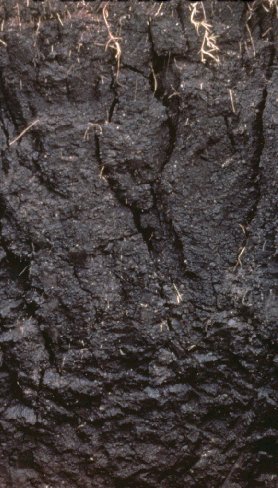
Regur, or black cotton soil, is one of India's major soil groups. It is dark, fine-grained and clayey, rich in lime, iron, magnesium and calcium but poor in nitrogen and phosphorus. Being highly moisture-retentive, it swells and turns sticky when wet and develops deep cracks on drying, which helps aeration. It is derived from the weathering of Deccan Trap basalt.
The trap here is the word 'light-coloured' in statement 1 — the soil's defining feature is that it is dark, so every option containing statement 1 can be eliminated at once. That leaves the answer to turn on whether cotton grows on it, which it does, giving 2 and 3.
Key facts
- Regur covers much of the Deccan Trap region — Maharashtra, Madhya Pradesh, Gujarat and parts of Karnataka, Telangana, Andhra Pradesh and Tamil Nadu.
- It is formed by the weathering of basaltic (volcanic) lava of the Deccan Trap.
- Its high clay content makes it swell and become sticky when wet and crack deeply when dry.
- Black-soil country is in fact hot and semi-arid with moderate to low rainfall, even though statement 2 phrases the conditions loosely as 'hot and humid'; its moisture-retentive nature is what suits rain-fed cotton.
Study next
Common traps
- Assuming black soil is light-coloured — it is dark, which is statement 1's trap.
- Thinking black soil is nitrogen-rich — it is actually poor in nitrogen and phosphorus.
- Confusing regur's parent rock (basaltic Deccan lava) with an alluvial or granitic origin.
NDA and UPSC test soil types by matching a soil to its colour, parent rock, region and best-suited crop — anchor regur to Deccan basalt and to cotton.
Related PYQs
Which of the following statements regarding laterite soils of India are correct? 1. They are generally red in colour. 2. They are rich in nitrogen and potash. 3. They are well-developed in Rajasthan and UP. 4. Tapioca and cashew nuts grow well on these soils. Select the correct answer using the codes given below.
- (a) 1, 2 and 3
- (b) 2, 3 and 4
- (c) 1 and 4
- (d) 2 and 3 only
Answer(c) 1 and 4
Same concept — identifying an Indian soil type from its characteristics; the UPSC item tests laterite soil, while this NDA question tests regur/black soil, both part of India's soil-classification syllabus.
Practice
- practice — not a real PYQ
Black cotton soil (regur) of the Deccan is formed by the weathering of which type of rock?
- (a)Granite
- (b)Basaltic lava
- (c)Sandstone
- (d)Limestone
Answer(b) Basaltic lava — regur develops from the weathered basalt of the Deccan Trap. - practice — not a real PYQ
Which one of the following soils is best known for high moisture-retention and deep cracking on drying?
- (a)Laterite soil
- (b)Alluvial soil
- (c)Black (regur) soil
- (d)Red soil
Answer(c) Black (regur) soil — its clayey texture makes it swell when wet and crack deeply when dry.