
Which one of the following is a covalent compound?
- (a)Calcium oxide
- (b)Sodium nitride
- (c)Silicon carbide
- (d)Zinc sulphide
Answer
Why
Correct — C, Silicon carbide. Silicon carbide (SiC) forms between two non-metals — silicon and carbon — which share electrons, making it a covalent compound (in fact a giant covalent network solid). The other three form between a metal and a non-metal by the transfer of electrons, so they are ionic: calcium oxide (CaO), sodium nitride (Na₃N) and zinc sulphide (ZnS).
Why the others are wrong
- (a)Calcium oxide — Calcium (a metal) transfers electrons to oxygen (a non-metal), forming the ionic compound CaO, not a covalent one.
- (b)Sodium nitride — Sodium is a reactive metal and nitrogen a non-metal, so they form the ionic compound Na₃N by electron transfer.
- (d)Zinc sulphide — Zinc is a metal and sulphur a non-metal, so ZnS is essentially ionic (with some covalent character), not a typically covalent compound.
Concept
A covalent bond forms when two atoms share electrons, which typically happens between two non-metals. An ionic bond forms when a metal transfers electrons to a non-metal, producing charged ions. So the metal-plus-non-metal pairs are ionic, while the non-metal-plus-non-metal pair is covalent.
Scan each option for a metal. Calcium, sodium and zinc are metals, so their compounds with oxygen, nitrogen and sulphur are ionic. Silicon and carbon are both non-metals, so silicon carbide is the covalent compound.
Key facts
- Covalent compounds form between two non-metals that share electrons.
- Silicon and carbon are both non-metals, so silicon carbide (SiC) is covalent.
- Metal-plus-non-metal combinations (CaO, Na₃N, ZnS) form ionic bonds by electron transfer.
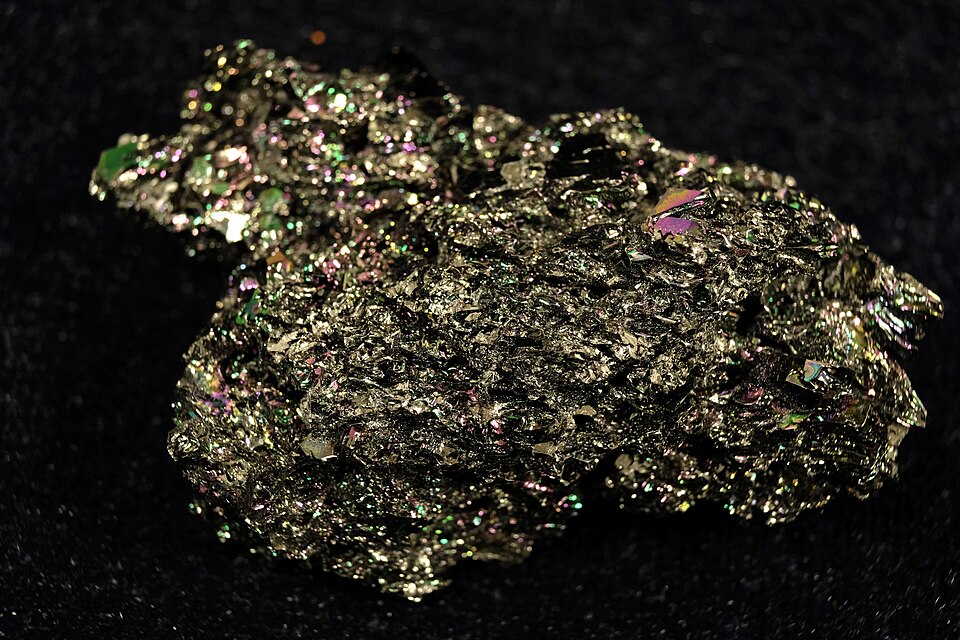
- Silicon carbide (carborundum) is a very hard covalent network solid used as an abrasive.
Study next
Common traps
- Assuming any compound with a metal-sounding name is covalent.
- Forgetting that a covalent bond forms between two non-metals.
Identify the compound made of two non-metals (silicon and carbon) — that is the covalent one, the rest being metal-plus-non-metal ionic compounds.
Related PYQs
How many covalent bonds are present in a Chloropropane molecule having molecular formula, C3H7Cl ?
- (a) 6
- (b) 8
- (c) 9
- (d) 10
Answer(d) 10
Same area — covalent bonding. That NDA item counts the covalent bonds in an organic molecule; this one identifies which compound is held together by covalent (shared-electron) bonds.
What is the total number of covalent bonds in methanol?
- (a) 3
- (b) 4
- (c) 5
- (d) 6
Answer(c) 5
Same area — covalent bonds in a molecule. That NDA item counts the covalent bonds in methanol; this one asks which of four compounds is covalent.
Practice
- practice — not a real PYQ
Which one of the following is an ionic compound?
- (a)CO₂
- (b)NaCl
- (c)CH₄
- (d)HCl
Answer(b) NaCl — a metal (Na) combined with a non-metal (Cl). - practice — not a real PYQ
A covalent bond is formed by
- (a)transfer of electrons
- (b)sharing of electrons
- (c)loss of electrons only
- (d)gain of electrons only
Answer(b) sharing of electrons.