
The periodic rise and fall of ocean water in response to gravitational forces is called
- (a)Current
- (b)Waves
- (c)Tides
- (d)Tsunami
Answer
Why
Correct — C, Tides. Tides are the regular, periodic rise and fall of ocean water caused chiefly by the gravitational pull of the Moon and, to a smaller extent, the Sun, together with the centrifugal force of the Earth–Moon system. That gravitational cause and the daily periodicity are exactly what the question describes. Currents are horizontal flows, waves are mostly wind-driven, and a tsunami is an occasional seismic sea wave — none is the routine gravity-driven vertical rise and fall.
Why the others are wrong
- (a)Current — A current is a horizontal movement of ocean water driven by winds, temperature and salinity differences — not a vertical rise and fall caused by gravity.
- (b)Waves — Waves are surface undulations produced mainly by wind blowing over the water; they are not caused by the gravitational pull of the Moon and Sun.
- (d)Tsunami — A tsunami is a series of long waves triggered by an undersea earthquake, landslide or volcanic eruption — an occasional event, not the periodic tide.
Concept
Tides are the alternate rise (flood) and fall (ebb) of sea level, repeating with the apparent motion of the Moon. They arise from the Moon's gravitational attraction (about twice as strong an influence as the Sun's) combined with the centrifugal effect of the Earth–Moon system, producing bulges of water on opposite sides of the Earth.
The key words are 'periodic' and 'gravitational' — that combination points to tides. Currents (horizontal flow), waves (wind) and tsunamis (earthquakes) each fail one of those two tests.
Key facts
- Tides are caused mainly by the Moon's gravity, with a lesser pull from the Sun.
- Most coasts see two high tides and two low tides in roughly a day.
- Spring tides (highest range) occur at full and new moon; neap tides (lowest range) at the quarter moons.
- The Bay of Fundy in Canada has the world's greatest tidal range.
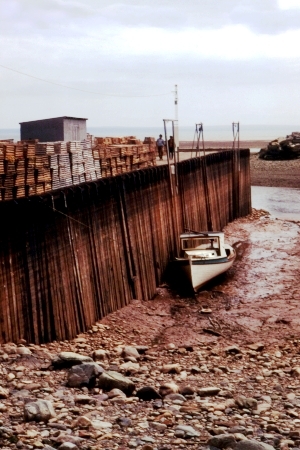
Study next
Common traps
- Confusing tides with wind-driven waves or with horizontal currents.
- Treating a tsunami as a kind of tide — it is an earthquake-generated wave.
Asked as the gravity-driven, periodic rise and fall of sea level — the answer is tides.
Related PYQs
Tides occur in the oceans and seas due to which among the following? 1. Gravitational force of the Sun 2. Gravitational force of the Moon 3. Centrifugal force of the Earth. Select the correct answer using the code given below.
- (a) 1 only
- (b) 2 and 3 only
- (c) 1 and 3 only
- (d) 1, 2 and 3
Answer(d) 1, 2 and 3
Same concept — the causes of tides: the gravitational forces of the Moon and the Sun plus the centrifugal force of the Earth–Moon system. This 2021 NDA item names the phenomenon; the UPSC item lists its causes.
Which of the following statements regarding neap tides is/are correct? 1. It occurs every 14 – 15 days, which coincides with the first and third quarter of the Moon. 2. This tide has a small tidal range because the gravitational forces of the Moon and the Sun are in quadrature. Select the answer using the code given below:
- (a) 1 only
- (b) 2 only
- (c) Both 1 and 2
- (d) Neither 1 nor 2
Answer(c) Both 1 and 2
Goes one step deeper into the same topic — neap tides, which occur at the quarter moons when the Moon's and Sun's gravitational pulls are at right angles, giving the smallest tidal range.
Practice
- practice — not a real PYQ
Spring tides, with the greatest tidal range, occur when
- (a)the Sun and Moon are at right angles to the Earth
- (b)the Sun, Moon and Earth are in a straight line (full or new moon)
- (c)the Moon is farthest from the Earth
- (d)there is an undersea earthquake
Answer(b) the Sun, Moon and Earth are in a straight line (full or new moon) — their gravitational pulls add up. - practice — not a real PYQ
The horizontal movement of ocean water driven mainly by prevailing winds is called a
- (a)tide
- (b)current
- (c)tsunami
- (d)neap tide
Answer(b) current — a horizontal flow of water, distinct from the vertical rise and fall of tides.