
Cinnabar is an ore of which one of the following?
- (a)Copper
- (b)Zinc
- (c)Mercury
- (d)Manganese
Answer
Why
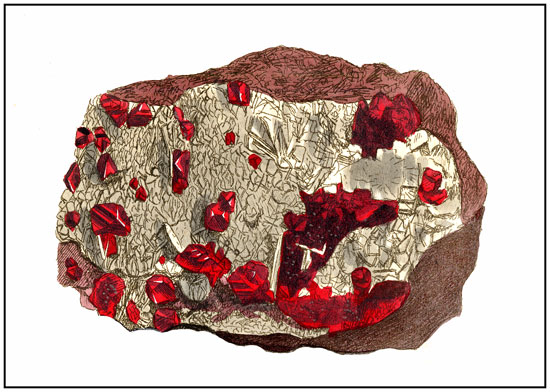
Correct — C, Mercury. Cinnabar is mercuric sulphide, HgS, and is the chief ore from which mercury is extracted. Heating cinnabar in air roasts the sulphide and releases mercury as vapour, which is then condensed to the liquid metal. Its bright red colour also made cinnabar a historical source of the pigment vermilion. It is not an ore of copper, zinc or manganese.
Why the others are wrong
- (a)Copper — Copper's important ores are copper pyrites (chalcopyrite) and copper glance, not cinnabar.
- (b)Zinc — Zinc is obtained from zinc blende (sphalerite, ZnS) and calamine, not from cinnabar.
- (d)Manganese — Manganese comes chiefly from pyrolusite (MnO₂); cinnabar contains no manganese.
Concept
An ore is a mineral from which a metal can be extracted profitably. Cinnabar is the red sulphide of mercury, HgS, and is the principal ore of that metal.
Tie the mineral to its metal: cinnabar is the red sulphide of mercury. Each distractor has its own well-known ore, so recalling those, such as zinc blende for zinc, clears them away.
Key facts
- Cinnabar is mercuric sulphide, HgS, the principal ore of mercury.
- Mercury is obtained by roasting cinnabar in air and condensing the vapour.
- Cinnabar is bright red and was long used as the pigment vermilion.
- Mercury is the only common metal that is liquid at room temperature.
Study next
Common traps
- Matching cinnabar to zinc blende or copper pyrites by confusion.
- Forgetting that cinnabar is a sulphide (HgS), not an oxide.
Asked to name the metal whose ore is cinnabar; it is mercury (HgS).
Related PYQs
No directly related past PYQ was found.
Practice
- practice — not a real PYQ
Cinnabar is chemically
- (a)mercuric oxide
- (b)mercuric sulphide
- (c)mercuric chloride
- (d)mercurous nitrate
Answer(b) mercuric sulphide — HgS. - practice — not a real PYQ
The chief ore of zinc is
- (a)cinnabar
- (b)zinc blende
- (c)bauxite
- (d)haematite
Answer(b) zinc blende — zinc sulphide, ZnS.