
Which one of the following tissues is known as basic packing tissue and found in xylem and phloem?
- (a)Collenchyma
- (b)Parenchyma
- (c)Sclerenchyma
- (d)Vessels
Answer
Why
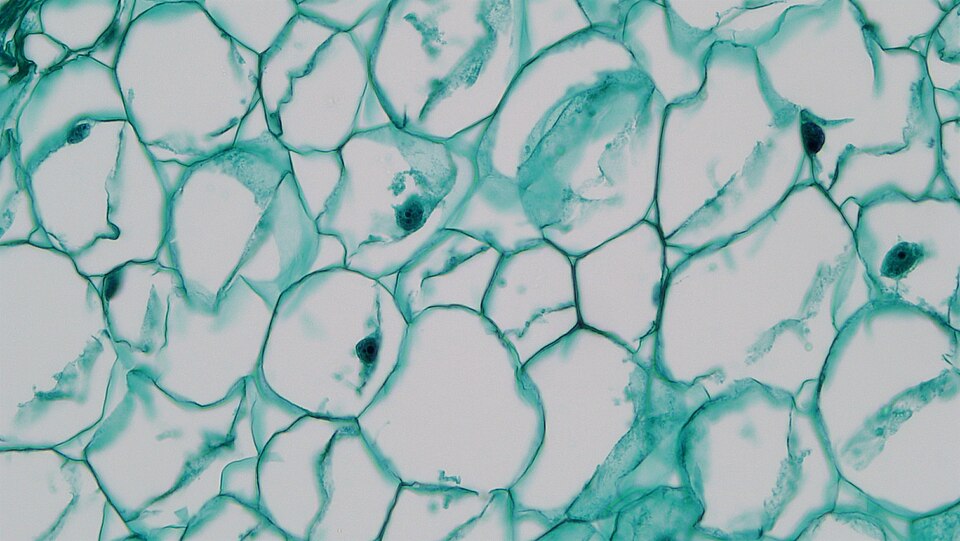
Correct — B, Parenchyma. Parenchyma is the basic or ground packing tissue of a plant, made of living, thin-walled cells that fill spaces, store food and support the other tissues. It occurs within both conducting tissues as xylem parenchyma and phloem parenchyma, packing around the specialised conducting cells. Because it is the general-purpose packing tissue present in xylem and phloem, parenchyma is the answer.
Why the others are wrong
- (a)Collenchyma — Collenchyma is a living tissue with corners thickened by cellulose that gives flexible mechanical support, especially in young stems and leaf stalks; it is not the general packing tissue of xylem and phloem.
- (c)Sclerenchyma — Sclerenchyma is made of dead, thick, lignified cells that provide rigid strength; it is a strengthening tissue, not the living basic packing tissue.
- (d)Vessels — Vessels are the water-conducting elements of xylem itself, not a packing tissue; they are the specialised cells that parenchyma packs around.
Concept
Plant tissues are grouped into simple permanent tissues, of which there are three: parenchyma, collenchyma and sclerenchyma. Parenchyma is the basic packing and storage tissue of living, thin-walled cells. The complex conducting tissues xylem and phloem each include some parenchyma along with their conducting and supporting elements.
The trick is to separate 'packing' from 'strengthening' and 'conducting'. Parenchyma packs and stores, collenchyma and sclerenchyma strengthen, and vessels conduct. The tissue that fills and packs, and appears within both xylem and phloem, is parenchyma.
Key facts
- Parenchyma is the basic ground or packing tissue of living, thin-walled cells.
- It stores food and fills spaces, and occurs as xylem parenchyma and phloem parenchyma.
- Collenchyma gives flexible support; sclerenchyma gives rigid support with dead lignified cells.
- Xylem and phloem are complex tissues that include parenchyma alongside their conducting cells.
Study next
Common traps
- Confusing the packing tissue (parenchyma) with the supporting tissues (collenchyma, sclerenchyma).
- Choosing vessels, which are conducting cells of xylem, instead of the packing parenchyma.
Asked as the basic packing or ground tissue, sometimes tied to xylem and phloem; the packing and storage role points to parenchyma.
Related PYQs
Which one of the following plant tissues has dead cells?
- (a) Epidermis
- (b) Parenchyma
- (c) Collenchyma
- (d) Sclerenchyma
Answer(d) Sclerenchyma
Same simple-permanent-tissue set — distinguishing parenchyma, collenchyma and sclerenchyma. Knowing parenchyma is the living packing tissue and sclerenchyma the dead strengthening one answers both questions.
Which one of the following statements is correct?
- (a) Xylem consists of tracheids, vessels, xylem parenchyma and xylem fibres.
- (b) Flexibility in plants is due to sclerenchyma.
- (c) Parenchyma have no intercellular spaces.
- (d) Xylem consists of sieve plate, sieve tube and companion cells.
Answer(a) Xylem consists of tracheids, vessels, xylem parenchyma and xylem fibres.
Same idea that xylem includes parenchyma among its cells — reinforcing that parenchyma is the packing tissue present within the complex conducting tissues.
Practice
- practice — not a real PYQ
Which one of the following plant tissues stores food and acts as packing tissue?
- (a)Sclerenchyma
- (b)Collenchyma
- (c)Parenchyma
- (d)Phloem fibres
Answer(c) Parenchyma — living thin-walled cells that pack spaces and store food. - practice — not a real PYQ
Rigid mechanical strength in mature plant parts is chiefly provided by
- (a)Parenchyma
- (b)Sclerenchyma
- (c)Epidermis
- (d)Xylem parenchyma
Answer(b) Sclerenchyma — dead, thick, lignified cells that give rigidity.