
What is the number of water molecules present in a Ferrous Sulphate crystal?
- (a)1
- (b)3
- (c)5
- (d)7
Answer
Why
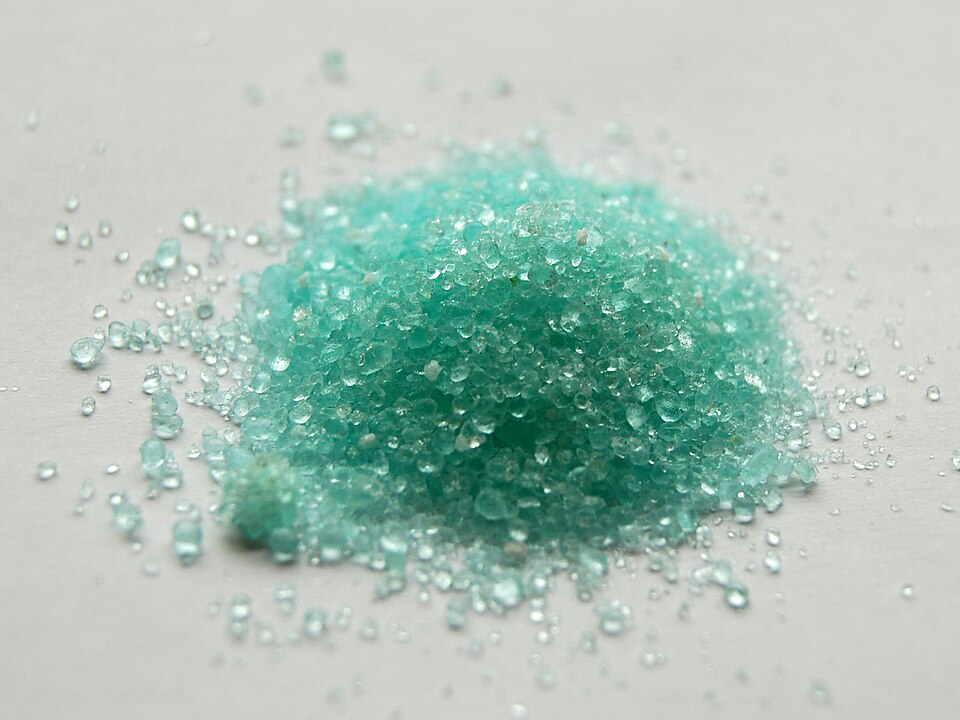
Correct — D, 7. The common green crystalline form of ferrous sulphate is the heptahydrate, FeSO4.7H2O, so each formula unit carries seven molecules of water of crystallisation. This is the familiar 'green vitriol' of the laboratory. The water is locked into the crystal lattice, which is why heating the crystal drives off the water and leaves a whitish anhydrous powder.
Why the others are wrong
- (a)1 — A single water of crystallisation belongs to salts such as the monohydrates; ferrous sulphate's green crystal holds seven, not one.
- (b)3 — Three waters of crystallisation is not the value for ferrous sulphate; its stable crystalline form is the heptahydrate with seven.
- (c)5 — Five is the water content of blue vitriol, copper sulphate (CuSO4.5H2O), a common trap; ferrous sulphate (green vitriol) carries seven.
Concept
Many salts crystallise with a fixed number of water molecules bound inside the crystal, called water of crystallisation. Ferrous sulphate crystallises as the heptahydrate, FeSO4.7H2O, known as green vitriol. The bound water gives the crystal its shape and pale green colour and can be removed by heating.
Vitriols are a classic exam set that is easy to mix up. The reasoning is to attach each colour and metal to its own water count: green vitriol is ferrous sulphate with seven waters, blue vitriol is copper sulphate with five, and white vitriol is zinc sulphate with seven.
Key facts
- Ferrous sulphate crystallises as FeSO4.7H2O, the heptahydrate, called green vitriol.
- Its seven water molecules are the water of crystallisation held in the lattice.
- Copper sulphate (blue vitriol) has five waters and Epsom salt (magnesium sulphate) has seven.
- Heating the crystal drives off the water, giving the anhydrous salt and changing its colour.
Study next
Common traps
- Confusing green vitriol (ferrous sulphate, 7 waters) with blue vitriol (copper sulphate, 5 waters).
- Forgetting that the water is part of the crystal and can be removed by heating.
Asked as the number of waters in a named hydrated salt; memorise each vitriol with its metal and water count rather than guessing.
Related PYQs
Match List I with List II and select the correct answer using the codes given below the lists: List I — I. Blue vitriol, II. Epsom salt, III. Baking soda, IV. Caustic soda; List II — A. Sodium bicarbonate, B. Sodium hydroxide, C. Magnesium sulphate, D. Copper sulphate.
- (a) I-C, II-D, III-B, IV-A
- (b) I-D, II-C, III-A, IV-B
- (c) I-C, II-D, III-A, IV-B
- (d) I-D, II-A, III-B, IV-A
Answer(b) I-D, II-C, III-A, IV-B
Same family of hydrated salts and their common names — blue vitriol is copper sulphate and Epsom salt is magnesium sulphate. Green vitriol (ferrous sulphate) sits in the very same 'vitriol' group, and this NDA item asks its water of crystallisation.
Number of molecules of water of crystallization in copper sulphate, sodium carbonate and Gypsum are
- (a) 5, 10 and 2 respectively
- (b) 10, 2 and 5 respectively
- (c) 5, 2 and 10 respectively
- (d) 2, 5 and 10 respectively
Answer(a) 5, 10 and 2 respectively
Directly the same concept — counting water molecules of crystallisation in named hydrated salts. If you can place copper sulphate at five, ferrous sulphate at seven follows from the same 'learn each hydrate' skill.
Practice
- practice — not a real PYQ
The number of water molecules of crystallisation in blue vitriol (copper sulphate) is
- (a)2
- (b)5
- (c)7
- (d)10
Answer(b) 5 — copper sulphate crystallises as CuSO4.5H2O, blue vitriol. - practice — not a real PYQ
Green vitriol is the common name of
- (a)Copper sulphate
- (b)Zinc sulphate
- (c)Ferrous sulphate
- (d)Magnesium sulphate
Answer(c) Ferrous sulphate — FeSO4.7H2O, the green heptahydrate.