
Numerically two thermometers, one in Fahrenheit scale and another in Celsius scale shall read same at
- (a)–40°
- (b)0°
- (c)–273°
- (d)100°
Answer
Why
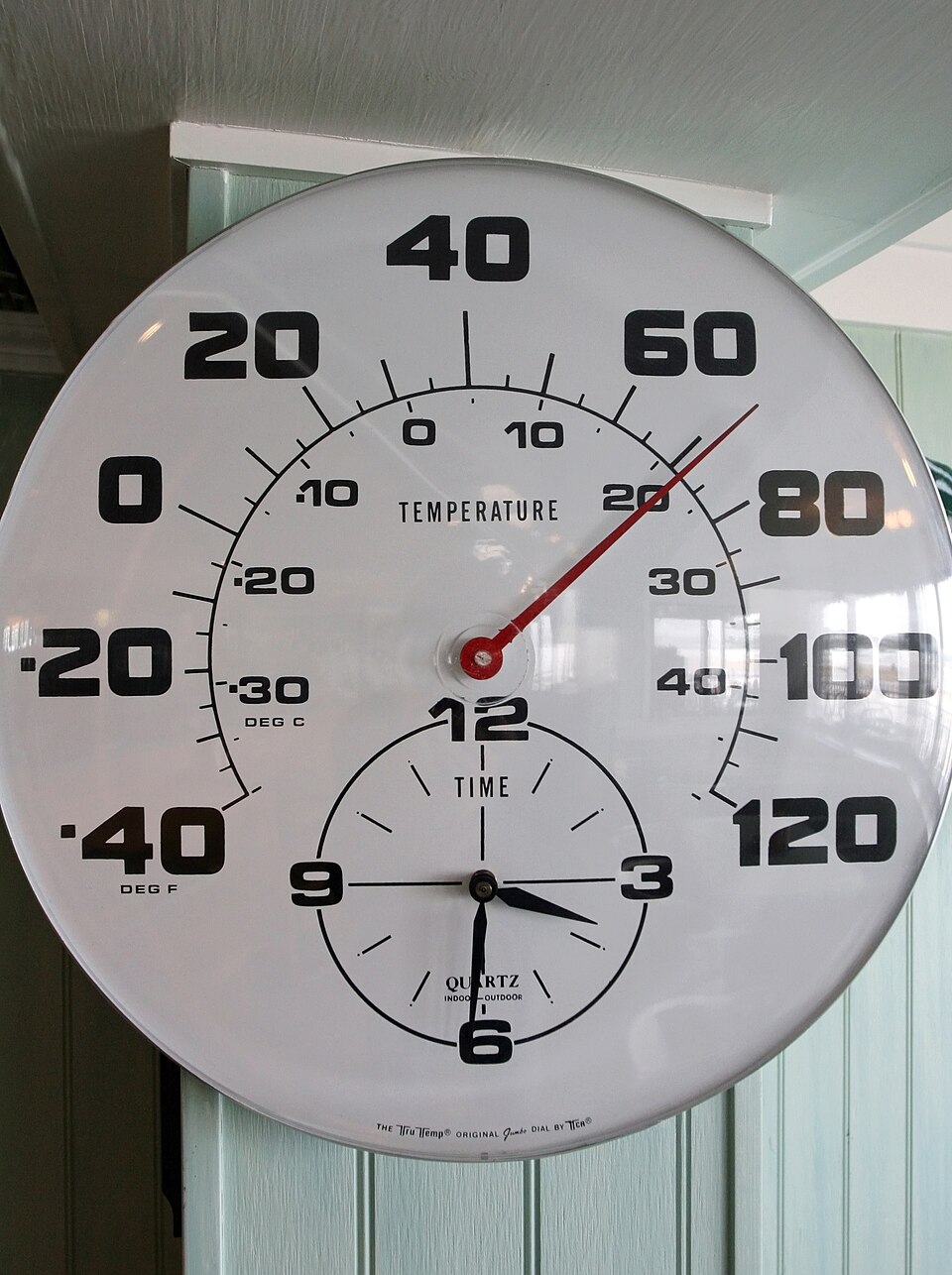
Correct — A, –40°. The two scales are linked by F = (9/5)C + 32. To find where the readings are numerically equal, put F = C: C = (9/5)C + 32, which gives –(4/5)C = 32, so C = –40. Hence –40 °C equals exactly –40 °F — the one temperature at which a Fahrenheit and a Celsius thermometer show the same number.
Why the others are wrong
- (b)0° — At 0 °C the Fahrenheit reading is (9/5)(0) + 32 = 32 °F, not 0 °F, so the two readings are not equal here.
- (c)–273° — –273 °C is close to absolute zero; on the Fahrenheit scale it is about –459 °F, so the numbers do not match — this option confuses the equal-reading point with absolute zero.
- (d)100° — 100 °C (the boiling point of water) equals 212 °F, so the two scales read very differently at this point.
Concept
The Celsius and Fahrenheit scales are linear scales built on different reference points and step sizes: water freezes at 0 °C / 32 °F and boils at 100 °C / 212 °F. Their conversion is F = (9/5)C + 32. Because the two lines cross at exactly one point, there is a single temperature at which the two scales give the same number.
Setting F equal to C and solving the linear equation is the fastest route. Students who guess are pulled towards 0° (freezing) or 100° (boiling) because those look 'natural', but the equal-reading point is the less obvious –40°, a value worth memorising outright.
Key facts
- Conversion formula: F = (9/5)C + 32, equivalently C = (5/9)(F – 32).
- The two scales read the same number only at –40° (–40 °C = –40 °F).
- Water freezes at 0 °C = 32 °F and boils at 100 °C = 212 °F at standard pressure.
- A Celsius degree is larger than a Fahrenheit degree — 100 Celsius divisions span the same range as 180 Fahrenheit divisions.
Study next
Common traps
- Assuming the scales match at 0° or 100° — they only coincide at –40°.
- Mixing up the equal-reading point (–40°) with absolute zero (–273 °C).
Asked either as a direct conversion sum or, as here, 'at what temperature do the two scales read the same number?' — the answer is always –40°.
Related PYQs
The normal temperature of human body on the Kelvin scale is
- (a) 280
- (b) 290
- (c) 300
- (d) 310
Answer(d) 310
Same concept — converting between temperature scales. Here 37 °C is converted to Kelvin (37 + 273 ≈ 310 K), the same scale-conversion skill needed to see that –40° is the point where Celsius and Fahrenheit coincide.
The temperature of a place on one sunny day is 113 °F on the Fahrenheit scale. The Kelvin scale reading of this temperature will be
- (a) 318 K
- (b) 45 K
- (c) 62·8 K
- (d) 335·8 K
Answer(a) 318 K
Same concept — Fahrenheit/Celsius/Kelvin conversion using F = (9/5)C + 32, the identical relation used to find the –40° equal-reading point.
The temperature of a body increases from 310 K to 340 K. The temperature increase in degree Celsius is
- (a) 20°C
- (b) 30°C
- (c) 37°C
- (d) 67°C
Answer(b) 30°C
Related — the size relationship between scale divisions, the same idea behind why –40° is the only common Celsius/Fahrenheit reading.
Practice
- practice — not a real PYQ
A temperature of 37 °C on the Fahrenheit scale is closest to
- (a)37 °F
- (b)69 °F
- (c)98.6 °F
- (d)310 °F
Answer(c) 98.6 °F — using F = (9/5)(37) + 32 = 98.6 °F, normal human body temperature. - practice — not a real PYQ
On the Kelvin scale, the freezing point of water (0 °C) is
- (a)0 K
- (b)100 K
- (c)273 K
- (d)373 K
Answer(c) 273 K — add 273 to the Celsius reading (0 + 273 ≈ 273 K).