
The composition of gases in exosphere is
- (a)Helium and Hydrogen.
- (b)Neon and Oxygen.
- (c)Neon and Hydrogen.
- (d)Helium and Neon.
Answer
Why
Correct — A, Helium and Hydrogen. The exosphere is the outermost layer of the atmosphere, where the air is extremely thin and only the lightest gases — mainly hydrogen and helium — remain, because heavier gases have settled into the lower layers. So its composition is helium and hydrogen; the options that add neon or oxygen are wrong.
Why the others are wrong
- (b)Neon and Oxygen. — Oxygen is concentrated in the lower atmosphere; the tenuous exosphere is dominated by the lightest gases (hydrogen and helium), not oxygen.
- (c)Neon and Hydrogen. — Hydrogen is right, but the other main light gas of the exosphere is helium, not neon.
- (d)Helium and Neon. — Helium is right, but the exosphere's other main constituent is hydrogen — the lightest of all gases — not neon.
Concept
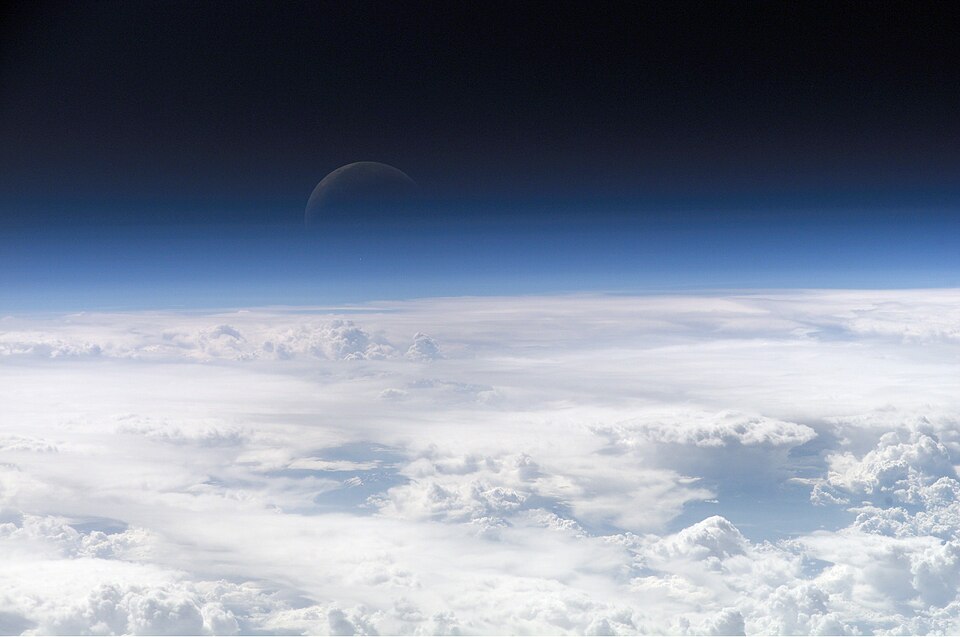
The atmosphere is layered by temperature into the troposphere, stratosphere, mesosphere, thermosphere and exosphere. In the exosphere at the very top, gas molecules are so sparse and so weakly bound that only the lightest ones, hydrogen and helium, predominate before the layer merges into outer space.
Think 'lightest gases at the top': the outermost layer keeps the lightest atoms, hydrogen and helium. Any option with a heavier gas such as oxygen or neon as the main constituent is a trap.
Key facts
- The exosphere is the outermost layer of Earth's atmosphere, merging into space.
- It is composed mainly of the lightest gases — hydrogen and helium.
- Atmospheric layers from the surface upward are troposphere, stratosphere, mesosphere, thermosphere and exosphere.
- Gas density in the exosphere is so low that molecules rarely collide.
Study next
Common traps
- Choosing oxygen — it is abundant lower down, not in the exosphere.
- Substituting neon for helium among the light gases.
Asked as 'gases in the exosphere' with light-versus-heavy gas decoys — recall that only the lightest gases (hydrogen and helium) reach the outermost layer.
Related PYQs
UPSC_1998_GS1_Q1091998The correct sequence of different layers of the atmosphere from the surface of the Earth upwards is
- (a) Troposphere, Stratosphere, Ionosphere, Mesosphere
- (b) Stratosphere, Troposphere, Ionosphere, Mesosphere
- (c) Troposphere, Stratosphere, Mesosphere, Ionosphere
- (d) Stratosphere, Troposphere, Mesosphere, Ionosphere
Answer(c) Troposphere, Stratosphere, Mesosphere, Ionosphere
Same concept — the layered structure of the atmosphere. That UPSC item orders the layers from the surface upward; this NDA item asks what the outermost layer, the exosphere, is made of — the lightest gases, hydrogen and helium.
Practice
- practice — not a real PYQ
The outermost layer of the Earth's atmosphere is the
- (a)troposphere
- (b)stratosphere
- (c)mesosphere
- (d)exosphere
Answer(d) exosphere. - practice — not a real PYQ
Which two gases are the main constituents of the exosphere?
- (a)Oxygen and nitrogen
- (b)Hydrogen and helium
- (c)Neon and argon
- (d)Carbon dioxide and oxygen
Answer(b) Hydrogen and helium — the lightest gases.