
Which of the following statements about the non-permanent members of the Security Council of the United Nations is/are correct? 1. Their total number is now 10, but was originally only 6. 2. They are elected for a term of two years only. Select the correct answer using the code given below:
- (a)1 only
- (b)2 only
- (c)Both 1 and 2
- (d)Neither 1 nor 2
Answer
Why
Correct — C, Both 1 and 2. When the UN Security Council was set up in 1945 it had 11 members — 5 permanent and 6 non-permanent — and a 1965 amendment to Article 23 of the UN Charter raised the non-permanent seats to 10, giving today's total of 15; so statement 1 is right. The non-permanent members are elected by the General Assembly for a fixed term of two years and are not eligible for immediate re-election, so statement 2 is right too — hence both statements are correct.
Why the others are wrong
- (a)1 only — Incomplete — statement 2 is also correct, because non-permanent members are indeed elected for a two-year term.
- (b)2 only — Incomplete — statement 1 is also correct, because the non-permanent seats were originally 6 and were raised to 10 in 1965.
- (d)Neither 1 nor 2 — Both statements are factually accurate, so this cannot be the answer.
Concept
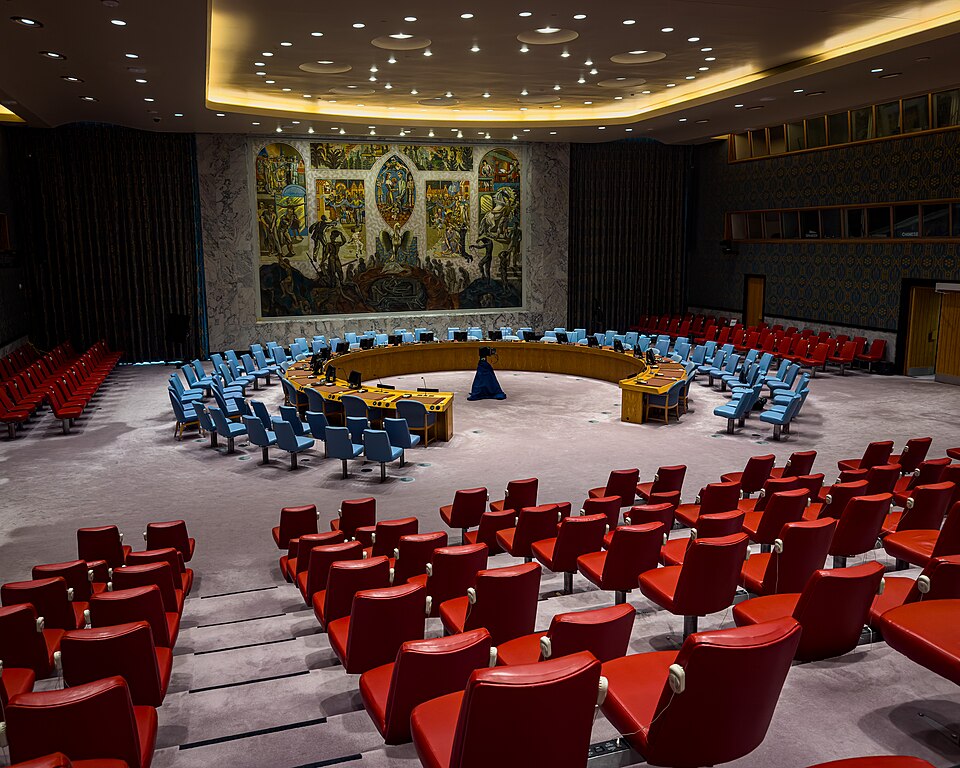
The UN Security Council has 15 members: 5 permanent (China, France, Russia, the UK and the USA, each with a veto) and 10 non-permanent members without a veto. The non-permanent seats are distributed by geographical region and are filled by election in the General Assembly.
The two facts tested are the change in numbers (6 to 10) and the length of the term (2 years). Candidates who remember only the current figure of 10 may wrongly reject statement 1, and those unsure of the term may reject statement 2; knowing both facts confirms that both statements stand.
Key facts
- Security Council = 15 members: 5 permanent + 10 non-permanent (since 1965).
- Non-permanent seats were 6 in the original 1945 Charter, raised to 10 by a 1965 amendment to Article 23.
- Non-permanent members are elected by the General Assembly for two-year terms, with no immediate re-election.
- Only the 5 permanent members hold the veto; non-permanent members do not.
Study next
Common traps
- Assuming the non-permanent number has always been 10 and rejecting statement 1.
- Confusing the two-year term of non-permanent members with the permanence of the P5.
Asked as statement-based (is/are correct) items on UN organs, or as direct facts on Security Council numbers, terms and the veto.
Related PYQs
The Security Council of UN consists of 5 permanent members, and the remaining 10 members are elected by the General Assembly for a term of
- (a) 1 year
- (b) 2 years
- (c) 3 years
- (d) 5 years
Answer(b) 2 years
Same concept — the composition of the Security Council and the two-year term of its non-permanent members, exactly the two facts tested here.
The United Nations Charter was signed by 51 original members of the United Nations in 1945 at the
- (a) Hague Conference
- (b) London Conference
- (c) San Francisco Conference
- (d) Berlin Conference
Answer(c) San Francisco Conference
Same theme — the founding of the United Nations and its Charter, the framework that created the Security Council and its permanent/non-permanent structure.
Practice
- practice — not a real PYQ
How many members does the UN Security Council have in total?
- (a)11
- (b)15
- (c)10
- (d)20
Answer(b) 15 — 5 permanent and 10 non-permanent members. - practice — not a real PYQ
Which body elects the non-permanent members of the UN Security Council?
- (a)The Secretariat
- (b)The General Assembly
- (c)The permanent members
- (d)The International Court of Justice
Answer(b) The General Assembly — it elects the 10 non-permanent members for two-year terms.