
Which one of the following planets has the highest density?
- (a)Mercury
- (b)Venus
- (c)Jupiter
- (d)Earth
Answer
Why
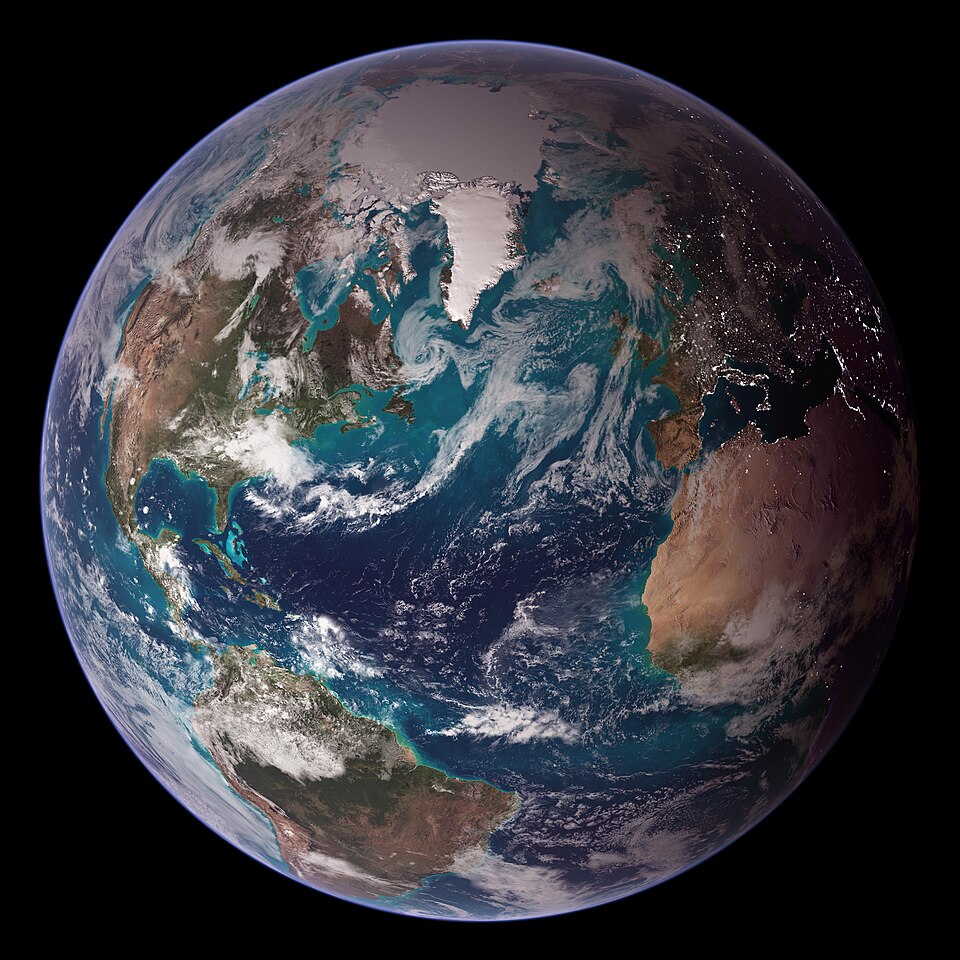
Correct — D, Earth. Earth has the highest mean density of any planet in the Solar System, about 5.51 g/cm³. Although Earth and Mercury are both rocky and iron-rich, Earth is far more massive, so its own gravity compresses the interior more strongly, giving it a slightly higher density than Mercury. The gas giants, being made mostly of hydrogen and helium, are far less dense.
Why the others are wrong
- (a)Mercury — Mercury has the second-highest density (~5.43 g/cm³) — very close to Earth's, but slightly lower because it is much smaller and less self-compressed.
- (b)Venus — Venus is a rocky planet with a density of about 5.24 g/cm³, lower than both Earth and Mercury.
- (c)Jupiter — Jupiter is a gas giant made mostly of hydrogen and helium; its mean density is only about 1.33 g/cm³, far below the rocky planets.
Concept
Planetary density reflects composition and self-compression. The four inner (terrestrial) planets — Mercury, Venus, Earth, Mars — are rocky and dense; the outer giants (Jupiter, Saturn, Uranus, Neptune) are made of light gases and ices and are much less dense. Among all eight, Earth's mean density is the highest.
Students often guess Jupiter because it is the largest, or Mercury because it is metal-rich. Size does not equal density: Jupiter is huge but light, while Earth's large mass compresses its iron-rich interior to give the top density.
Key facts
- Earth's mean density is about 5.51 g/cm³ — highest of all planets.
- Mercury is second (~5.43 g/cm³); Venus about 5.24 g/cm³.
- Gas giants are far less dense — Jupiter ~1.33 g/cm³, Saturn less than water.
- Self-gravitational compression makes larger rocky bodies slightly denser.
Study next
Common traps
- Assuming the largest planet (Jupiter) is the densest — it is the least dense of the giants relative to rocky planets.
- Picking Mercury; it is a very close second but Earth edges it out.
Asked as 'highest/lowest density planet' or by ordering planets on a physical property.
Related PYQs
Which one of the following statements is correct with reference to our solar system?
- (a) The Earth is the densest of all the planets in our solar system
- (b) The predominant element in the composition of Earth is silicon
- (c) The Sun contains 75 % of the mass of the solar system
- (d) The diameter of the Sun is 190 times that of the Earth
Answer(a) The Earth is the densest of all the planets in our solar system
Same fact — Earth is the densest planet in the Solar System, tested here as a solar-system statement.
Practice
- practice — not a real PYQ
Which planet in the Solar System has the lowest mean density?
- (a)Earth
- (b)Mercury
- (c)Saturn
- (d)Mars
Answer(c) Saturn — its density is less than that of water. - practice — not a real PYQ
The four inner planets of the Solar System are described as
- (a)gas giants
- (b)terrestrial (rocky) planets
- (c)ice giants
- (d)dwarf planets
Answer(b) terrestrial (rocky) planets — Mercury, Venus, Earth, Mars.