
Advantage(s) of tectonic activity in Iceland include(s): 1. Source of natural geothermal energy 2. Creation of new land 3. Attraction of tourists Select the correct answer using the code given below:
- (a)1 only
- (b)2 and 3 only
- (c)1 and 3 only
- (d)1, 2 and 3
Answer
Why
Correct — D, 1, 2 and 3. Iceland straddles the Mid-Atlantic Ridge, a divergent plate boundary, which makes it intensely volcanic and geothermally active. This yields all three benefits: (1) abundant geothermal energy for heating and electricity, (2) creation of new land as lava builds up (the island of Surtsey emerged from the sea in 1963–67), and (3) a strong tourist draw from volcanoes, geysers and hot springs. So all three statements are correct.
Why the others are wrong
- (a)1 only — Geothermal energy is real, but limiting the answer to it ignores the equally valid creation of new land and the tourism benefit.
- (b)2 and 3 only — This wrongly excludes geothermal energy, which is arguably Iceland's most important tectonic advantage.
- (c)1 and 3 only — This omits the creation of new land, which genuinely occurs at Iceland's divergent boundary (e.g., the new island of Surtsey).
Concept
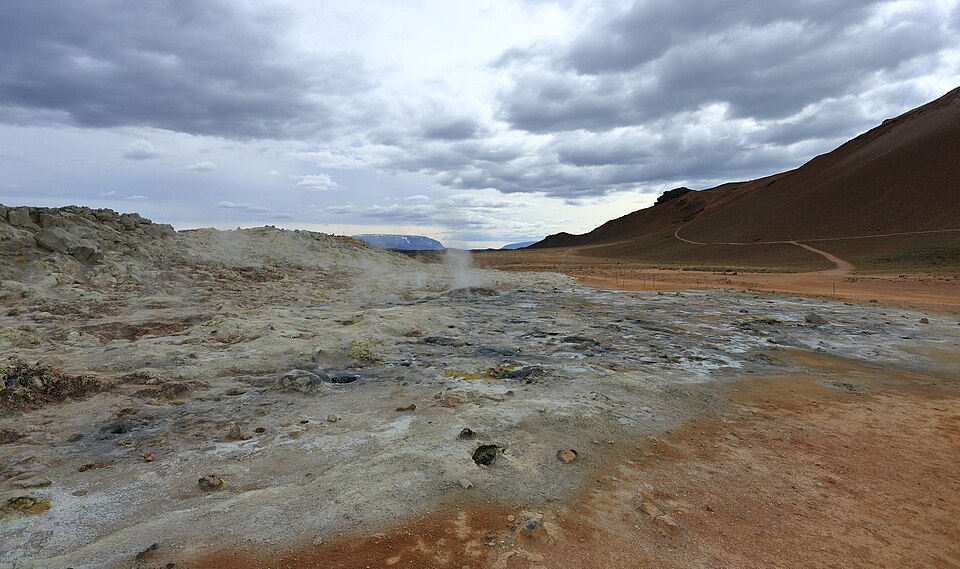
Iceland sits astride the Mid-Atlantic Ridge, where the North American and Eurasian plates pull apart (a divergent boundary). Rising magma feeds frequent volcanic eruptions and heats groundwater, so the island is both volcanically and geothermally very active. Tectonic hazards there come with clear resource and economic upsides.
Each statement describes a well-known benefit of that setting, so there is no false statement to eliminate — the answer must be 'all of them'. Recognising Iceland as a divergent-boundary, ridge-crest island makes each of the three advantages obvious.
Key facts
- Iceland lies on the Mid-Atlantic Ridge — a divergent boundary between the North American and Eurasian plates.
- It draws heavily on geothermal energy for space heating and electricity.
- New land forms at the ridge; the island of Surtsey was created by eruptions in 1963–67.
- Volcanoes, geysers and hot springs make geotourism a major industry.
Study next
Common traps
- Treating tectonic activity as purely a hazard and missing its resource benefits.
- Confusing Iceland's ridge (divergent) volcanism with hotspot volcanism such as Hawaii's.
Asked as 'benefits/features of volcanic or tectonic regions' or by linking Iceland to the Mid-Atlantic Ridge and divergent boundaries.
Related PYQs
Volcanic eruptions do not occur in the
- (a) Baltic Sea
- (b) Black Sea
- (c) Caribbean Sea
- (d) Caspian Sea
Answer(a) Baltic Sea — it lies on the stable Baltic Shield with no active plate boundary, unlike the tectonically active seas.
Same principle — volcanism concentrates at active plate boundaries and is absent on stable shields, the reasoning that makes ridge-crest Iceland so volcanically active.
Which one among the following volcanic island chains is NOT associated with mid-oceanic ridge?
- (a) Azores Islands
- (b) Ascension Islands
- (c) Hawaiian Islands
- (d) Tristan da Cunha
Answer(c) Hawaiian Islands
Same concept — volcanic islands of the Mid-Atlantic Ridge (the very ridge on which Iceland lies), distinguishing ridge volcanism from hotspot volcanism.
Practice
- practice — not a real PYQ
Iceland's high volcanic and geothermal activity is mainly because it lies on a
- (a)convergent (subduction) boundary
- (b)transform boundary
- (c)divergent boundary (Mid-Atlantic Ridge)
- (d)stable continental shield
Answer(c) divergent boundary (Mid-Atlantic Ridge) — where the North American and Eurasian plates separate. - practice — not a real PYQ
The island of Surtsey, formed by volcanic eruptions in 1963–67, is located near
- (a)Japan
- (b)Iceland
- (c)New Zealand
- (d)Hawaii
Answer(b) Iceland — Surtsey emerged off Iceland's south coast, an example of new land created at the ridge.