
The instrument used for detecting the presence of electric current in a circuit is
- (a)Refractometer
- (b)Galvanometer
- (c)Viscometer
- (d)Diffractometer
Answer
Why
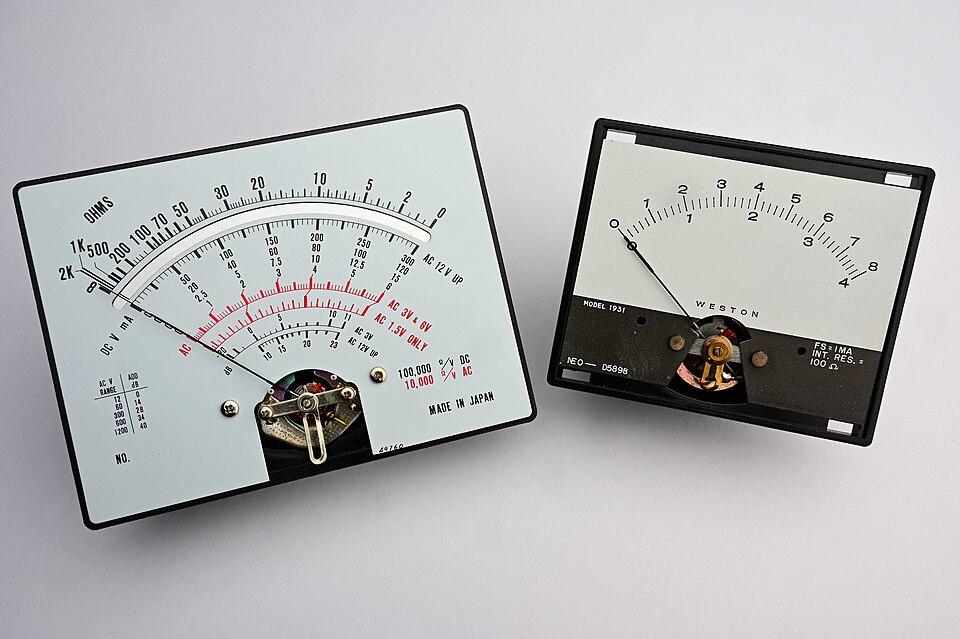
Correct — B, Galvanometer. A galvanometer is a sensitive current-detecting instrument: a coil suspended in a magnetic field twists when even a tiny current passes through it, and the attached pointer deflects across a central-zero scale. The direction of deflection also shows the direction of the current, which is why it is the standard instrument for detecting the presence of current in a circuit.
Why the others are wrong
- (a)Refractometer — Measures the refractive index of a liquid or transparent solid (used to check purity or concentration), not electric current.
- (c)Viscometer — Measures the viscosity, i.e. the resistance to flow, of a fluid, not electric current.
- (d)Diffractometer — Measures diffraction patterns of X-rays or electrons to study crystal structure, not electric current.
Concept
A galvanometer works on the magnetic effect of electric current: a current-carrying coil placed in a magnetic field experiences a torque and turns. In the common moving-coil design this deflection is proportional to the current, so the instrument can both detect and measure very small currents. With suitable resistors it is adapted into an ammeter or voltmeter.
The trap is that all four names end in '-meter'. Match each instrument to the physical quantity it responds to; only the galvanometer is built around electric current.
Key facts
- A galvanometer detects and measures very small electric currents and has a central-zero scale, so it can show current in either direction.
- It works on the magnetic effect of current, a current-carrying coil in a magnetic field experiences a torque.
- A low-resistance shunt in parallel converts it into an ammeter, a high resistance in series makes it a voltmeter.
- A refractometer measures refractive index, a viscometer measures viscosity, and a diffractometer studies diffraction and crystal structure.
Study next
Common traps
- Confusing instrument names ending in '-meter' — match each to its physical quantity.
- Assuming a galvanometer measures voltage; it fundamentally responds to current.
NDA and general-science GK asks 'which instrument measures or detects X' — pair the galvanometer with current, the refractometer with refractive index, and the viscometer with viscosity.
Related PYQs
Which one of the following instruments can be used to measure -250°C temperature?
- (a) By using a mercury based thermometer
- (b) By using an alcohol based thermometer
- (c) By using a clinical thermometer
- (d) By using thermocouple based thermometer
Answer(d) By using thermocouple based thermometer
Same 'match the instrument to the measuring task' theme that NDA tests repeatedly — here choosing the right thermometer for a very low temperature, just as this item pairs the galvanometer with detecting current.
Practice
- practice — not a real PYQ
A galvanometer can be converted into an ammeter by connecting a
- (a)high resistance in series
- (b)low resistance in parallel (shunt)
- (c)capacitor in series
- (d)inductor in parallel
Answer(b) low resistance in parallel (shunt) — the shunt diverts most of the current so the meter can read large currents. - practice — not a real PYQ
Which instrument is used to measure the refractive index of a substance?
- (a)Galvanometer
- (b)Refractometer
- (c)Viscometer
- (d)Barometer
Answer(b) Refractometer — it measures refractive index.