
Which one of the following instruments can be used to measure -250°C temperature?
- (a)By using a mercury based thermometer
- (b)By using an alcohol based thermometer
- (c)By using a clinical thermometer
- (d)By using thermocouple based thermometer
Answer
Why
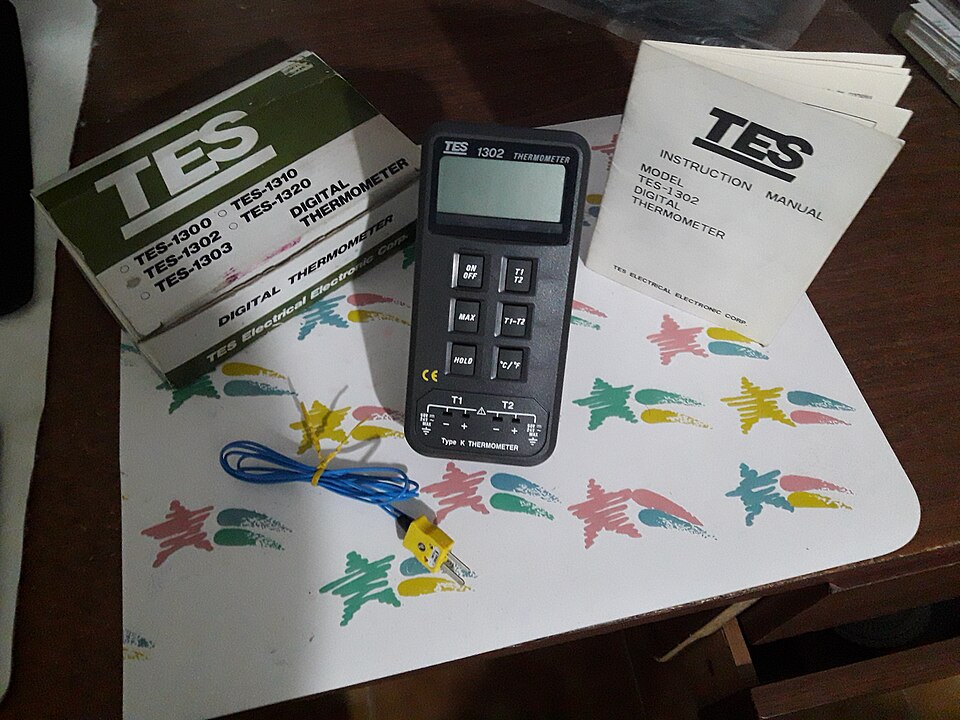
Correct — D, a thermocouple-based thermometer. -250 degrees C is a cryogenic temperature (about 23 K, near liquid-hydrogen cold). Liquid-in-glass thermometers cannot reach it — mercury freezes at about -39 degrees C and alcohol at about -114 degrees C — and a clinical thermometer only spans 35-42 degrees C. A thermocouple, which generates a small voltage from the temperature difference between two dissimilar-metal junctions, works over a very wide range including cryogenic temperatures, so it is the only listed instrument that can measure -250 degrees C.
Why the others are wrong
- (a)By using a mercury based thermometer — Mercury freezes (solidifies) at about -39 degrees C, so it turns solid long before -250 degrees C and cannot measure such a temperature.
- (b)By using an alcohol based thermometer — Alcohol reaches lower than mercury but only to about -115 degrees C (ethanol freezes near -114 degrees C) — still far above -250 degrees C.
- (c)By using a clinical thermometer — A clinical (fever) thermometer is calibrated over a tiny range of about 35-42 degrees C for body temperature — useless for cryogenic measurement.
Concept
The usable range of a thermometer is set by the physical property it exploits. Liquid-in-glass thermometers rely on the thermal expansion of a liquid and stop working once that liquid freezes (mercury near -39 degrees C, alcohol near -114 degrees C). A thermocouple instead uses the Seebeck effect — a voltage produced across a junction of two different metals that depends on temperature — so it spans a huge range, from cryogenic (below -250 degrees C) to well over 1000 degrees C.
Rule out the options by their freezing points. -250 degrees C is colder than the freezing point of both mercury and alcohol, so those liquids are solid and useless; the clinical thermometer's 35-42 degrees C range never comes close. That leaves the thermocouple, the standard electrical sensor for extreme (very hot or very cold) temperatures.
Key facts
- Mercury freezes at about -39 degrees C and alcohol (ethanol) at about -114 degrees C — those are the low limits of such thermometers.
- A clinical thermometer reads only about 35-42 degrees C (the human-body range).
- A thermocouple uses the Seebeck effect (a voltage from two dissimilar-metal junctions) and covers cryogenic to very-high temperatures.
- -250 degrees C is about 23 K, a cryogenic temperature (near liquid hydrogen, which boils at about 20 K).
Study next
Common traps
- Choosing alcohol because 'alcohol goes lower than mercury' — it still freezes near -114 degrees C, far above -250 degrees C.
- Forgetting that a clinical thermometer spans only a few degrees around body temperature.
Thermometry is asked as 'which instrument for very high/very low temperature' — match the required range to the sensor (thermocouple or pyrometer for extremes).
Related PYQs
No directly related past PYQ was found.
Practice
- practice — not a real PYQ
Which instrument is most suitable to measure the temperature of a furnace at about 1500 degrees C?
- (a)Clinical thermometer
- (b)Mercury thermometer
- (c)Pyrometer
- (d)Alcohol thermometer
Answer(c) Pyrometer — a radiation thermometer for very high temperatures beyond mercury's boiling point. - practice — not a real PYQ
A thermocouple works on the principle of
- (a)thermal expansion of a liquid
- (b)the Seebeck effect (thermo-emf)
- (c)change of resistance with pressure
- (d)latent heat
Answer(b) the Seebeck effect — a voltage arises across two dissimilar-metal junctions kept at different temperatures.