
Which one of the following statements is correct?
- (a)Both boiling and evaporation are surface phenomena.
- (b)Boiling is a surface phenomenon, but evaporation is a bulk phenomenon.
- (c)Both boiling and evaporation are bulk phenomena.
- (d)Boiling is a bulk phenomenon, but evaporation is a surface phenomenon.
Answer
Why
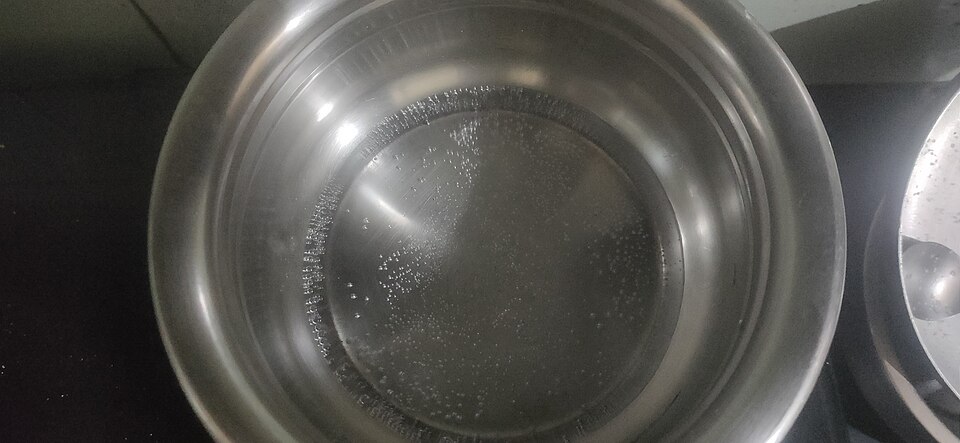
Correct — D. Boiling is a bulk phenomenon: at the boiling point vapour bubbles form throughout the whole volume of the liquid. Evaporation is a surface phenomenon: only the faster-moving molecules at the exposed surface escape, and it happens at any temperature below boiling. So the right pairing is that boiling is a bulk process while evaporation is a surface process.
Why the others are wrong
- (a)Both boiling and evaporation are surface phenomena. — Boiling is not confined to the surface — vapour bubbles form throughout the bulk of the liquid, so calling boiling a surface phenomenon is wrong.
- (b)Boiling is a surface phenomenon, but evaporation is a bulk phenomenon. — This reverses the truth — boiling is the bulk process and evaporation is the surface process, not the other way round.
- (c)Both boiling and evaporation are bulk phenomena. — Evaporation is not a bulk process; it occurs only at the free surface of the liquid, so this is wrong.
Concept
Evaporation takes place only at the free surface of a liquid, at any temperature, and cools the liquid because the most energetic molecules leave. Boiling takes place throughout the liquid at a fixed temperature (the boiling point) where the saturated vapour pressure equals the surrounding pressure, so bubbles of vapour form in the bulk.
Separate the two by where the change happens: surface only (evaporation) versus everywhere in the bulk (boiling). Both turn liquid into vapour, but only boiling forms bubbles throughout and only at the boiling point.
Key facts
- Evaporation is a surface phenomenon occurring at any temperature and causing cooling.
- Boiling is a bulk phenomenon occurring at the boiling point, with bubbles forming throughout.
- The boiling point falls as the external pressure falls (e.g. at high altitude).
- Both are changes from the liquid to the vapour state.
Study next
Common traps
- Swapping the two — remember evaporation = surface, boiling = bulk.
- Thinking evaporation needs a high temperature; it happens at any temperature.
Asked as 'which is a surface / bulk phenomenon' — fix evaporation as the surface process and boiling as the bulk one.
Related PYQs
Consider the following statements: 1. Steam at 100 °C and boiling water at 100 °C contain the same amount of heat. 2. Latent heat of fusion of ice is equal to the latent heat of vaporization of water. 3. In an air-conditioner, heat is extracted from the room air at the evaporator coils and is rejected out at the condenser coils. Which of these statements is/are correct?
- (a) 1 and 2
- (b) 2 and 3
- (c) Only 2
- (d) Only 3
Answer(d) Only 3
Same theme — the liquid–vapour change and its latent heat. UPSC tests that steam carries the extra latent heat of vaporization over boiling water; this NDA item tests that boiling (a bulk change) differs from surface evaporation.
Practice
- practice — not a real PYQ
Evaporation of a liquid causes
- (a)heating of the liquid
- (b)cooling of the liquid
- (c)no change in temperature
- (d)an increase in mass
Answer(b) cooling of the liquid — the most energetic molecules escape, lowering the average energy left behind. - practice — not a real PYQ
The boiling point of water at the top of a high mountain is
- (a)higher than at sea level
- (b)lower than at sea level
- (c)exactly 100 °C
- (d)independent of pressure
Answer(b) lower than at sea level — reduced atmospheric pressure lowers the boiling point.